

Oct 6, 2022
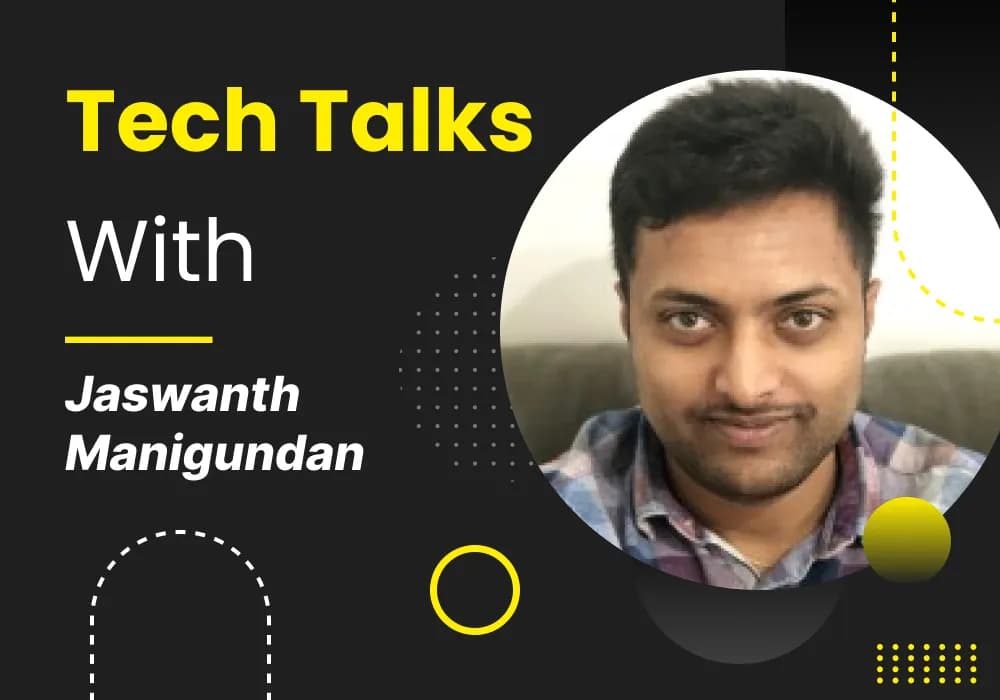
Tech Talks with Jaswanth Manigundan
We are already in the last quarter of 2022, and 2023 is all set to showcase innovations like never before, with tech enthusiasts progressing on their initiatives to change the world for good. Since digital transformation is more of a journey than a milestone, the future of technology would need an even more critical focus on quality assurance than ever.
And this time, the idea of quality assurance would no longer be limited to compliance and performance, but also the need for giving a more customized experience to the end users. It means the business leaders would need to look into the depth of creating sustainable technology overcoming all the flaws and errors that have restricted or hampered the user experience in one way or another.
The process would even involve finding the perfect balance between manual testing, automation testing, and all sorts of technologies and best practices that could aid developers and testers to explore greater aspects of quality development.
Since exchanging thoughts with leaders of the industry can prove to be a highly beneficial practice for setting a path toward quality assurance services of the future, this time, our in-house expert, Parteek Goel, interviewed Jaswanth Manigundan, who is working as a Lead Quality Coach at Culture Amp, Melbourne, specializing in test automation and testability.
Jaswanth has worked in mobile app development space for over a decade, building his familiarity with operating systems and devices in order to create apps that are efficient and effortless. However, Jawanth’s quest for creating more testable mobile apps brought him into test automation aligning him with a variety of test automation frameworks.
Jaswanth is not only a dynamic professional who holds proficiency in dealing with mobile apps but has even helped several leading mobile app teams in Australia on their test automation initiatives. Besides, he has even shared her expertise and journey as a speaker at testing conferences like Testbash by Ministry of Testing and Saucecon by Saucelabs.
With his current vision and expertise in working on test automation frameworks that cater to functionality, contract, and load for APIs, microservices, and event sourcing systems, let us quickly jump on the interview to learn about his role and everything related to innovations he seeks with his obsession for observability within test frameworks.
Let’s begin!
Parteek: What does your current role entail?
Jaswanth: I currently work as a Quality Coach. I work alongside engineers and product teams to help them build out their automation capability. I work in a team called “Quality Foundations”. We work alongside different teams on a push (recommend process/test automation improvements) and pull (requests from teams on the services we provide) model.
Parteek: How can a tester innovate? Do you have any specific examples?
Jaswanth: I’m going to throw in a quote here. “Necessity is the mother of all innovations”. It has never been more true. As software professionals, we always get fascinated by shiny new things (frameworks or language, etc..).
During these times, instead of looking for the latest new thing, it is very important to think about what is required in the current scenario. Be it a team requiring process or automation improvements, instead of jumping into new things, it is very important to understand what problem we are solving.
Once we start with problems and context, the innovation happens automatically. And these innovations are the ones that will provide value back.
Parteek: What are some of the things you’re researching the most right now?
Jaswanth: I’m currently more into API test automation. We have a good setup to test synchronous APIs but now my attention is on Asynchronous API testing. This includes things like CQRS and Event sourcing. It has been a very interesting space to work in. This is where the company is heading and working for a solution on testing has been very interesting.
Parteek: According to you, what role does quality assurance play in DevOps?
Jaswanth: Now-a-days, CI/CD has become something the team owns. As testers, it is important to first fully understand what they do in the context of their own teams and projects. I feel the testing team should customize the pipelines to the way it works for them.
This is where the best value add can happen. For example, things like deploying to different test environments, running a variety of tests based on different scenarios, managing notifications that add value, etc. can all be something that can add great value to testers and teams in general.
Parteek: Can you talk about the challenges that you’ve had to address to identify the right automation testing tool?
Jaswanth: This has been something that I have been speaking about a lot in recent conferences, specifically with mobile. When it comes to picking the right tool, I will speak about the 4S - Situation, Skillset, Support and Solution.
It is very important to start with context (situation), and then understand the skills of yourself and the team, understand what level of support you have around you and finally look at what problem you are trying to solve with this tool. Once you understand all these items, then it becomes very easy to pick the tool that solves problems and not something that is new or fancy.
Parteek: What is your opinion for leading Agile for small scale and medium scale companies?
Jaswanth: In my view, there are different sets of challenges with implementing agile processes for small vs medium companies. When you start with small companies, you are just setting up processes and you make things work for you. Starting with the tools that you use to run your projects and the processes that you have are on the lighter side.
But once you start growing, it is very important that you bring some consistency across teams. This is very important for teams to then agree on processes and tools, so that there are proven defaults that are available for people to lean on. Consistency all the way!
Parteek: If anyone wants to connect with you, how can they?
Jaswanth: I’m pretty active on LinkedIn. Feel free to reach out to me https://www.linkedin.com/in/-jaswanth/
Need help exploring the dynamics of quality assurance in the near future or planning to create a product that can reform the world the tech? We can help you with everything from expertise to implementation.
Reach our team through info@bugraptors.com

BugRaptors
Software Testing Company
About the Author
BugRaptors is a global software testing and QA company founded in 2016, specializing in AI-driven testing and automation to deliver reliable, high-quality digital experiences across web, mobile, and enterprise platforms.


