

Jan 31, 2026
AI in QA: Moving Beyond Hype to Execution in 2026
The development of software is becoming shorter. What took months is now done in weeks or even days. Traditional tests in high-speed environment have been found to act as bottlenecks, which slows down the software release process cycles.
Here is where Artificial Intelligence comes in, not only as a new product, but as a very essential infrastructure of the modern Quality Assurance. Although the discussion on AI is usually based on the potential possibilities in the future, the actual worth is in what is presently going on.
Teams are no longer asking what AI can do? How do we achieve it effectively?
This blog explores the practical application of AI in QA, separating real-world utility from marketing noise.
Why Execution Matters More Than Hype
The industry is currently in a unique position. According to recent reports from TestRail and LambdaTest, over 86% of QA professionals are exploring or actively using AI. However, a significant gap remains between interest and implementation.
While over half of testing teams use tools like ChatGPT for generating test cases, fewer than 30% have fully integrated AI into their core CI/CD pipelines.
The "hype" suggests that AI will magically fix all quality issues overnight. The "execution" reality is different. Success in 2026 isn't about buying a tool; it is about building a process where AI handles repetitive cognitive tasks, allowing human testers to focus on strategy and user experience.
Reasons for the Growing Popularity of AI in QA
The shift toward AI-driven QA testing is driven by necessity rather than trends.
Self-Healing Capabilities
Script brittleness is one of the most irritating factors of test automation. A minor change to a button or UI object ID can invalidate an entire set of tests. Intelligent locators are now used in the AI-powered tools. In case the Submit button changes its ID but is located in the same place and works in a similar manner, the AI fixes the script itself and avoids false failures.Rapid Script Generation & Execution
Another reason for adoption is the ability to accelerate the entire testing lifecycle. AI tools can now generate robust test scripts from simple requirements, execute them autonomously, and compile detailed reports with minimal human involvement. This end-to-end automation removes the manual bottlenecks of writing and running code, significantly speeding up the overall release pace.Visual Validation
Traditional automation checks code, but it does not always verify what the user can view. AI visual testing can identify missing or crossed-over text, broken images, or layout changes across thousands of devices and browser sets in real time, which would otherwise require days of manual testing by human testers.Predictive Analytics
Rather than having to run all the tests whenever a small change is made in the code, AI uses historical data to find out what tests are most likely to fail in the presence of the particular change. This intelligent testing significantly reduces feedback time for programmers.
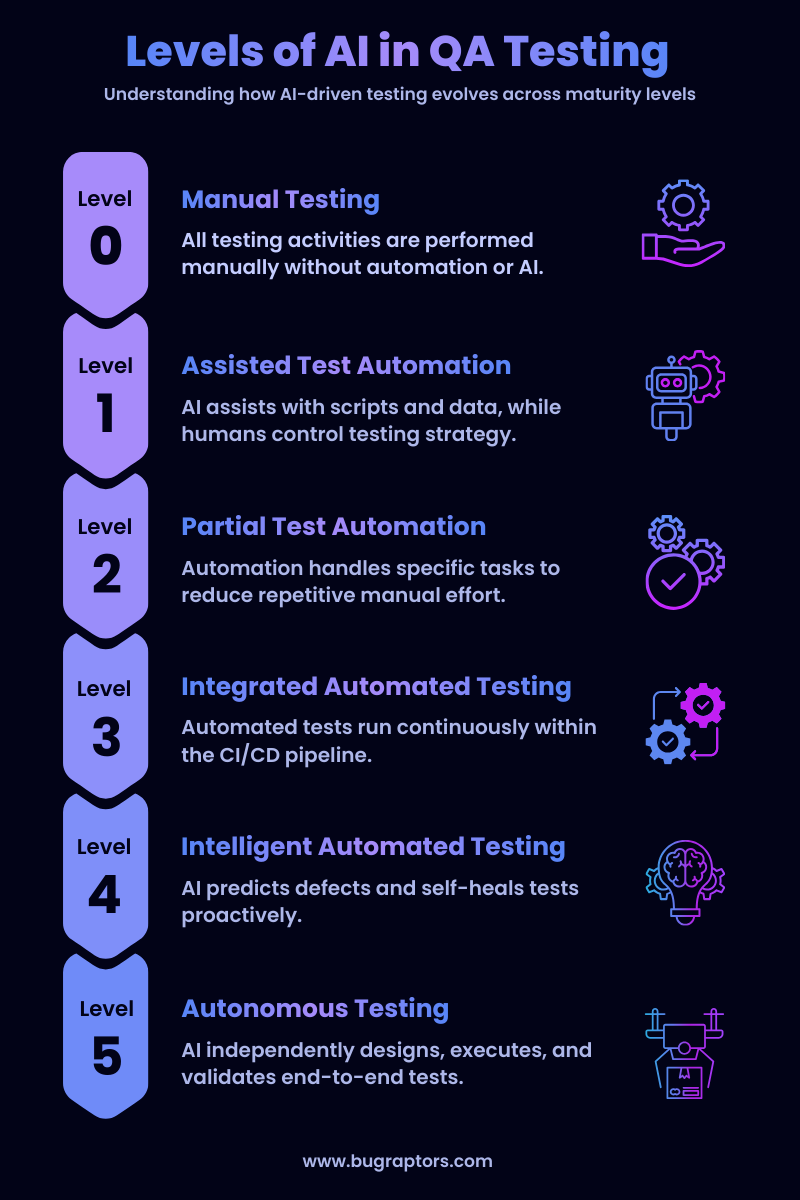
Levels of AI in QA Testing
To implement AI in QA testing effectively, organizations must understand their position on the maturity curve. This evolution is categorized into six distinct levels, guiding teams from manual efforts to fully autonomous systems.
Level 0: Manual Testing
At this foundational stage, no AI or automation is involved. All test case creation, execution, and analysis rely entirely on human effort and intuition.
Level 1: Assisted Test Automation
Here, technology acts as a support system. AI helps draft basic scripts or generate test data, but humans still drive the strategy.
Level 2: Partial Test Automation
Tools are beginning to take over specific tasks, such as visual validation and element detection. Many companies engage standard automation testing services at this stage to establish a baseline of efficiency and reduce repetitive manual work.
Level 3: Integrated Automated Testing
Automation becomes part of the continuous delivery pipeline. Tests run automatically upon code commits, though they still require human maintenance for updates and debugging.
Level 4: Intelligent Automated Testing
The system shifts from reactive to proactive. It uses predictive analytics to anticipate defects and employs self-healing mechanisms to automatically fix broken scripts. Implementing this level of sophistication often requires specialized AI testing services to manage the data models and infrastructure.
Level 5: Autonomous Testing
The pinnacle of maturity. AI agents independently explore the application, generating and validating complex user flows without human intervention. To achieve this "self-driving" quality, enterprises are increasingly relying on advanced AI automation testing services to build resilient ecosystems where software tests itself.
AI Agents: New Brain Behind Test Execution
The industry is moving rapidly from simple automation scripts to AI Agents. Unlike a standard script that follows a linear path (Step A -> Step B), an agent has a degree of reasoning.
An AI agent can be given a goal, such as "purchase a red shirt," and it will figure out how to navigate the site to achieve that goal, even if the menu structure has changed. This is particularly useful for complex, non-deterministic workflows.
Agents use the Model Context Protocol (MCP) to interact with various tools and environments seamlessly. Read our guide on Software Testing with AI Agents and MCP for a deeper look at how agents are changing the software testing industry.
Best Tools for AI in QA Testing
The market is flooded with tools, but a few stand out for their practical application and maturity.
AccelQ
AccelQ is a codeless platform that supports self-healing and AI-driven predictive analytics. It is good at managing complex enterprise applications like Salesforce and SAP, where the identification of elements is infamously challenging.
LambdaTest (KaneAI)
LambdaTest has installed KaneAI, an agentic test assistant. It enables users to write and develop complex end-to-end testing in natural language, and is very user-friendly to teams, filling the manual and automated testing gap.
Applitools
A leader in Visual AI. Applitools concentrates on the Visual AI, which replicates the human eyes and brain so that its applications would appear right on all kinds of screens without creating noise due to trivial pixel variations.
TestRail
Although it is mainly a test management solution, currently, TestRail incorporates AI to produce test cases based on requirements and coordinate testing priorities to enable teams to design their quality initiatives in a much more effective way.
How QA Teams Are Using The AI Tools Today
The majority of successful QA testing teams adopt a hybrid method. They may consider Applitools as a frontend visual check, AccelQ as core functional flows, and a more conventional framework like Selenium or Playwright as unit tests of the backend. This is not intended to supersede the stack but to improve it.
Integrating AI in QA Testing: A How-To Guide
Adopting AI is not a plug-and-play process; it requires a structured roadmap to avoid wasted resources. To truly capitalize on emerging AI automation testing strategies and trends, organizations must move beyond simple tool adoption and embrace a phased implementation plan.
Assess Data Readiness
AI models thrive on data. Unless your organization has past test data, defect logs, or clear requirements, AI tools will be unable to make accurate predictions. Begin by planning and cleaning your test assets to achieve a good base.Start with High-Volume, Low-Complexity Tasks
Do not try to automate your most complex workflow first. Begin with visual regression testing or automated test data generation. These areas offer quick ROI and help build team confidence before scaling up.Implement Self-Healing First
Before trying to generate new tests autonomously, use AI to stabilize your existing suite. Enabling self-healing reduces the daily maintenance burden, freeing engineers to focus on more advanced integration.Human-in-the-Loop Validation
Always review AI-generated test cases. AI can sometimes create "happy path" tests while missing edge cases. A human expert should validate the logic before the tests are added to the main pipeline.
Real-World Execution: The TwinMind Case Study
TwinMind, an AI-powered transcription platform, faced a critical challenge: ensuring 98% accuracy despite infinite real-world variables like accents and background noise—nuances standard test scripts simply couldn't capture.
To bridge the gap between model potential and user trust, BugRaptors implemented an "AI-First" Quality Strategy. We moved beyond basic functional testing to deep Model Validation, embedding experts to audit the full data path (Recording → Transcription → Memory). This ensured the AI handled interruptions and edge cases without "hallucinating" data.
The Impact: We reduced AI-related defects by 55% and eliminated critical production failures. This proves that shifting from "checking code" to "validating intelligence" is the key to scaling AI reliability.
How BugRaptors is Turning AI in QA Into Action
While tools provide the capability, strategy provides the results. BugRaptors focuses on bridging the gap between owning an AI tool and actually driving quality with it. We move beyond the buzzwords to implement Actionable AI Frameworks. To deliver on this promise, we have developed a suite of intelligent accelerators designed to solve specific QA testing bottlenecks:
BugBot
Our intelligent AI partner for superior software delivery. BugBot is not just a tool but a suite of capabilities (RaptorGen, RaptorHub, RaptorAssist, RaptorSelect, RaptorScan, and RaptorVision) that simplifies your day-to-day QA tasks/activities. It eliminates manual bottlenecks, allowing teams to engineer flawless quality at unmatched speed.
RaptorInfinity
Enables testers to create robust automation tests using plain English. Powered by an intelligent prompt system utilizing Model Context Protocols (MCPs) and a multi-agent AI architecture, it instantly converts human-readable steps into maintainable, framework-aligned automation scripts.
Our Approach Involves:
Customized AI Readiness Audits: We analyze your current maturity level to recommend the right mix of tools, whether that involves agentic workflows or predictive analytics.
Hybrid Framework Implementation: We build frameworks that combine the precision of code-based automation with the flexibility of AI agents.
Proprietary Accelerators: BugRaptors utilizes internal accelerators that leverage GenAI to reduce test data creation time by up to 40%.
We do not just run tests; we engineer quality ecosystems that adapt to change. By focusing on execution, we help enterprises reduce cycle times and improve test coverage.

Prateek Goel
Automation Testing, AI & ML Testing, Performance Testing
About the Author
Parteek Goel is a highly-dynamic QA expert with proficiency in automation, AI, and ML technologies. Currently, working as an automation manager at BugRaptors, he has a knack for creating software technology with excellence. Parteek loves to explore new places for leisure, but you'll find him creating technology exceeding specified standards or client requirements most of the time.


