

Dec 3, 2025
AI Agents & MCP: The New Architecture of Scalable Test Automation

The domain of software quality engineering is undergoing an architectural transformation. The established paradigm of imperative, scripted test automation services, while foundational, is reaching its operational limits against the backdrop of exponentially complex, distributed systems. Frameworks like Selenium and Playwright, though powerful executors, are fundamentally script-followers, lacking the cognitive capabilities to adapt to dynamic UIs or reason about system-wide failures. This brittleness results in a high "test maintenance tax," creating a bottleneck in modern CI/CD pipelines.
To break this ceiling, a new architecture is emerging—one based on declarative, goal-oriented validation driven by autonomous AI agents. These agents, powered by Large Language Models (LLMs) and orchestrated through standardized frameworks like the Model Context Protocol (MCP), represent a shift from instructing an application on what to do to asking it to achieve a specific goal. This article provides a comprehensive technical breakdown of this new paradigm, exploring its architecture, implementation frameworks, and the practical engineering required to deploy it effectively.
Redefining the Test Executor: The AI Agent Architecture
An AI agent for testing is an autonomous software entity engineered to validate an application's behavior through a continuous perception-reasoning-action cycle. This model is a significant departure from linear script execution.
Perception
This is the agent's data ingestion layer. To build a rich understanding of the application's state, a sophisticated agent must perceive context from multiple sources beyond a simple DOM tree. A robust perception module would integrate:
Structured DOM and Accessibility Tree Parsers: To understand the semantic structure and user-facing roles of elements, which is more resilient than relying on CSS selectors or XPaths.
Visual-to-Text Models (VLM): To analyze screenshots and understand the visual layout, identifying elements that may lack clear DOM attributes.
Network Analyzers: To capture and inspect HAR (HTTP Archive) files, allowing the agent to validate API payloads, response codes, and timing information in concert with front-end actions.
Log Stream Aggregators: To ingest real-time logs from application servers, databases, and infrastructure, providing a backend view of the system's health.
Reasoning
The reasoning core is an LLM that acts as a decision-making engine. It receives the multi-modal context from the perception layer and uses it to determine the next action. This process is not a simple if-then-else statement; it involves complex chain-of-thought reasoning to plan multi-step tests, self-heal from unexpected errors, and correlate disparate data points to diagnose failures.
Action
The agent executes its chosen action through a set of defined tools. These tools are abstracted interfaces to the underlying drivers (e.g., Playwright, REST clients, database connectors), allowing the reasoning engine to operate at a higher level of abstraction.
This architecture is the foundation for the next generation of AI Testing Services, enabling capabilities that are intractable with traditional methods. For instance, the agent's ability to self-heal is not magic; it's a programmatic error-handling loop. When an action fails (e.g., ElementNotFound), the agent triggers a reasoning sub-routine: "The action to click selector ‘div.main > #submit-v2’ failed. Re-perceiving the DOM. The closest semantic element is a ‘button’ with text 'Complete Order' and aria-role 'submit'. The probability of this being the intended target is high. Proposing a new action: click this button."
The Linchpin of Scalability: The Model Context Protocol (MCP)
An agent with a dozen hardcoded tool integrations is a prototype. An agent that can dynamically leverage hundreds of tools is an enterprise-grade platform. This scalability is impossible without a standardized communication layer—the Model Context Protocol (MCP).
MCP is an architectural specification for a middleware that decouples the AI agent's reasoning from the tool's execution. It serves as a universal translator and a secure orchestration layer, preventing the agent from needing to know the specific syntax of every tool it uses.
MCP Payload Structure and Advanced Features
The power of MCP lies in its structured, context-rich communication format, typically a JSON payload. Unlike a simple function call, an MCP request provides the execution layer with not just a command, but also the intent and policies surrounding that command. This is essential for sophisticated testing with AI agents. A mature MCP payload from an agent to the MCP server would include the following:
JSON |
{ "session_id": "test-run-a4b3-c1d2", "task_id": "login-flow-negative-test-001", "tool_id": "webapp_browser", "action": "enter_text", "parameters": { "target_element": { "description": "the primary input field for the username on the login page", "aria_label": "Username", "type": "textbox" }, "text_to_enter": "testuser@example.com" }, "execution_policy": { "timeout_seconds": 30, "retry_count": 2, "on_failure": "capture_full_context" } } |
Key Components of this MCP structure include:
Identifiers (session_id, task_id): These are crucial for traceability, logging, and debugging in large-scale test runs. They enable engineers to correlate specific agent actions with system logs and test reports.
Declarative Target (target_element): This is a fundamental departure from traditional automation. Instead of providing a brittle selector like //div/input[@id='user'], the agent offers a description of the element. The MCP tool adapter is then responsible for the more intelligent task of locating the element that best matches this description. This makes the test resilient to minor UI changes.
Execution Policy: This section provides advanced control over the action's execution. The agent can specify timeouts, automatic retries, and what to do in case of failure (e.g., capture_full_context could trigger screenshots, DOM snapshots, and HAR file captures). This level of control is a cornerstone of reliable test automation services.
MCP vs. Simple API Wrappers
It's easy to mistake MCP for a simple collection of API wrappers, but they are architecturally different. Understanding this distinction is key to appreciating the value MCP brings to professional software testing services.
Feature | Simple API Wrappers | Model Context Protocol (MCP) |
|---|---|---|
Coupling | Tightly Coupled: The agent's code directly calls specific wrapper functions (e.g., browser.click_login_button()). Changes to the tool require changing the agent's logic. | Decoupled: The agent sends a standardized JSON payload to the MCP server. The agent has no knowledge of the underlying tool's implementation. |
Standardization | Bespoke and Inconsistent: Each wrapper is custom-built, resulting in varying function signatures and data formats throughout the system. | Protocol-Driven: All communication adheres to a single, consistent standard. Any tool that has a compliant adapter can be used by the agent. |
Extensibility | Low: Adding a new tool (e.g., a performance testing tool) requires writing a new wrapper and modifying the agent's core logic to know when and how to call it. | High (Plug-and-Play): To add a new tool, you simply create a new MCP adapter for it. The agent can immediately leverage it without any changes to its own code, as it already speaks the standard MCP language. |
Governance | Decentralized: Security, logging, and error handling are implemented inconsistently within each individual wrapper. | Centralized: The MCP server acts as a central gateway, allowing for the consistent enforcement of security policies, authentication, rate limiting, and standardized auditing across all tools. |
Engineering in Practice: Frameworks, Models, and Prompts
Building an AI testing agent for tasks ranging from UI validation to load testing for your applications requires orchestrating several powerful open-source components. The theoretical architecture comes to life through the practical application of frameworks that structure the agent's logic, models that power its reasoning, and the carefully engineered prompts that guide its behavior.
LangChain: The Agent Development Framework
LangChain provides the essential software engineering framework to structure the agent's core logic. It's the "application server" for LLM-powered systems. Its primary value in a testing context comes from its AgentExecutor class, which masterfully combines an LLM, a set of tools, and a prompting strategy (like ReAct - "Reason and Act") to drive perception-reasoning-action loop. Tools in LangChain are abstractions that give the agent capabilities.
For our purposes, a key tool would be one that communicates with the MCP server. Here’s a conceptual Python snippet of how such a tool could be defined:
PYTHON |
| from langchain.tools import BaseTool import requests # Used to communicate with the MCP Server
class MCPBrowserTool(BaseTool): name = "WebAppBrowser" description = "Use this to interact with the web app via the MCP server. Your input must be a valid MCP JSON object describing the action." def run(self, mcprequest_json: str) -> str: """Sends the request to the MCP server and returns the result.""" # In a real implementation, this would have robust error handling mcp_endpoint = "http://localhost:8000/mcp" try: response = requests.post(mcp_endpoint, json=mcp_request_json) response.raise_for_status() # The response from MCP is the new context for the agent return response.json() except requests.exceptions.RequestException as e: return f"Error: Failed to communicate with MCP Server. Details: {e}"
# This tool would then be provided to a LangChain AgentExecutor. |
This abstraction allows the agent's reasoning logic to remain clean, focusing on what goal to achieve, while the tool handles the implementation detail of how to communicate with the application.
AutoGen: Engineering Multi-Agent Collaboration
For complex test scenarios, a single agent can be overwhelmed. Microsoft's AutoGen excels at creating a "society of agents" where different specialized agents collaborate by exchanging messages to solve a problem. This is a powerful pattern for end-to-end test automation services. A typical QA workflow could be orchestrated as a conversation:
A UserProxyAgent (representing the human tester) initiates the task: "Generate and execute a full regression suite for the user profile page."
This message is received by a TestStrategistAgent, a planning agent that consults a knowledge base of requirements and formulates a high-level test plan.
The TestStrategistAgent then delegates the first task, like "Test profile data update with valid inputs", to a specialized TestEngineerAgent.
The TestEngineerAgent is a code-generation agent. It translates the task into a precise sequence of MCP JSON requests needed to perform the actions and verifications.
It passes these JSON requests to an MCPExecutorAgent, whose sole job is to execute the requests via the MCP server and report back the raw pass/fail results and logs.
This multi-agent separation of concerns mirrors a human QA team, allowing for highly complex, scalable, and maintainable test execution.
The Critical Role of Prompt Engineering
The reliability of testing with AI agents is directly proportional to the quality of the prompts used to guide the LLM. Vague prompts lead to non-deterministic, unreliable behavior. Effective prompt engineering for QA is a technical skill that enables the LLM to transition from a generalist to a focused testing specialist.
Consider the difference:
Bad Prompt: "Test the login page."
This is ambiguous. What should it test? What constitutes success? The agent is forced to guess, leading to inconsistent results.
Good, Engineered Prompt:
You are a meticulous QA Automation Agent. Your goal is to execute a single, precise test case.
## ROLE Execute a negative test for the login functionality.
## CONTEXT The user 'inactive_user' exists in the system but their account has been deactivated.
## ACTION & VERIFICATION 1. Navigate to the '/login' page. 2. Enter 'inactive_user' into the field labeled 'Username'. 3. Enter 'valid_password' into the field labeled 'Password'. 4. Click the 'Login' button. 5. Verify that an error message containing the text 'Account is inactive' is visible.
## FORMAT Return a single JSON object with keys: "success" (boolean) and "verification_result" (string).
|
This level of detail, structure, and clarity removes ambiguity and ensures the agent performs the test consistently and correctly every time.
Ollama and Local LLMs: The Key to Enterprise Adoption
For any serious enterprise implementation of AI testing services, relying on third-party, cloud-based LLMs introduces significant risks related to data security, cost, and reliability. Tools like Ollama are game-changers because they simplify running powerful open-source LLMs (like Llama 3 or Mistral) on local, private infrastructure.
This is a technical and strategic necessity for several reasons:
Zero Data Leakage: With a local model, no proprietary code, test data, or sensitive application information ever leaves your network. This is non-negotiable for organizations in regulated industries or those with valuable intellectual property.
Cost Control: Cloud API calls are metered per token. A full regression suite with thousands of agentic steps could become prohibitively expensive. A local model represents a fixed hardware cost, making large-scale testing economically viable.
Deterministic Control: Cloud providers can update their models without notice, which could suddenly change your test outcomes. Running a specific model version locally ensures that your testing environment is stable and your results are repeatable.
Fine-Tuning for Specialization: A general-purpose model can be fine-tuned on your company's specific codebase, API documentation, and past bug reports. This creates a highly specialized expert agent that understands your application's unique context, leading to more accurate and efficient testing.
Strategic Implications and Engineering Challenges
Adopting an AI-driven approach to testing is a strategic shift that redefines the role of quality engineering and introduces new technical hurdles. This modern strategy, which includes finding better ways to optimize website with performance testing, requires understanding both the opportunities and the challenges for success.
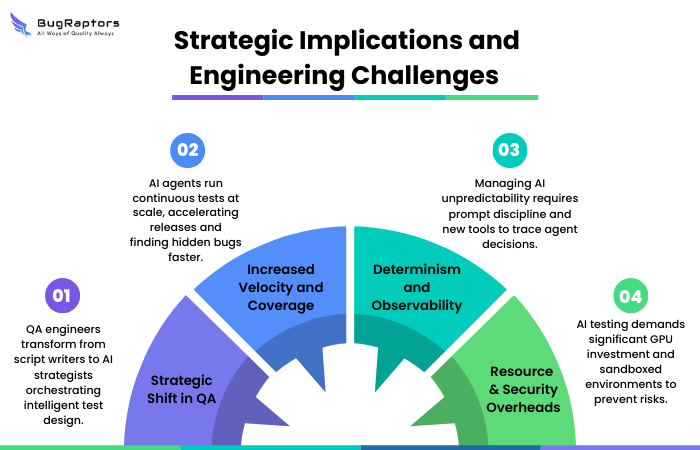
Strategic Shift in QA: The primary implication is the evolution of the QA engineer's role from a manual scriptwriter to an AI test strategist. The focus moves to high-level test design, sophisticated prompt engineering, and analyzing the complex results from autonomous exploratory agents. This elevates the team's impact from simple validation to comprehensive quality intelligence.
Increased Velocity and Coverage: AI agents can execute vast suites of regression and exploratory tests continuously, providing faster feedback and uncovering bugs in user paths that manual scripts would miss. This directly accelerates the CI/CD pipeline and improves release confidence.
Determinism and Observability: A key engineering challenge is managing the non-deterministic nature of LLMs. Ensuring repeatable test outcomes requires disciplined prompt engineering, setting low model "temperatures," and version-controlling prompts. Furthermore, debugging an agent's "thought process" demands new observability tools to trace its decisions and diagnose failures.
Resource and Security Overheads: Running powerful LLMs, especially locally, requires significant investment in GPU infrastructure. Additionally, autonomous agents with system access must be operated in secure, sandboxed environments with tightly controlled permissions to mitigate the risk of unintended or destructive actions.
Conclusion
The architecture of AI agents, orchestrated by a standardized protocol like MCP and powered by locally-hosted LLMs, represents the future of quality engineering. It moves the industry from writing brittle, imperative scripts to developing intelligent, resilient validation systems. This is not a replacement for human QA engineers, but an empowerment tool, allowing them to offload repetitive tasks and focus on complex test strategies, risk analysis, and creating more sophisticated, self-healing quality gates.
For organizations looking to accelerate development velocity without compromising quality, investing in the expertise and infrastructure to build this new capability is no longer an option, it is a strategic imperative. Navigating this complex transition requires deep expertise, and partnering with advanced software testing services can provide the necessary strategy and engineering talent to realize the full potential of AI in software testing.

Prateek Goel
Automation Testing, AI & ML Testing, Performance Testing
About the Author
Parteek Goel is a highly-dynamic QA expert with proficiency in automation, AI, and ML technologies. Currently, working as an automation manager at BugRaptors, he has a knack for creating software technology with excellence. Parteek loves to explore new places for leisure, but you'll find him creating technology exceeding specified standards or client requirements most of the time.


