

Sep 23, 2026
Crowdsourced Testing for Mobile Apps: Overcoming the Device and OS Fragmentation Problem
The mobile sector has undergone massive transformations since the early days. What used to be a predictable verification exercise is now an intricate web of competing hardware manufacturers, custom firmware distributions, distinct chipset designs, and fast software update schedules.
Modern software teams face hundreds of real-world variables every time they prepare a public build. Managing device fragmentation stands as one of the most demanding technical roadblocks in software verification. Engineering teams quickly discover that standard in-house labs and emulated environments cannot replicate authentic end-user conditions across international markets.
Bridging the divide between internal build environments and unpredictable real-world usage requires a modernized strategy. Mobile app crowdsourced testing provides direct access to authentic hardware fleets, localized network conditions, and diverse user environments worldwide.
The Anatomy of Mobile Device and OS Fragmentation
A build that runs cleanly in a local continuous integration pipeline often fails when deployed to end users. Teams integrate AI-automated mobile app testing to speed up regression passes, but scripts running in controlled environments cannot simulate unpredictable consumer hardware.
When software crashes on an entry-level smartphone in an emerging market, users don't submit stack traces; they post negative reviews, delete the app, and switch to competitors. Device and OS fragmentation disrupts engineering pipelines across four operational layers:
Silicon & Hardware Architectures: Disparate processors, graphics components, volatile memory allocations, and physical sensor configurations cause budget handsets to suffer from thread blocking, battery drain, and thermal throttling under workloads flagships handle easily.
Operating Systems & Custom OEM Firmware: Legacy iOS builds persist on older devices, while Android spans multiple concurrent releases altered by proprietary OEM skins (such as One UI, HyperOS, and ColorOS). These vendor skins alter background task handling and memory allocation, breaking background sync and push notifications.
Display Geometries & Viewports: Screens feature diverse aspect ratios, dynamic display cutouts, punch-hole cameras, curved edges, and folding form factors that trigger UI clipping, misaligned text, and overlapping touch targets.
Carrier Profiles & Network Topologies: Real-world usage involves regional network throttling, carrier proxies, fluctuating cell towers, dead zones, and sudden Wi-Fi handoffs that clean office Wi-Fi never encounters.
How Device Fragmentation Impacts Mobile Applications
Unverified variations across target hardware directly trigger software regressions in key operational areas:
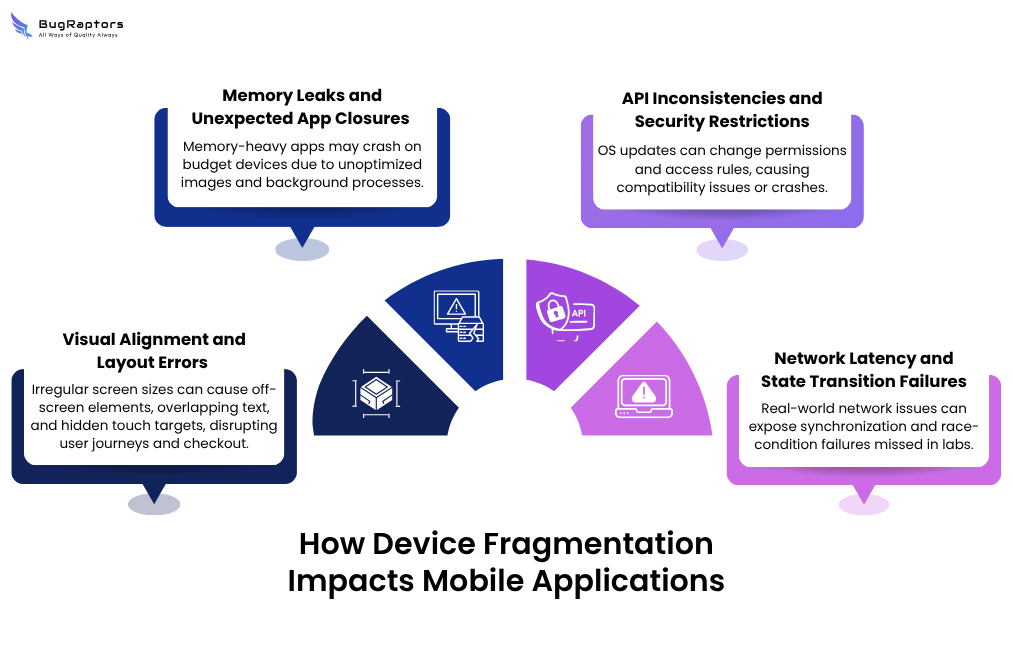
Visual Alignment and Layout Errors
Dynamic screen layouts frequently break on irregular aspect ratios. Interactive elements can render off-screen, text boxes can overlap, and touch targets can sit behind fixed system bars. These interface defects disrupt user journeys and halt checkout funnels.
Memory Leaks and Unexpected App Closures
Applications configured solely on high-spec developer devices often exhaust system memory on budget handsets. Unoptimized image caches or open background threads trigger operating system Out-Of-Memory exceptions, closing the application without warning.
API Inconsistencies and Security Restrictions
Operating system updates regularly change security permissions, file access policies, and background process rules. Applications serving wide audiences must handle these changes across multiple versions. An unverified permission request on an older platform version can trigger immediate crashes.
Network Latency and State Transition Failures
Office networks feature low latency and zero packet loss. Real-world end users travel through tunnels, switch cell towers, and encounter dropped signals while processing payment transactions. These authentic conditions reveal race conditions and data synchronization failures that internal labs miss.
What Does Mobile Compatibility Testing Cover?
Comprehensive compatibility testing services evaluate how a software build interacts with varied physical components, operating system versions, and environmental variables. A thorough testing process verifies:
Cross-Hardware Execution: Validating user interfaces, frame rates, and memory footprints across diverse processors, memory sizes, and display resolutions.
System Version Compatibility: Confirming that core transaction flows operate reliably on older operating system builds and new beta platforms.
Hardware Sensor Integration: Verifying camera capture, location tracking, biometric authentication, and Bluetooth communication across various device lines.
Regional and Cultural Formatting: Validating right-to-left text direction, dynamic font scaling, regional currency displays, and localized calendar formats.
Interruption Handling: Confirming that the application retains state during incoming phone calls, low-battery dialogs, alarms, and sudden network disconnections.
Maintaining an internal physical inventory to cover every permutation is financially impractical for most software organizations. This operational reality makes mobile app crowdsourced testing an indispensable part of quality engineering.
Where Crowd Testing Fits into the Mobile QA Strategy
A resilient quality framework balances automated verification with human-led exploratory testing. Internal automated test suites run repetitive regression tests, API validations, and unit tests within continuous integration pipelines. These frameworks catch functional regressions during active feature development.
Laboratory automation cannot simulate human unpredictability, regional network behaviors, or authentic hardware conditions. Emulators execute instructions using host server processors rather than actual mobile silicon, and cloud device racks route traffic through stable data-center networks.
Deploying mobile app crowdsourced testing bridges this operational gap. Distributing pre-release builds to verified testers on their own physical hardware validates the product under real consumer conditions. Engaging specialized crowdsourced testing services provides four primary advantages:
Extensive Device Fleets: Instant access to thousands of physical smartphone, tablet, and operating system combinations without the overhead of purchasing hardware.
Human-Led Exploratory Testing: Skilled testers discover unscripted edge cases, broken navigation paths, and design flaws that automated scripts cannot detect.
Authentic Regional Verification: Real-time verification of local payment gateways, geo-fencing features, language translations, and regional telecommunications providers.
Elastic Resource Scaling: On-demand access to specialized testing teams allows engineering leads to scale testing capacity during major releases without expanding permanent payroll.
How Crowd Testing Helps Solve Device & OS Fragmentation
Adopting mobile app crowdsourced testing helps engineering organizations manage the fragmentation dilemma across four key dimensions:
Instant Coverage of Real-World Target Hardware
Teams configure testing groups based on actual user demographics rather than arbitrary device purchases. If customer analytics show strong adoption of mid-range hardware in a growing market, teams can quickly mobilize matching configurations.
Authentic Operating Environments
Testers run the build on their primary personal devices. These phones run active background apps, have varying storage levels, and show typical battery degradation. This setup surfaces memory leaks, race conditions, and performance stutters that clean lab devices never show.
True Localization and Payment Gateway Validation
International releases demand more than textual translations. Distributed testers verify regional compliance rules, identity verification flows, postal code validation, and localized payment processing using real local currencies and payment methods.
Parallel Execution Speed
Running an extensive exploratory and compatibility sweep across two hundred physical devices in a local lab can take weeks. Distributing mobile app crowdsourced testing across a managed global pool completes the entire verification cycle within a matter of days.
The BugRaptors Quality Blueprint: Orchestrating Lab Automation and Distributed Crowd QA
Overcoming the mobile fragmentation dilemma requires looking past single-method quality checks. Engineering organizations cannot rely solely on the predictable sandbox of an internal laboratory, nor can they risk turning pre-release verification over to an unmanaged crowd.
For applications backed by complex cloud architectures, pairing device validation with dedicated enterprise SaaS testing ensures backend microservices and APIs remain resilient under unpredictable load from diverse mobile endpoints.
At BugRaptors, we bridge this operational gap through a unified quality engineering blueprint that pairs deterministic continuous integration checks with managed real-world exploration.
Layer 1: The Deterministic Lab Baseline (Structured Compatibility)
Before an application build reaches live consumer hands, it must satisfy baseline structural and functional assertions. We integrate automated compatibility sweeps directly into active continuous integration pipelines to catch foundational defects early in sprint cycles:
Automated Layout & Viewport Sweeps: Executing automated test suites across high-density device matrices to detect UI truncation, broken viewport constraints, punch-hole camera overlaps, and dynamic font-scaling regressions.
Hardware Architecture & OS Sanity: Verifying that core business logic, thread synchronization, and memory footprints remain stable across minimum-supported OS versions and distinct silicon configurations.
API & Integration Stability: Validating network contracts, authentication handshakes, and database state transitions in isolated test harnesses to isolate client-side rendering defects from backend instability.
Layer 2: The Probabilistic Boundary (Managed Crowd QA)
Once a build proves structurally sound in automated pipelines, our teams expose it to the unpredictable conditions of the live consumer ecosystem. Deploying verified testers on their primary personal hardware uncovers defects that clean laboratory environments inherently conceal:
Degraded Hardware & System Stress: Surfacing race conditions and memory leaks triggered by active background apps, thermal CPU throttling, fragmented memory allocations, and aged battery states.
True Network Chaos: Validating transaction integrity, offline data sync, and session recovery across real-world edge cases—including fluctuating cellular handoffs, high jitter, localized carrier proxies, and transit dead zones.
Localized Production Gateways: Verifying regional checkout flows, third-party authentication services, local SIM routing, and native payment mechanisms under actual geographic and regulatory conditions.
Layer 3: The Defect Triage and Signal Engine
The primary failure mode of traditional crowdsourcing is noise. Engineering teams cannot burn sprint velocity sifting through hundreds of duplicate tickets or ambiguous feedback.
BugRaptors eliminates this friction through an intermediate triage gate: our embedded QA leads reproduce every crowd submission on matching target configurations, scrub duplicates, and verify defect validity.
Development squads receive prioritized, engineering-ready tickets complete with exact device metadata, network traces, console logs, and step-by-step screen captures.
By aligning structured compatibility testing services with managed global crowdsourced testing services, BugRaptors enables software teams to eliminate device blind spots without adding triage overhead to internal developer backlogs.
The Strategic Path Forward
Mobile development will continue to be characterized by the range of operating systems and hardware. The ongoing introduction of new silicon architectures, folding displays, and localized network requirements means the device matrix will only continue to grow.
If you rely only on emulators and clean internal laboratories, mobile devices are susceptible to unexpected crashes, UI malfunctions, and customer attrition. By integrating mobile app crowdsourced testing into a larger mobile app testing service, engineering teams may identify flaws on real hardware, real networks, and real user settings before they reach production.
A proactive quality strategy combines fast automated processes with real-world validation. This balance protects brand value, prevents expensive post-launch fixes, and delivers a consistent experience for every user on every screen.

Raghav Vashishth
Performance Testing, API Testing, Mobile & Web Testing
About the Author
Raghav is a QA enthusiast working as a Team Lead at BugRaptors. He has diverse exposure in various projects and application testing with a comprehensive understanding of all aspects of SDLC. He has 7 plus years of hands-on experience with blue-chip companies like Hitachi, Vmware, and Kloves. He is well versed in Load and Performance testing, API Testing, Manual testing, Mobile application testing, Web application testing and can create effective documentation related to testing such as Test Plan, Test Cases, Test Reports, etc.


