

Jul 9, 2026
Architecting Market Readiness: The Enterprise SaaS Testing Checklist to Prevent Post-Launch Churn

Streamlining software deployment timelines poses serious architectural risks to cloud systems. When building multi-tenant infrastructure, deploying unvetted code directly compromises operational stability, security boundaries, and corporate ARR. Industry research indicates that the cost of unplanned system degradation can exceed $100,000 per hour of continuous outage in current cloud applications.
In multi-tenant systems, a single failure in a backend infrastructure rapidly propagates to the shared customer database pool, resulting in broad interruption. Technical executives understand that disciplined and systematic SaaS platform testing is a vital method to preserve baseline income.
By partnering with a specialist software testing company, quality assurance may go from being a manual checkpoint for verification to an automated risk mitigation method. This blog content outlines the operational framework for validating the cloud infrastructure prior to deployment.
The Pre-Launch SaaS Testing Checklist
Before authorizing your production release, your quality engineering groups must complete this targeted verification checklist to identify system vulnerabilities and ensure structural readiness.
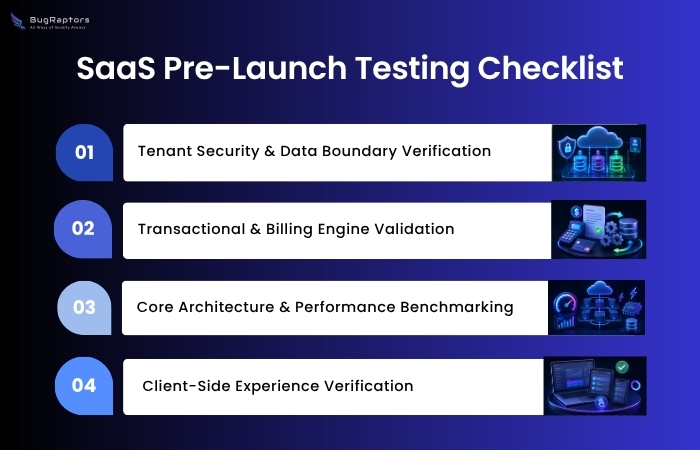
Tenant Security & Data Boundary Verification
Access Scopes: Confirm that bulk data exports, report compilation, and cloud storage buckets check tenant authorization scopes prior to execution.
Isolation Integrity: Verify row-level security (RLS) configurations return empty sets across all database views when queried without valid tenant tokens.
Token Expiration: Audit JSON Web Token (JWT) expiration windows, cryptographic signature validation rules, and server-side revocation logs upon user logout.
Transactional & Billing Engine Validation
Proration Accuracy: Trigger mid-cycle plan upgrades and downgrades to verify that proration algorithms process fractional currency charges precisely without rounding variances.
Webhook Resilience: Simulate network drops during asynchronous payment gateway webhooks to confirm that failure handling architectures trigger automated retries without duplicating account states.
Access Control Coordination: Verify that feature-flag databases restrict or grant application privileges the exact millisecond a subscription modification occurs.
Core Architecture & Performance Benchmarking
Soak Profiles: Execute a continuous 12-hour soak test at 120% of projected peak concurrency to identify memory leaks, unclosed database connections, and thread pool exhaustion.
Auto-Scaling Rules: Verify that horizontal pod autoscalers scale microservice containers dynamically according to your target metrics. The test must confirm that resource replication activates within defined scaling windows to prevent performance degradation.
Client-Side Experience Verification
Viewport Scaling: Audit dashboard responsive layouts and multi-column data tables across Chrome, Safari, Edge, and Firefox viewports to prevent layout fragmentation.
Memory Footprints: Verify that complex data grids with infinite scroll and heavy client-side filtering run cleanly without causing browser memory allocation spikes.
The Multi-Tenant Reality: Deep Architectural Failures
Executing the checklist above requires an understanding of why SaaS application testing is structurally different from testing isolated applications. Modern software testing protocols must address underlying cloud infrastructure conflicts that occur when independent enterprise tenants execute concurrent transactional queries against a unified codebase.
Data Isolation Vulnerabilities
Data security in a shared database schema requires rigorous validation of client boundaries. Engineering teams must confirm that a tenant cannot view, search, or modify data fields belonging to another organization. Testing teams isolate these vectors by building automated scripts to analyze Row-Level Security (RLS) execution. They verify that database queries lacking an explicit tenant filter yield zero records.
Additionally, engineers simulate JWT claim forgery vectors by modifying token identification payloads and confirm that the API gateway blocks unauthorized mutations with a 403 Forbidden response. Search index isolation must also be validated to ensure cross-tenant queries never leak data across Elasticsearch aliases, OpenSearch indexes, vector databases, or shared cache namespaces.
Asynchronous Subscription Engine Risks
The billing subsystem serves as the transactional foundation of the application. Quality engineering groups must validate the subscription lifecycle under high load, where race conditions can corrupt state management. Automated proration logic during mid-cycle tier shifts must be verified to ensure precise calculations as user seats scale.
Similarly, testing teams map feature-flag synchronization latency to confirm that permissions adjust across active sessions at the exact millisecond a subscription changes. To protect revenue, engineers inject latency spikes during asynchronous payment webhooks, ensuring retry loops handle errors without duplicating financial states or generating double charges.
Distributed API Resilience
Cloud software architectures depend on an interconnected network of external integrations for identity management, messaging, telemetry, and financial processing. If a third-party dependency experiences high latency or complete downtime, the primary application must remain stable.
Advanced SaaS testing protocols execute service virtualization and intentional fault injection to verify that circuit breaker patterns activate correctly, preserving core performance through controlled degradation.
The SaaS Quality Engineering Blueprint: Execution Methodology
To transform the pre-launch checklist into a functional testing reality, organizations deploy a structured execution blueprint. This blueprint connects your development pipeline directly to verified QA methodologies managed by an expert software testing company.
Functional Testing Services and Multi-Persona Access Control
Functional validation verifies that every application feature behaves according to strict acceptance criterias. For multi-tenant cloud applications, this requires executing end-to-end user paths across a matrix of diverse user personas, authorization levels, and custom organizational rules.
Our comprehensive functional testing services focus on auditing role-based access control policies. The verification plan must validate that account owners, workspace administrators, standard managers, and read-only guests can perform only the actions explicitly granted to their roles. For instance, an API request to modify subscription billing configurations initiated by a read-only guest persona must be rejected with an explicit 401 Unauthorized or 403 Forbidden server response.
This operational phase requires automated cross-browser and cross-device testing execution. Front-end application interfaces, analytics dashboards, and data tables must scale across Google Chrome, Apple Safari, Microsoft Edge, and Mozilla Firefox viewports without breaking layouts or dropping critical data properties.
Performance Engineering and Scalability Benchmarks
Slow page execution times directly drive user abandonment. Industry performance metrics show that web application delays exceeding 3 seconds trigger a 53% drop in active engagement. Performance engineering simulates distributed global traffic to expose hidden scaling bottlenecks before code reaches production servers.
Testing Methodology | Core Engineering Objective | Target Performance Benchmark |
Load Testing | Evaluates platform stability under normal and anticipated peak traffic volumes. | Maintain p95 response times under 2.0 seconds for core write operations. |
Stress Testing | Forces the application beyond its scaling limits to evaluate automated resource recovery. | Identify the exact concurrency limit where error rates exceed 1%. |
Soak Testing | Sustains high virtual user volumes over an extended window (12 to 24 hours). | Monitor for memory leaks, unclosed database connections, and thread exhaustion. |
Spike Testing | Evaluates system stability during sudden, dramatic traffic surges and subsequent drops. | Verify auto-scaling boundaries activate quickly enough to prevent HTTP 504 gateway timeouts. |
During load testing runs, engineers track system performance metrics such as database connection pool utilization. If connection pools reach saturation thresholds under concurrent user activity, API requests queue up, causing cascading system timeouts across the platform.
Security Architecture and Compliance Auditing
Because modern platforms store business-critical client information, they remain high-priority targets for external threats. Comprehensive security testing must incorporate automated Vulnerability Assessment and Penetration Testing workflows alongside manual code reviews to discover hidden injection vulnerabilities.
Testing teams audit Access Control Lists to prevent privilege escalation bugs, verify end-to-end encryption for data at rest and data in transit, and confirm the infrastructure meets global regulatory demands. In highly regulated sectors like healthcare, data safety is tied directly to legal compliance.
You can review how these security and quality benchmarks are integrated into complex compliance frameworks by reading our strategic insights on QA practices for healthcare platforms.
Scaling Execution via Continuous Autonomous Testing
As deployment frequencies accelerate, traditional automation frameworks often struggle to maintain pace. When development teams push code updates to production environments multiple times per day, updating traditional UI automation configurations creates significant maintenance friction and false test failures.
To overcome these execution barriers, forward-thinking engineering groups adopt advanced AI testing services to maximize pipeline efficiency. Integrating artificial intelligence and machine learning models into your quality engineering ecosystem introduces three core advantages:
Self-Healing Test Automation: Brittle testing scripts frequently break when minor frontend properties change, such as modified CSS classes or altered button placement. AI-driven test suites inspect the application's Document Object Model (DOM) in real time. If a locator changes, the execution script self-corrects and continues running, eliminating false negatives.
Predictive Defect Modeling: Rather than executing a massive regression suite for minor code changes, predictive models analyze historical code modifications and bug registries to pinpoint vulnerable application modules, running only the test cases needed to confirm build stability.
Automated Scenario Generation: Generative models analyze functional specifications to instantly build out thousands of unique data permutations and complex user paths, expanding test coverage far beyond manual capabilities.
Transitioning to automated, intelligent QA frameworks allows engineering directors to accelerate deployment velocity without introducing regression risks. To see a detailed operational breakdown of how machine-learning-driven quality engineering scales across corporate architectures, look into our guide on enterprise autonomous testing.
Engineering Outcomes: B2B Marketplace Case Study
Practical engineering results provide clear proof of a structured quality assurance strategy. BugRaptors partnered with an enterprise B2B marketplace application that was encountering severe performance limitations under concurrent user traffic, resulting in high transaction latency, API timeout errors, and frequent database deadlocks during peak trading windows.
Our engineering team deployed a custom performance testing architecture built to simulate real-world system stress within an isolated staging environment. We simulated thousands of concurrent global users executing transactions, updating inventory data, and processing financial statements simultaneously.
The engineering engagement yielded measurable improvements. We uncovered hidden database connection pooling constraints and unindexed queries that were causing deadlocks, resolving them to drop transaction latency by 35%. Concurrently, our testing verified 100% data isolation across competing multi-tenant workflows, ensuring zero cross-tenant visibility.
This architecture allowed the platform to launch with a stable configuration designed for rapid growth. To read the full technical analysis of this optimization, review our complete case study on B2B SaaS Marketplace Performance Engineering.
Strategic Partnerships for Cloud Deployment Success
Launching an enterprise cloud application demands a careful balance of deployment speed and structural operational stability. Skipping comprehensive verification phases to hit arbitrary timelines leads directly to post-launch technical debt, degraded customer trust, and rising user cancellation rates.
Execution verification requires deep specialization across data layers and user layers alike. BugRaptors serves as an experienced software testing company dedicated to helping engineering groups launch stable, scalable, and secure applications. Our comprehensive functional testing services, deep performance validation methodologies, and automated AI testing services integrate smoothly into your deployment pipelines, maximizing code coverage while protecting user stability.
Let us partner with your engineering team to build a quality framework that protects your users and supports your long-term business growth.

Kanika Vatsyayan
Automation & Manual Testing, QA Delivery & Strategy
About the Author
Kanika Vatsyayan is Vice-President – Delivery and Operations at BugRaptors who oversees all the quality control and assurance strategies for client engagements. She loves to share her knowledge with others through blogging. Being a voracious blogger, she published countless informative blogs to educate audience about automation and manual testing.


