

Jan 20, 2026
Beyond End-to-End: Why Your Microservices Need Contract Testing

You push a small code update. Your unit tests are green, and the functional tests pass. You feel confident. The release pipeline triggers, and the new feature hits production. Ten minutes later, your monitoring dashboard lights up with errors. The frontend team updated a User ID field from an integer to a string, and your backend service just choked on it.
In a monolithic design, the compiler or a rudimentary integration suite often identifies these issues. They fall through the holes in a distributed system, which causes disruptions that are both annoying and expensive. This is how microservices testing works these days. We make systems up of many separate services that need to be able to speak to each other.
The hardest part of the job isn't testing the code inside the service; it's testing the "empty space" between them. Many Quality Engineering teams rely on heavy, slow End-to-End (E2E) testing to catch these integration issues. But as your system grows, that safety net starts to tear. There is a better approach, one that fits perfectly into a modern test automation services strategy: Contract Testing.
The Limits of End-to-End Testing
To understand why contract testing is important, we need to look at the problems with the old testing pyramid. For many QA teams, E2E testing is the default defense against integration flaws.
E2E tests spin up the entire application environment. They verify that the system works as a whole. While these tests are valuable for verifying user flows, relying on them to catch API schema errors is inefficient.
The Feedback Loop is Too Slow: Running a full E2E suite can take hours. If an API contract breaks, you want to know in seconds, not the next morning.
The Flakiness Factor: E2E tests fail due to factors unrelated to the code, network blips, browser rendering issues, or test data collisions. This noise makes it hard to distinguish a real bug from a "flake."
The Debugging Nightmare: When an E2E test fails, it tells you a button didn't work. It rarely tells you that "Service A sent a null value to Service B."
You need a strategy that validates connection points without spinning up the entire universe.
What is Contract Testing?
Contract testing is a quality assurance methodology that validates the integration between two applications in isolation. It assures that the communications between a "Consumer" (the client) and a "Provider" (the server) adhere to some mutual understanding.
The Contract is that mutual understanding.
Consider the contract a formally binding treaty or a schema. It records precisely what the request must appear like, as well as what the reply will be.
The Request: Method, path, headers, body.
The Response: Status codes, body structure, data types.
Crucially, contract testing is a strategy that can be implemented in several ways:
Code-Based Contract (e.g., Pact): The consumer creates a contract file while evaluating the product.
Schema-Based Contracts (like OpenAPI/Swagger): The supplier puts out a specification, and the consumer uses it to verify their requests.
JSON Schema Validation: Ensuring that the payloads are specified by a tight set of rules on how they should be structured.
The idea behind the various tools is the same; to identify breaking changes during the build phase, way before the code reaches a deployed environment.
Why QA Needs to Own Contract Testing
A lot of people think that contract testing is only the job of developers because it is typically done near the code. But if QA sees this as "someone else's problem," the quality strategy as a whole suffers.
Contract testing is a vital part of API testing services. It sits squarely in the domain of Quality Engineering for several reasons:
Defining the Scenarios: Developers might write the code, but QA knows how the services interact in complex workflows. QA ensures the contracts cover the right edge cases, not just the "happy path."
Governance: Who ensures that the OpenAPI spec in the repo actually matches what the service returns? QA does.
Pipeline Integration: Integrating contract verification into the CI/CD pipeline is a core test automation service. It serves as a quality gate, preventing incompatible versions from being deployed.
How Contract Testing Differs from Integration Testing
There is often confusion between contract testing and integration testing. They both verify that components work together, but they do it differently.
Integration Testing
Standard integration tests usually involve running the actual services. If you want to test your Order Service, you might spin up a Docker container for the Inventory Service and a real database.
Pros: Tests the code against a running version of the dependency.
Cons: Requires infrastructure. Tests are prone to instability caused by external factors such as service availability, version mismatches, configuration drift, or shared data states, rather than actual code bugs.
Contract Testing
Contract tests do not use the real provider. Instead, they use a "stub" or a "mock" generated from the contract file.
Pros: Extremely fast. No infrastructure requirements. Tests are stable because the "stub" never goes down.
Cons: It only checks the format of the data, not the complex business logic inside the provider.
The point of contract testing is not to check that the software works, but to make sure that the services can talk to one other.
The Technical Workflow: A Strategic Overview
To use contract testing, we need to change the way we think about automation. No matter if you use a Consumer-Driven method (like Pact) or a Provider-Driven approach (like OpenAPI validators), the workflow usually goes like this:
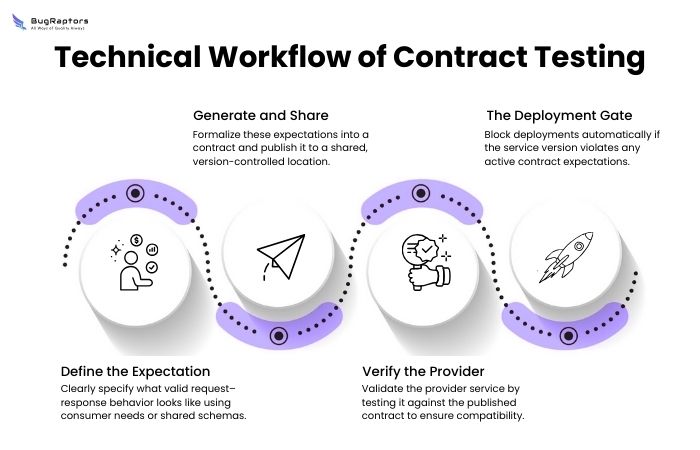
Define the Expectation
The quality strategy defines what valid communication looks like. In a Consumer-Driven model, the consumer team writes a test stating, "I need a user object with an ID string." In a schema-based model, this is defined in the OpenAPI YAML file.Generate and Share
This definition is formalized into a contract file (e.g., a Pact JSON or an OpenAPI spec) and stored in a central location. This could be a specialized broker or a version-controlled repository.Verify the Provider
The Provider service runs a test suite that pulls this contract. It replays the requests defined in the contract against itself. If the Provider returns a numeric ID when the contract demanded a string, the test fails immediately.The Deployment Gate
This is the most critical step for test automation services. Before any service is deployed to a staging or production environment, the pipeline checks the contract status. It asks, "Is the version I am about to deploy compatible with the versions currently running?" If not, the deployment is halted.
Implementing Test Automation Services for Contracts
Adopting this workflow requires a shift in your CI/CD pipeline. It falls under the umbrella of mature test automation services. You are moving away from manual alignment meetings and towards automated verification. To make this work, you need to integrate these checks into your build process:
Consumer Build: Runs unit tests, generates contracts, and publishes them to the Broker.
Provider Build: Pulls contracts, verifies them, and publishes verification results.
Deployment Gate: Before deploying Consumer to production, check: "Has the version of Provider in production verified the contract I need?"
This last step, often called "Can I Deploy?", prevents a situation where you deploy a new Consumer that relies on an API field the Provider hasn't released yet. For a deeper look at setting up these automated pipelines, check our guide to API test automation services.
The Business Value for the Organization
Why should leadership invest in this strategy?
Decoupling Teams
In many organizations, the frontend team sits idle waiting for the backend API to be finished. With contract testing, teams agree on the contract first. The frontend mocks the API based on the contract and keeps working. The backend builds to the contract. This parallel workflow significantly speeds up delivery.
Cost Efficiency
Finding a bug in an E2E test or production is expensive. It requires triage, environment debugging, and hotfixes. Contract testing pushes discovery to the "build" phase. Finding a schema mismatch here costs pennies compared to finding it in production.
Living Documentation
Static documentation (Wikis, PDFs) goes stale. Contracts are enforced by code. If the API changes, the contract must be updated, or the build fails. This ensures your system documentation is always accurate, which is a massive asset for onboarding new developers or testers.
Common Challenges and How to Overcome Them
Adoption is rarely a straight line. Here are common hurdles teams face when implementing API testing services focused on contracts.
The "Initial Setup" Hump
Setting up a Broker and configuring the pipelines takes time. It is not as simple as npm install.
Solution: Start with just two services. Pick a Consumer and a Provider that break frequently. Prove the value there before rolling it out to the whole organization.
Data Management
The Provider needs to be in a specific state to verify the contract. If the contract asks for "User 123," then "User 123" must exist in the Provider's database during the test.
Solution: Use "Provider States." The contract framework allows you to define setup hooks. Before the test runs, the framework triggers a hook saying "Create User 123." The Provider configures its local database, runs the test, and then tears it down.
Scope Creep
Teams sometimes try to use contract tests for functional testing. They check complex business rules via the contract.
Solution: Keep it simple. Contract tests check the shape of the data (types, field names, presence of headers). Use functional tests for business logic.
Future-Proofing Your Architecture
As organizations grow, the web of services becomes denser. A change in a legacy service can ripple out and break a mobile app three layers away. Without a strategy to manage these dependencies, developers become afraid to touch code. Releases slow down because every change requires a week of manual regression testing.
Contract testing restores confidence. It acts as a guardrail. It allows you to modify the internals of a microservice aggressively, knowing that as long as you pass the contract verification, you haven't broken your consumers. This method turns test automation services from a problem into a solution. It lets you get the real benefits of microservices, such speed, scalability, and independence.
Start small. Figure out which integration points hurt you the most. Put contracts into effect there. You'll wonder how you ever got by without it once your team sees the green build lights and quits being afraid of the "deploy" button.

Kanika Vatsyayan
Automation & Manual Testing, QA Delivery & Strategy
About the Author
Kanika Vatsyayan is Vice-President – Delivery and Operations at BugRaptors who oversees all the quality control and assurance strategies for client engagements. She loves to share her knowledge with others through blogging. Being a voracious blogger, she published countless informative blogs to educate audience about automation and manual testing.


