

Nov 4, 2026
AI Governance Auditing: Testing, Traceability, and Regulatory Compliance
Historically, software deployment depended on deterministic criteria where test execution confirmed adherence to rigid functional requirements. Passing pre-release staging gates served as a reliable proxy for operational stability and corporate safety.
Today’s artificial intelligence implementations challenge this fundamental paradigm. Machine learning systems function as complex probabilistic engines whose runtime behaviors are shaped by statistical weights and evolving data distributions rather than hardcoded logic. Consequently, systemic defects rarely present as broken code paths; they manifest silently as algorithmic bias, security vulnerabilities, and compliance with non-conformance.
To mitigate these unmonitored operational liabilities, enterprises must implement a formal AI governance audit, shifting quality oversight from passive policy checklists to empirical, code-level verification across the entire model lifecycle.
What Is AI Governance Auditing?
An AI governance audit is a rigorous, code-level inspection of your models, pipelines, and runtime boundaries. Traditional compliance audits lean on static paperwork. Teams fill out policy checklists and secure executive sign-offs. That approach falls apart the moment a model runs live customer data.
Algorithmic systems demand empirical proof. An engineering audit inspects raw data splits, evaluates model weights, and verifies inference calls. It confirms that the system behaves within defined operational thresholds before deployment.
Why AI Governance Demands a QA Layer
Corporate policies look great on paper, but a written rule cannot monitor an AI model in real time. Legal teams cannot spot when an AI assistant starts making up facts with complete confidence, or when its answers quietly degrade because customer behavior has shifted.
Translating policy into practice requires mature quality engineering services. We treat regulatory mandates the same way we treat critical user stories. We convert them into executable test suites, deterministic boundary checks, and automated release gates.
Without technical verification, governance remains pure wishful thinking. Skipping the QA layer leaves teams vulnerable to sudden production failures and severe statutory penalties.
Core Technical Pillars of an AI Governance Audit
A dependable technical audit interrogates four distinct engineering dimensions:
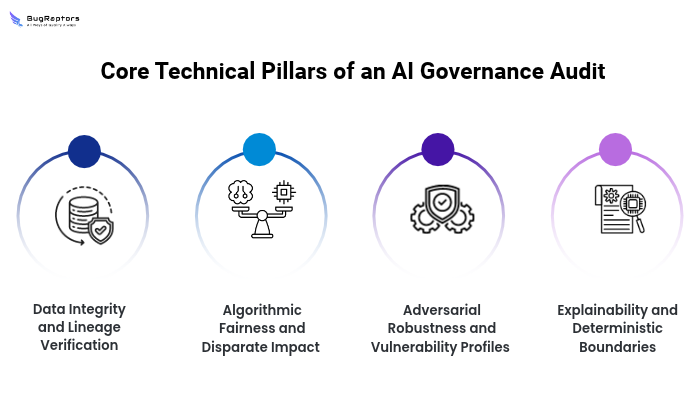
Data Integrity and Lineage Verification
Algorithmic stability depends on input hygiene. The audit inspects training, validation, and test partitions to confirm zero data leakage across historical splits. We trace raw data from ingestion storage through transformation scripts to model training.
Synthetic data pipelines generated through tools like RaptorGen are evaluated for statistical integrity. Poisoning vulnerability tests verify that malicious inputs cannot distort downstream model weights.
Algorithmic Fairness and Disparate Impact
Evaluating demographic parity requires mathematical assertions across protected classes. The audit calculates Disparate Impact Ratios, Demographic Parity Differences, and Equalized Odds across every output tier.
When a pipeline exhibits skewed approval rates across distinct demographic cohorts, mitigation scripts apply targeted re-weighting. Explore our technical breakdown of AI model bias testing to review concrete mitigation benchmarks.to review concrete mitigation benchmarks.
Adversarial Robustness and Vulnerability Profiles
Modern neural architectures present novel attack surfaces that legacy scanners miss. Rigorous AI application testing probes live endpoints against prompt injections, model inversion, and evasion vectors. Our teams inject Gaussian noise into continuous inputs to map inference boundary stability.
Partnering with a dedicated AI security testing service provider identifies vulnerable API connectors and unsafe retrieval augmentations, preventing unauthorized model extraction.
Explainability and Deterministic Boundaries
Black-box predictions trigger immediate pushback from auditors. The technical audit measures feature attributions using SHAP and LIME frameworks. We check whether feature weights align logically with business rules or rely on spurious correlations.
The audit also tests system guardrails, verifying whether fallback routines and human override triggers activate when prediction confidence drops.
The Global Regulatory Landscape
Statutory frameworks have moved from voluntary ethics to hard legal requirements with big consequences. For robust AI regulatory compliance, engineering teams must connect verification suites directly to international standards:
EU AI Act: Requires high-risk algorithmic systems to have stringent transparency, risk assessment, and event-logging requirements.
NIST AI RMF 1.0: Demands quantifiable testing controls based on four operational pillars: Govern, Map, Measure and Manage.
ISO/IEC 42001: Defines formal management system certifications, including traceable test artifacts, risk mitigations, and ongoing documentation.
An organized AI governance audit ensures these standards are met by the verification suites prior to deployment. Teams turn regulatory requirements into automated checks, taking friction out of compliance in regulated marketplaces.
The Three Audit Evidence Pillars
When regulatory auditors walk into an enterprise engineering environment, they care very little about slide decks, corporate ethics charters, or high-level risk policies. They ask for one thing: verifiable, reproducible engineering artifacts.
If your team cannot reconstruct the exact state of a system that produced an inference six months ago, you will fail the audit. A defensible AI governance audit rests on three concrete evidence pillars that bridge runtime code with regulatory mandates:
Pillar 1: End-to-End Lineage and System Traceability
Traceability requires establishing an unbroken, forensic link between training data, code commits, pipeline configurations, and running endpoints. Quality teams must supply machine-readable Software Bills of Materials (SBOMs), Git commit hashes, and SHA-256 cryptographic signatures of serialized model weights.
If an auditor flags a suspect transaction, your verification harness must pinpoint the exact training batch, data preprocessing scripts, and hyperparameters that produced that decision boundary.
Pillar 2: Empirical Explainability Checks and Baseline Verification
Regulatory structures such as the EU AI Act and the NIST AI RMF do not permit black-box opacity. Auditors need mathematical evidence that inference logic is stable and sound in edge circumstances. This evidence is provided in the form of versioned SHAP (Shapley Additive exPlanations) values, LIME attribution matrices, and counterfactual test logs.
Teams automate assertions to show that feature significance rankings don't fluctuate wildly with little input noise, indicating the system is making judgments based on genuine domain logic rather than bogus proxy signals.
Pillar 3: Immutable, Machine-Readable Compliance Documentation
Handcrafted spreadsheets and static PDFs fail audits because they lack version control and change accountability. Mature QA operations generate dynamic Model Cards and System Risk Profiles directly out of continuous delivery pipelines.
These artifacts bundle verified test execution runbooks, historical defect triage logs, protected-class bias ratios, and coverage matrices into immutable, timestamped object repositories. Storing these artifacts alongside automated build outputs provides external evaluators with an unalterable ledger of compliance health at every release gate.
How QA Builds a Verifiable AI Audit Trail
Building an audit trail requires embedding automated verification directly into daily deployment pipelines. Constructing compliance reports days before an external review invites failure; the evidence chain must compile continuously alongside application code.
In a mature continuous delivery pipeline, every model iteration moves through four verifiable stages:
Stage 1: Versioned Ingestion and Baseline Lineage
The pipeline records immutable SHA-256 hashes of training datasets, preprocessing scripts, hyperparameter configurations, and resulting binary weights. Software bills of materials (SBOMs) capture system packages and environment dependencies to guarantee identical runtimes across test and production environments.
Stage 2: Automated Multi-Layer QA Gate
On every pull request and retraining run, automated test harnesses run parallel suites targeting data leakage, algorithmic bias ratios, prompt injection resilience, and inference latency. These execution suites log deterministic pass/fail results, boundary edge-case sweeps, and attribution stability scores directly to runtime data stores.
Stage 3: Evidence Ledger Compilation
Rather than storing scattered console logs, specialized platforms like BugRaptors' AI Code Assurance Framework™ aggregate requirement-to-code traceability, model cards, and security risk profiles. The framework scores algorithmic risk and assigns a release confidence score, proving the model meets predefined safety criteria before staging sign-off.
Stage 4: Immutable Deployment Registry
Only artifacts with verified test suites receive signed container image tags. The deployment orchestrator pushes these verification runbooks and telemetry traces into append-only, tamper-evident object stores, establishing a permanent record for auditors.
This engineering approach converts the AI governance audit from an unpredictable manual bottleneck into an automated, background validation process that produces forensic proof on demand.
Continuous Post-Deployment AI Governance
Algorithmic verification never stops at release. Real-world input data shifts over time, degrading decision quality while application code remains unchanged. Relying on an isolated, one-time AI governance audit exposes organizations to production drift. Runtime monitoring tracks continuous telemetry to detect data and concept shifts early.
Monitoring engines calculate the Population Stability Index (PSI) to flag covariate drift in input vectors. They compute Wasserstein distances to measure shifts in prediction distributions. When inferences drift beyond preset statistical thresholds, automated alerts trigger canary rollbacks or switch traffic to deterministic fallbacks.
Organizations deploy autonomous monitoring agents to continuously stress-test live endpoints. Read our guide on enterprise autonomous testing to see how runtime validation isolates regressions across live enterprise workflows. When production telemetry captures anomalous edge cases, autonomous systems push those payloads into regression repositories. Conducting a continuous AI governance audit ensures sustained operational stability long after initial certification.
Strategic Next Steps for Enterprise Compliance
Algorithmic accountability cannot survive on static checklists or manual spreadsheets. Decades of shipping software demonstrate that quality lives in your automated regression suites, pipeline triggers, and continuous test harnesses. Establishing a rigorous AI governance audit transforms regulatory mandates into code-level protections that safeguard end users.
BugRaptors bridges this gap between strict regulatory standards and practical engineering execution. Through our specialized quality engineering services, proprietary tool ecosystems, and dedicated testing labs, we help enterprise teams build dependable, audit-ready verification pipelines.
Embedding continuous validation into your software delivery lifecycle allows you to prove algorithmic integrity, satisfy global statutory requirements, and deploy artificial intelligence with verified release confidence.

Kanika Vatsyayan
Automation & Manual Testing, QA Delivery & Strategy
About the Author
Kanika Vatsyayan is Vice-President – Delivery and Operations at BugRaptors who oversees all the quality control and assurance strategies for client engagements. She loves to share her knowledge with others through blogging. Being a voracious blogger, she published countless informative blogs to educate audience about automation and manual testing.


