

Sep 1, 2026
AI Model Bias Verification: Step-by-Step Framework for Auditing and Mitigating Model Bias

Artificial intelligence plays a vital role in high-stakes decision-making across recruitment, credit scoring, healthcare, and criminal justice. This rapid adoption is reflected in market data (Statista): the global AI technology sector is valued at approximately $617 billion and is projected to surpass $1.4 trillion by 2032, with a steady annual growth rate (CAGR 2026-2032) of 14.82%.
However, mathematical execution does not guarantee objectivity. Machine learning models analyze historical data to identify operational patterns. When training datasets contain missing information or historical inequalities, algorithms learn and compound those flaws. Establishing a systematic AI bias testing protocol is essential to verify equity before models transition into production environments.
Where Does Algorithmic Bias Originate in Machine Learning Models?
Algorithmic bias occurs when an AI system's processes cause repeated, negative inequities among groups or subgroups of people. Engineering leaders want to design balanced validation pipelines, typically study the fundamental difference between human-driven evaluation and automated testing frameworks, and then set a baseline of performance on which to base their automation introduction.
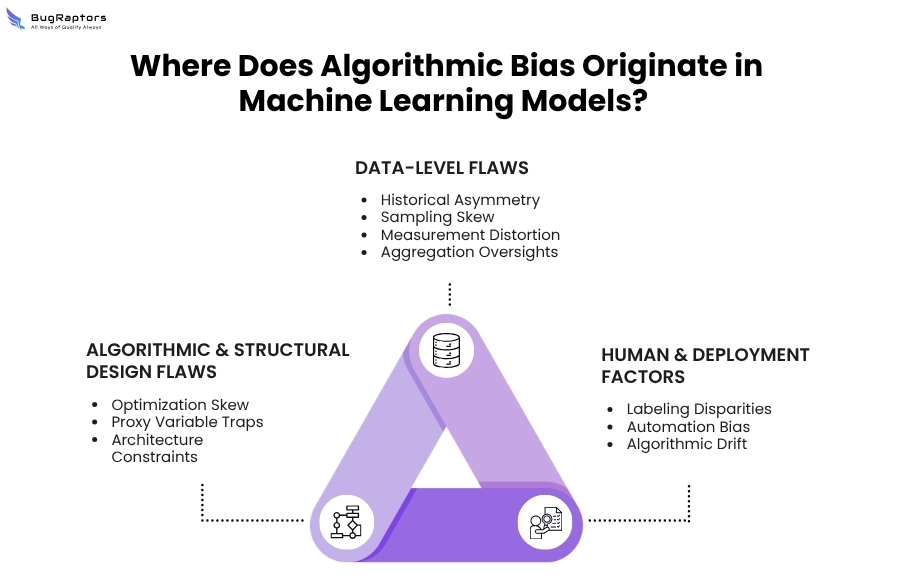
Data-Level Flaws
Historical Asymmetry: Training data often reflects past societal imbalances. For instance, an automated resume screening system trained on historical hiring data from male-dominated engineering roles will learn to rank female applicants lower.
Sampling Skew: This occurs when specific sub-populations are underrepresented within the data pipeline. Early facial analysis software showed error rates up to 34.7% for darker-skinned females while maintaining a very high accuracy for lighter-skinned males.
Measurement Distortion: This develops when data collection tools systematically misrepresent specific cohorts due to structural errors in telemetry design.
Aggregation Oversights: These happen when distinct subgroups are combined into a single group, hiding underlying performance variations.
Algorithmic and Structural Design Flaws
Optimization Skew: Standard loss functions prioritize overall global accuracy. If a dominant demographic makes up 95% of a dataset, the neural network might maximize accuracy for that group while misclassifying the remaining 5% minority population.
Proxy Variable Traps: Removing protected attributes like race, gender, or age does not guarantee neutrality. Deep learning models can easily reconstruct those attributes using highly correlated proxy variables like zip codes or education history.
Architecture Constraints: Inherent structural limitations within neural networks often favor broad global patterns over subtle, regional variations.
Human and Deployment Factors
Labeling Disparities: Human data labelers introduce personal bias during early annotation phases, creating inconsistent ground-truth data.
Automation Bias: Operators often accept automated outputs without verification, allowing incorrect system predictions to pass through uncorrected.
Algorithmic Drift: Post-deployment shifts in real-world user behavior can cause system performance to stray from its initial training objectives.
The 7-Step Operational Framework for Bias Auditing
Validating an intelligence layer requires going beyond standard functional tests. Quality engineering teams must combine comprehensive AI bias testing methodologies, statistical validation, comparative analysis, and explainability frameworks directly into their delivery pipelines.
Step 1: Deep Dataset Diagnostics
Auditors must map data distributions before starting training or evaluation cycles. This step involves auditing data vectors for demographic imbalances, checking for missing values across subgroups, and scanning for hidden proxy variables.
Analysts run statistical divergence checks, such as Kullback-Leibler (KL) divergence, to measure differences between baseline demographic distributions and actual training partitions. Catching these imbalances during ingestion stops data skew from spreading through downstream network layers.
Step 2: Selecting Fairness Metrics
Measuring mathematical equity requires selecting explicit fairness metrics tailored to the operational and regulatory needs of the application:
Demographic Parity: Verifies that the probability of a positive outcome ($P(Y=1)$) remains statistically equivalent across all demographic groups.
Equal Opportunity: Confirms that the true positive rate is uniform across groups, giving qualified candidates an equal mathematical chance of approval.
Disparate Impact Ratio: Measures the selection rate of an unprivileged group against a privileged group. Under regulatory guidelines like the U.S. EEOC four-fifths rule, a ratio below 0.80 indicates actionable adverse impact.
Step 3: Comparative Subgroup Validation
Standard test suites often hide underlying failures behind strong global metrics (such as a 94% overall accuracy score). Subgroup validation isolates key performance metrics, like precision, recall, and false positive rates, across intersecting demographics to uncover hidden performance drops.
By setting up isolated validation loops, quality teams can generate confusion matrices for individual demographic slices, helping isolate localized spikes in false negatives that point to systemic rejection patterns.
Step 4: Applying Explainability Frameworks (XAI)
Black-box validation relies on model-agnostic explainability tools like SHAP and LIME. These frameworks measure feature importance scores, enabling testers to confirm whether proxy attributes carry unintended mathematical weight in final predictions.
By tracing decision pathways down to individual neuron weights or game-theoretic contribution values, verification scripts flag unexpected feature correlations prior to release.
Step 5: Intersectional Evaluation
Biases rarely occur in isolation. Evaluation protocols must analyze multi-factor combinations, testing how models handle individuals at the intersection of several categories (such as low-income senior citizens), where separate data gaps can combine into high error rates.
Evaluating these combined cohorts requires structured combinatorial testing methods that systematically scan variations across race, gender, geographic location, and socioeconomic brackets to catch performance drops.
Step 6: Real-World Contextual Assessment
Models operate within dynamic social structures. Contextual analysis assesses the downstream social impacts of deployment, mapping how data drift, shifting user behaviors, and feedback loops alter model outputs once live.
Identifying these drifts early helps explain why AI apps fail in production, as real-world operational variables frequently diverge from those in controlled staging environments. Continuous tracking ensures deployment engineers catch deviations caused by shifting user profiles before they distort downstream analytics.
Step 7: Structuring the Bias Audit Report
The final phase involves compiling all analytical findings into a structured audit ledger. This document outlines identified disparities, quantifies statistical deviations, and provides clear remediation playbooks (such as re-weighting datasets, adjusting inference thresholds, or applying algorithmic guardrails).
This documentation provides a repeatable reference point for future model releases, ensuring subsequent training iterations actively address verified vulnerabilities.
Integrating Equity Controls into Quality Engineering Services
True equity management requires weaving continuous validation steps into automated verification pipelines. The following matrix details the specific failure points, detection methods, and technical remediation vectors across automated testing environments.
Evaluation Area | Risk Vector | Detection Methodology | Remediation Vector |
Test Case Generation | Automated coverage skews toward high-frequency primary user flows, leaving critical edge paths untested. | Statistical comparison of automated coverage distributions against real-world user metrics. | Inject explicit synthetic rules targeting rare flows and edge-case profiles. |
Self-Healing Automation | Locators heal based on raw frequency metrics, systematically breaking on contextual shifts. | Tracking element replacement drift and mapping failure rates across distinct sub-environments. | Enforce contextual verification rules (anchoring semantic labels and structural layout spatial areas). |
Natural Language Interfaces | Semantic interpreters fail when encountering non-standard dialects, regional jargon, or diverse phrasing styles. | Executing automated syntax variations and measuring interpretation success drops. | Diversify training syntax inputs; inject comprehensive variations of language tokens. |
Synthetic Data Pipelines | Data generation scripts replicate historical imbalances, missing extreme out-of-bounds scenarios. | Running variance tests and tracking statistical dispersion across generated profiles. | Implement automated boundary-injection rules to guarantee data variety. |
How to Automate Disparate Impact Verification
To automate these processes within continuous integration pipelines, quality engineers implement custom algorithmic checks alongside core software unit tests. Writing structural regression validations ensures that every model update undergoes static validation before deployment to cluster nodes.
Below is a strategic Python validation example leveraging open-source fairness toolkits to run programmatic disparate impact evaluations:
PYTHON
from aif360.datasets import BinaryLabelDataset from aif360.metrics import BinaryLabelDatasetMetricdef verify_model_fairness(validation_dataframe, unprivileged, privileged):
"""
Executes automated disparate impact calculations on inference outputs.
Validates model outcomes against regulatory compliance guardrails.
"""
# Transform raw inference dataframe into structured validation vector
structured_dataset = BinaryLabelDataset(
df=validation_dataframe,
label_name='approval_status',
favorable_label=1,
unfavorable_label=0,
protected_attribute_names=['demographic_group']
)
# Instantiate structural metric calculator
fairness_evaluator = BinaryLabelDatasetMetric(
structured_dataset,
unprivileged_groups=unprivileged,
privileged_groups=privileged
)
# Calculate operational metrics
disparate_impact_score = fairness_evaluator.disparate_impact()
statistical_parity = fairness_evaluator.statistical_parity_difference()
# Output system diagnostics
print(f"[DIAGNOSTIC] Calculated Disparate Impact Ratio: {disparate_impact_score:.4f}")
print(f"[DIAGNOSTIC] Statistical Parity Difference: {statistical_parity:.4f}")
# Enforce build-pipeline boundary conditions
if disparate_impact_score < 0.80:
raise ValueError(
f"[CRITICAL FAILURE] Disparate Impact Ratio falls below compliance threshold: {disparate_impact_score:.4f}"
)
return True
Adding validation blocks like this to active deployment pipelines shifts bias verification from a manual check to an automated quality gate.
Strategic Optimization for Large Language Models
Enterprise deployments rely heavily on generative foundation models. Managing risk in these environments requires targeted LLM optimization services that go beyond basic data re-balancing to actively govern model behavior. Advanced optimization depends on running real-time testing frameworks directly within the inference layer.
For instance, automated test scripts can verify that an internal enterprise knowledge model rejects requests to generate biased or restricted text. By using automated prompt injection, semantic boundary checks, and alignment testing, teams can systematically evaluate LLM safety boundaries. This confirms that foundational models deliver clear business value without generating toxic outputs, hallucinated facts, or discriminatory assertions.
Managing these generative validation paths requires systematic alignment algorithms, including Direct Preference Optimization (DPO) and Reinforcement Learning from Human Feedback (RLHF). Optimization teams use these techniques to adjust token probability matrices, ensuring the generation pipeline drops biased phrase options before final decoding. Building these programmatic filters requires specialized execution tracks that combine safety fine-tuning with precise AI bias testing parameters.
Technical Strategies to Fix AI Model Bias
When an audit uncovers systematic bias, remediation teams take action across three technical entry points:
Pre-Processing Mitigation
This involves adjusting raw datasets before feeding them into training loops. Techniques include reweighting historical samples to balance representation, oversampling sparse demographic records, or applying targeted pre-filters to remove latent proxy variables.
In-Processing Alignment
During model training, engineering teams update the core optimization equations. By adding a customized fairness penalty to the loss function, the network receives a mathematical penalty whenever predictions result in disparate demographic impacts. This guides the optimization algorithm toward high overall accuracy while maintaining fairness across groups.
Post-Processing Adjustments
If retraining the underlying model structure is restricted by compute budgets or tight deployment schedules, engineers apply post-processing remediation. This strategy adjusts decision thresholds across distinct demographic groups. By refining classification score boundaries post-inference, teams calibrate outputs to achieve equal true-positive distributions without altering core neural network weights.
Why Algorithmic Fairness Belongs in Modern Software Quality Standards
As software architectures transition from fixed procedural logic to probabilistic learning models, definition standards for software quality must evolve. System reliability can no longer be evaluated solely on uptime or execution speed; a model that outputs biased decisions for underrepresented cohorts fails core quality benchmarks.
However, automated testing frameworks alone cannot solve systemic bias. Achieving true algorithmic equity requires pairing continuous automated validation with a robust Human-in-the-Loop (HITL) architecture. While automated regression gates detect statistical variances and metric drops, human domain experts provide essential contextual oversight. HITL workflows ensure that edge-case anomalies, ambiguous boundary decisions, and subtle demographic shifts are reviewed by specialists who understand regulatory compliance and real-world social impact.
At BugRaptors, we bridge this gap by embedding advanced AI bias testing directly into end-to-end quality engineering services. By combining automated verification algorithms, custom CI/CD regression gates, and expert human review protocols, BugRaptors empowers enterprise teams to deploy AI solutions that are mathematically sound, fully compliant, and measurably equitable across all user populations.

Prateek Goel
Automation Testing, AI & ML Testing, Performance Testing
About the Author
Parteek Goel is a highly-dynamic QA expert with proficiency in automation, AI, and ML technologies. Currently, working as an automation manager at BugRaptors, he has a knack for creating software technology with excellence. Parteek loves to explore new places for leisure, but you'll find him creating technology exceeding specified standards or client requirements most of the time.


