

Jun 25, 2026
From Scripts to Systems: Why Enterprises Are Transitioning to Autonomous Testing

Every enterprise engineering leader knows the frustration of a stalled delivery pipeline. You push a minor user interface optimization or rename a single CSS utility class, and suddenly, a stable deployment build turns red. Hundreds of automated test scripts break instantly, not because the application logic failed, but because a static element locator changed. This is the reality of modern software delivery.
Traditional test automation services have hit a structural ceiling. In architectures defined by dynamic microservices and headless frontends, static validation scripts become obsolete almost as fast as engineers can write them. When quality engineering relies entirely on this fixed logic, it introduces severe maintenance debt, forcing teams to drain 20% to 30% of their engineering capacity simply to repair broken automation.
To maintain velocity, enterprises must move past the script-centric era. True continuous delivery demands a shift to autonomous testing: replacing brittle, deterministic validation with probabilistic, self-healing systems that evolve in lockstep with your codebase.
What Is Autonomous Testing?
Autonomous testing is a paradigm change away from following predefined pathways to deploying autonomous AI agents that control the entire quality lifecycle. Traditional automation is a static response, whereas autonomous systems utilize real-time sensing and reasoning to evaluate application conditions with little human overhead. This cognitive technique is based on four basic technological pillars:
Computer Vision (CV): Removes the testing dependency on fragile DOM attributes such as XPath expressions or static IDs. Visual models evaluate layout structures in the same way a human eye would, by visual intent, recognizing elements (e.g., shopping carts, checkout inputs) independent of structural code changes.
Natural Language Processing (NLP): Processes unstructured data such as user stories, Jira specs, or product requirements papers and automatically turns them into executable, multi-layered verification scenarios.
Predictive Machine Learning: Uses past execution data and code delta trends to estimate regression hazards. This allows the system to prioritize testing pathways based on the impact of changes, rather than blindly running regressions.
LLMs & Semantic Reasoning: Leverages advanced LLM testing services to evaluate non-deterministic application features and verify that generated outputs conform to the business context and guardrails.
Technical Comparison: Automation vs. Autonomous Systems
The core distinction lies in the underlying logic driving the execution engine. Traditional automation requires human foresight for every edge case; autonomous platforms rely on runtime adaptation.
Operational Dimension | Automation Testing (Scripts) | Autonomous Testing (Systems) |
Logic Basis | Deterministic: Rigid, instruction-bound execution. | Probabilistic: Context-aware, semantic validation. |
Maintenance Profile | Manual: Human engineering required for script updates. | Self-Healing: Machine runtime identifies and reconciles UI deltas. |
Test Generation | Author-Dependent: Scenarios must be manually mapped. | Discovery-Driven: Agents independently map application states. |
Scalability Path | Linear: Expanding coverage demands proportional headcount. | Exponential: Scale scales across environments with near-zero overhead. |
Resilience to Change | Vulnerable: Minor front-end refactoring breaks builds. | Adaptive: The system re-routes workflows around unexpected steps. |
Core Engineering Focus | Script authoring, selector debugging, & maintenance. | Architecture oversight, risk profiling, & strategic edge cases. |
The Six Stages of the Autonomous Quality Model
Transitioning an enterprise to an autonomous quality state requires a phased maturity model. This structured progression helps mitigate migration risks while systematically reducing human labor.
Level 0: Manual Execution
Complete reliance on human engineers for script-free exploration and verification. While contextually aware, it cannot scale to meet the demands of continuous, multi-daily deployment schedules.
Level 1: Scripted Automation
The baseline standard for most modern enterprises. Frameworks like Selenium, Playwright, or Cypress automate repetitive paths. However, execution remains fragile; any variance in the application path causes immediate script failure.
Level 2: Intelligent Assist
AI functions as a localized co-pilot. The system accelerates human authoring by predicting target locators, generating boilerplate code, or identifying optimization opportunities within IDEs, though humans retain absolute control over execution logic.
Level 3: Conditional Autonomy
The system takes ownership of isolated testing segments. It autonomously generates mock datasets, detects layout drift, and suggests self-healing fixes. However, human validation remains mandatory before updates are committed to the main branch.
Level 4: High Autonomy
The system independently manages standard validation flows. It explores application changes, maps feature sets, builds comprehensive test suites from scratch, and runs parallel executions across diverse browser configurations. Human intervention is limited to highly specialized, multi-system workflows.
Level 5: Full Autonomy
Deep integration within the development runtime. The system evaluates real-time production telemetry, automatically converts user stories into test environments, and scores release risks continuously during the code composition phase.
Strategic Value: Enterprise Efficiency and Resource Optimization
Deploying autonomous testing frameworks scales corporate engineering capacity by eliminating systemic overhead from delivery pipelines. By converting testing into responsive, diagnostic environments, enterprises address three major operational challenges:
Mitigating the Maintenance Tax
For large-scale enterprise platforms, maintaining a repository of thousands of static scripts represents a high operational cost. By utilizing visual intelligence and intent mapping, autonomous systems decouple verification intent from the volatile surface layer of code. If a CSS container changes or an ID updates, the autonomous agent focuses on the functional target, maintaining pipeline velocity and avoiding false-negative test failures.
Validating Complex AI and Data Workflows
As enterprise architectures integrate intelligent features, validation becomes increasingly difficult. Through targeted AI testing services, teams can validate complex, multi-turn workflows where the application output is variable. Furthermore, for systems relying on complex external data layers, specialized RAG testing services ensure that retrieval mechanisms operate with high precision, filtering out hallucinated or out-of-context payloads before they reach production.
Smart Impact Analysis and CI/CD Pipeline Acceleration
Executing an entire multi-hour regression suite for a localized code change slows down delivery cycles. Autonomous validation engines utilize Smart Impact Analysis to map code diffs directly to the application's behavioral tree. The system executes only the specific execution paths affected by the modification, shrinking feedback loops from hours to minutes and reducing cloud infrastructure costs.
What Can You Do With Autonomous Software Testing? (How It Works)
The autonomous platform comprises an inner workflow mechanism that resembles the human mind. These systems move away from the static execution of an application and move towards the dynamic interpretation of application behavior through visual perception and machine learning. To achieve this level of adaptability, modern QA architectures are increasingly deploying specialized software testing with AI agents and MCP to bridge the gap between LLM reasoning and system-level execution.
Step 1: Application Crawling and Discovery
This is initiated by an intelligent crawler. The agent crawls through the application, locating all the clicks, form fields, and routes. It constructs a "Dynamic Map" of the state machine of the application.
Example: On an e-commerce site, the crawler independently discovers that clicking a product thumbnail opens a details page with a "Size Selection" dropdown and an "Add to Cart" button, mapping these pathways without manual guidance.
Step 2: Intent Recognition
The system uses NLP to scan documentation or monitor manual sessions to capture intent. For example, it detects entering a username and password and clicking submit as a "Login" event. It classifies these actions into functional blocks.
Example: The NLP engine reads a requirement stating, "Users can apply promo codes at checkout." When it sees a user type "SAVE20" into a field and hit "Apply," it groups these actions under the functional block: Apply Discount Code.
Step 3: Test Generation and Execution
The AI produces the execution paths based on the map and the detected intents. These routes are not programmed, but lists of objectives. The system tries to solve the goal via the most rational way found in the crawling stage.
Example: Instead of following a script like "Click element ID #btn-99," the AI is given an objective: "Complete checkout as a guest." It analyzes the map to determine the optimal path for adding items, entering shipping details, and processing payment.
Step 4: Self-Healing and Reporting
During execution, if there is an unanticipated change, such as a pop-up or a change in the page layout, the AI stops and examines it. If the change has been established as a valid update, the system repairs the test path and proceeds. It consequently produces a report outlining functional inconsistencies with deliberate UI developments.
Example: If a deployment changes the "Proceed to Payment" button from a text link to a blue button on the right side of the screen, the AI uses visual perception to recognize the new button's purpose, updates the test path in real time, and logs the visual modification in the final report.
Where Autonomous Testing Fits in the Modern SDLC
Autonomous testing tools are best used when incorporated into the CI/CD pipeline. All these systems offer a safety net in the early stages of any code commit, so that regressions to the staging environment are avoided.
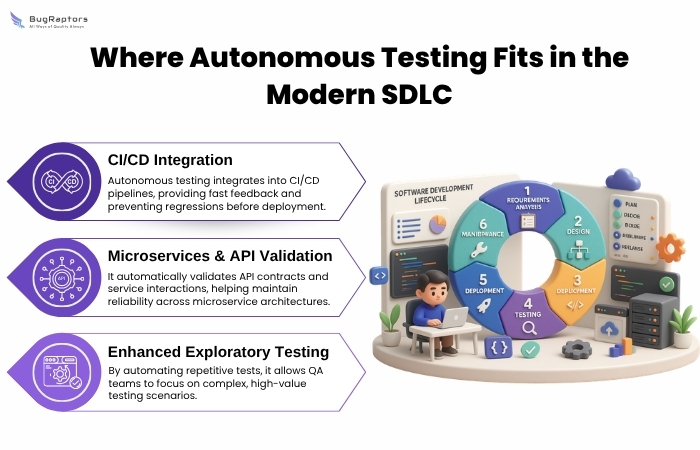
Integration in CI/CD Pipelines
By moving away from brittle scripts, autonomous testing becomes a reliable gatekeeper in the pipeline. It gives feedback of high fidelity in minutes during a code push. This enables the teams to have a high deployment frequency without compromising production stability.
Support for Microservices and API Testing
Modern architectures are fragmentary. Autonomous tools can track API contracts and automatically generate tests to ensure that changes in one service do not cause downstream failures. This is a critical component of contract testing for microservices, where automated validation ensures system-wide integrity.
Enhancing Exploratory Testing
If the tedious elements of testing, i.e., regression and smoke tests, are delegated to an autonomous agent, human testers have time to engage in high-level exploratory testing. They can pay attention to usability, accessibility, and complex security requirements that demand human intuition.
BugRaptors' Quality Architecture
Our platform-driven approach to software testing service centers on embedding continuous quality intelligence directly into the engineering pipeline. We assist enterprises in transitioning away from brittle script writing and moving toward self-validating code systems.
Our technical framework delivers these core capabilities:
Autonomous Intelligent Systems: Employs powerful AI agents to understand user requirements, determine cross-system relationships, and independently generate targeted validation plans.
AI-Augmented Functional Validation: Uses machine vision to monitor UI components based on behavioral intent, not fragile HTML attributes. No need to manually maintain locators.
Discovery-Driven Exploration: Smart crawlers autonomously explore application states, discovering fluid routes via microservices and headless frontends.
Release Risk Intelligence: Calculates a predicted Release Readiness Score based on historical defect patterns, code churn, and pipeline parameters before production deployment.
Self-Healing Runtime: Automatically fixes test baselines based on legitimate application design changes by doing real-time visual and semantic difference analysis.
Concluding Thoughts
Shifting from scripts to systems is an operational necessity for organizations looking to achieve true continuous delivery at scale. Legacy test frameworks had minimal automation, but autonomous testing gives you the flexibility to navigate the world of current microservices and complicated, AI-enabled applications.
By shifting the burden of script maintenance to intelligent models, technology firms can better leverage their quality engineering teams by freeing talent from manual code upkeep to focus on architectural design and high-level risk management.

Prateek Goel
Automation Testing, AI & ML Testing, Performance Testing
About the Author
Parteek Goel is a highly-dynamic QA expert with proficiency in automation, AI, and ML technologies. Currently, working as an automation manager at BugRaptors, he has a knack for creating software technology with excellence. Parteek loves to explore new places for leisure, but you'll find him creating technology exceeding specified standards or client requirements most of the time.


