

Nov 20, 2026
AI Code Testing: Preventing Architectural Drift Across Automated Pipelines
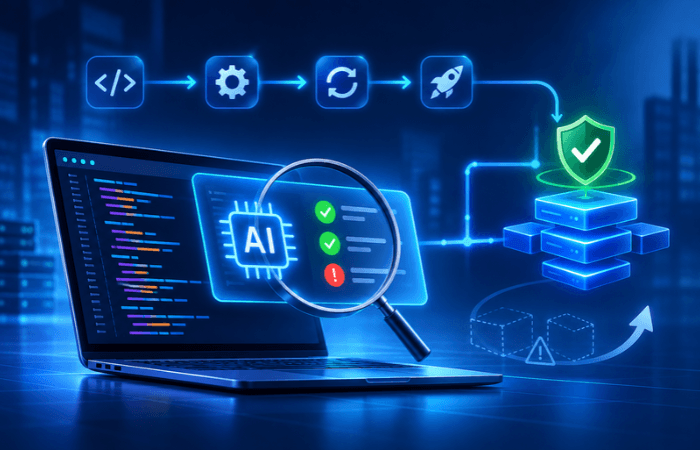
Over two decades of shipping enterprise software, the rhythm of development has shifted through multiple paradigm changes. Teams transitioned from rigid waterfall releases to rapid agile sprints, embraced continuous integration pipelines, and moved monolithic architectures into containerized microservices, all reinforced by disciplined quality engineering services. Yet nothing matches the sheer velocity at which generative coding assistants have entered modern development environments.
Logic that once took three days of manual scaffolding now appears in code editors within seconds. Writing code has rarely been the true bottleneck in the software development lifecycle. Verifying semantic intent, safeguarding architectural boundaries, preserving transaction integrity, and defending production environments are where systems truly stand or fall.
Treating synthetic code as production-ready without strict verification turns short-term developer speed into an unmanageable quality assurance deficit. Navigating this challenge requires making disciplined AI code testing an integral component of the deployment pipeline.
What Actually Breaks When AI Writes Your Code
Large language models generate syntax based on statistical probability rather than architectural comprehension. They predict the next most plausible token given an immediate prompt, producing methods that read impeccably on the surface while introducing severe systemic risks.
Hallucinated Third-Party Dependencies: Generative engines frequently invent fictitious package names, method signatures, or API parameters. Attackers monitor these behavioral patterns through "slopsquatting," intentionally publishing malicious libraries to public repositories that match commonly hallucinated names to compromise build servers.
Invisible Edge-Case Failures: Generated functions handle clean, standard scenarios with textbook precision, yet they collapse under boundary extremes. Off-by-one errors, unhandled empty collections, uncalibrated null-pointer logic, and silent floating-point rounding errors pass casual inspection but break under high concurrent loads.
Architectural Drift and Duplication: Copilots lack whole-system context. When instructed to serialize data or handle errors, they write isolated custom routines instead of invoking the shared utility libraries already standardized across your repository, increasing technical debt.
Security Anti-Patterns: Generated logic often defaults to unsafe development conventions: hardcoded credentials, permissive CORS origins, weak cryptographic ciphers, and disabled SSL verification introduced simply to make sample execution pass.
Why AI-Generated Code Is Harder to Test
Validating human-authored code follows established defect patterns. Quality engineers anticipate where developers cut corners, such as rushed commits, boundary off-by-one errors, or neglected null assertions.
Test suites have historically been engineered around these human cognitive blind spots. Synthetically generated logic breaks those assumptions by introducing unique verification challenges:
The Tautological Test Loop: Developers frequently prompt AI to write both the implementation and its accompanying unit tests. The model crafts tests mirroring its own flawed logic, validating its assumptions rather than actual business requirements. Without human-in-the-loop oversight, where QA engineers independently define acceptance criteria and review test assertions against domain rules, the pull request arrives with deceptive high branch coverage, masking critical runtime defects behind passing test suites.
Non-Human Defect Distributions: LLMs do not produce predictable human mistakes. A model will write flawless syntax while subtly transposing parameters, such as swapping tenant_id and user_id, that pass static type checks while introducing silent authorization bypasses. Conventional boundary value heuristics fail to catch these stochastic errors.
Context Dilution over Token Limits: Frontier models boast massive context windows, yet access to code does not equate to understanding stateful execution. Models suffer from semantic retrieval misses across microservice boundaries, creating routines that satisfy local interfaces while violating distributed transaction isolation or queue backpressure contracts.
Brittle, Over-Mocked Test Suites: When prompted to test complex integrations, AI tools heavily stub dependencies with superficial mocks. This generates fragile suites that offer a false sense of security while disconnecting from production database states, rate limits, and network latency.
Why Traditional QA Misses AI Code Bugs
Legacy quality assurance relies on static analysis security tools (SAST) and deterministic regression suites. While essential, these approaches were built to catch structural defects in human code, not the nuanced failures typical of machine-generated pull requests.
Standard linters only verify syntactic correctness. A function can pass every static rule while computing completely incorrect corporate tax tiers or dropping transactional rollbacks. Without specialized LLM output evaluation and hallucination detection, traditional verification pipelines miss synthetic dependencies and logical flaws entirely.
Furthermore, traditional unit suites only exercise the paths that human engineers anticipated. Synthetic code frequently fails along obscure, non-linear vectors that traditional test coverage never touches, allowing subtle regressions to slip quietly into staging environments. Bridging this gap requires dedicated AI application testing services and targeted AI code testing to uncover edge-case failures before deployment.
Real-World Production Failures and Enterprise Risks
Deploying unverified synthetic logic carries substantial operational, financial, and legal liabilities across modern enterprise systems:
Vulnerability Vector | Real-World Incident Precedent | Enterprise Impact |
Package Hallucination | Vulcan Cyber demonstrated public registry takeovers where fictitious AI-suggested packages were claimed on npm/PyPI. | Malicious remote code execution (RCE) inside build environments and automated supply-chain poisoning. |
Code Churn & Degradation | GitClear’s empirical analysis of 150M+ commits showed a 2x surge in code churn and a drop in refactored code across teams using AI copilots. | Accelerated technical debt, fragmented codebases, and ballooning maintenance overhead. |
Ungrounded Logic Drift | Widely publicized corporate bot exploits, such as dealership pricing errors and the Air Canada tribunal ruling over hallucinated policy exceptions. | Direct balance sheet liabilities, enforceable legal penalties, and severe brand damage. |
DOM & Accessibility Breakage | Synthetic frontend generation routinely merges unsemantic container wrappers (<div> buttons) lacking keyboard listeners. | Immediate WCAG accessibility compliance violations and broken screen reader flows |
How to Test AI-Generated Code: A Strategy That Works
Securing high-velocity development pipelines requires upgrading your verification architecture. Organizations cannot simply pull AI assistants away from developers; instead, engineering teams must establish automated quality guardrails that intercept synthetic defects before production deployment. Adopting a structured approach to AI code testing transforms developer speed into verified software stability.
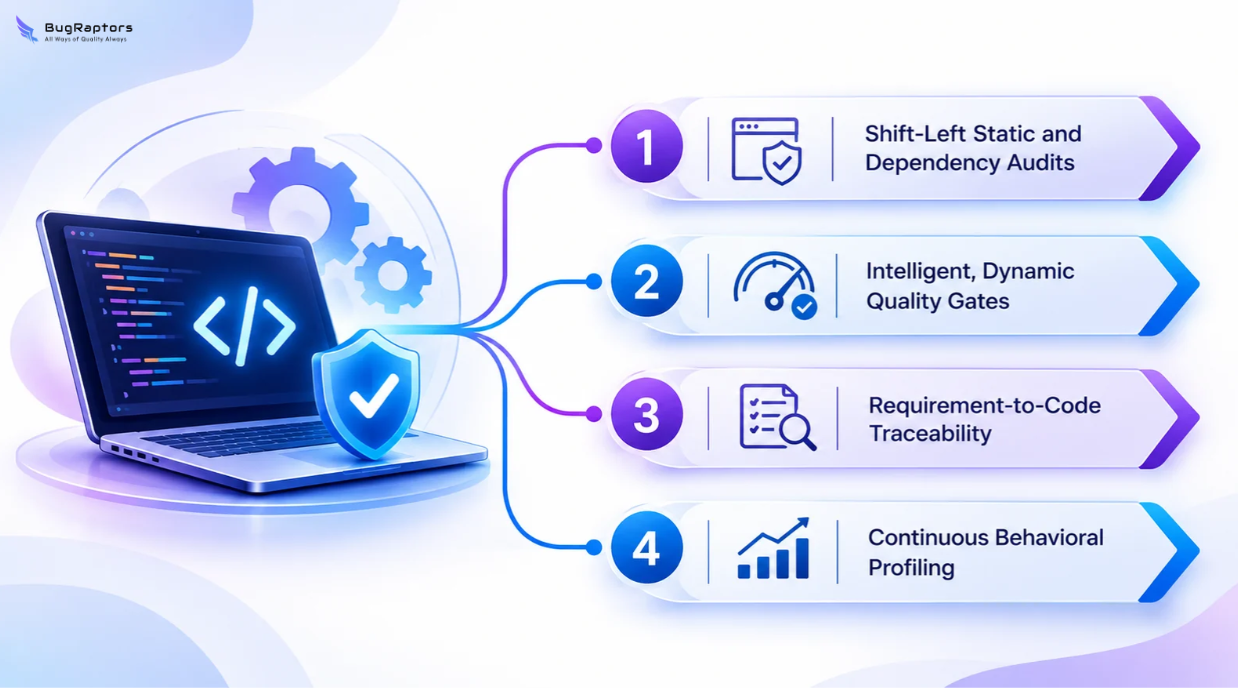
1. Shift-Left Static and Dependency Audits
Before incoming code reaches a shared pull request, run automated AST parsers and dependency verifiers. Every referenced package must be validated against approved internal artifact registries to neutralize supply chain attacks and package hallucination threats.
2. Intelligent, Dynamic Quality Gates
Static test suites must evolve into dynamic execution environments. Leading organizations deploy enterprise autonomous testing frameworks that generate exploratory test scenarios on the fly, stress-testing complex application paths and self-healing alongside rapid interface modifications.
3. Requirement-to-Code Traceability
Automated test harnesses must cross-reference generated functions directly against functional business specifications. Validating semantic alignment guarantees that the deployed code executes the exact business logic requested, rather than plausible hallucinations.
4. Continuous Behavioral Profiling
Establish targeted regression passes that stress-test boundary parameters, concurrency limits, and memory usage. Executing systematic AI code testing across every integration build ensures that synthetic logic handles unpredictable production loads with consistent resilience.
Continuous Code Governance with BugRaptors
Accelerated code generation requires an integrated review and governance ecosystem. Relying on peer developers to manually scrutinize thousands of lines of machine-generated code creates unmanageable review bottlenecks.
At BugRaptors, we bridge this operational gap by integrating automated static intelligence with seasoned quality engineering expertise. Through our specialized AI application testing services, we deliver end-to-end governance anchored in our proprietary systems:
Intelligent Code Assurance & Risk Profiling: Our automated AI-powered code review workflows analyze abstract syntax trees, map third-party package dependencies, evaluate technical debt accumulation, and generate objective AI risk scores before code merges.
Autonomous Execution & Requirement Validation: We cross-reference generated functions directly against functional business specifications, deploying AI-powered test automation agents that continuously validate requirement-to-code integrity and catch logic regressions.
Human-in-the-Loop Governance: Instead of burdening developers with tedious line-by-line proofreading, senior BugRaptors quality engineers govern high-level release gates. Our QA architects evaluate architectural compliance, verify system-wide transaction contracts, and audit release risk scorecards. Explore our analysis of human testing vs AI testing for a deeper breakdown of balancing automation with manual oversight.
Treating synthetic code as a frictionless shortcut introduces hidden technical debt that inevitably surfaces during production release cycles. True engineering acceleration happens only when rapid code generation pairs with disciplined, automated verification.
Organizations seeking to protect release stability while maintaining development speed can implement structured AI code testing protocols and end-to-end AI code validation strategies to deploy mission-critical software with complete release certainty

Prateek Goel
Automation Testing, AI & ML Testing, Performance Testing
About the Author
Parteek Goel is a highly-dynamic QA expert with proficiency in automation, AI, and ML technologies. Currently, working as an automation manager at BugRaptors, he has a knack for creating software technology with excellence. Parteek loves to explore new places for leisure, but you'll find him creating technology exceeding specified standards or client requirements most of the time.


