

Apr 10, 2026
LLM Output Evaluation & Hallucination Detection
As enterprises transition from experimenting with Generative AI (GenAI) to deploying Large Language Models (LLMs) in production, a critical challenge has emerged: reliability. While LLMs demonstrate remarkable proficiency in automating workflows from drafting executive communications to summarizing complex legal corpora, their susceptibility to "hallucinations" remains a significant operational risk.
The scale of this challenge is non-trivial. Recent industry benchmarks indicate that even the most advanced models exhibit significant error rates. For instance, research into Retrieval Augmented Generation (RAG) systems has shown that hallucination rates can range from 2% to 25% depending on the complexity of the domain and the quality of the retrieval context. Ensuring the integrity of these models requires a specialized approach to LLM testing.
Consequently, organizations are prioritizing LLM model optimization to fine-tune architectures for precision and factual alignment. This technical deep dive explores the frameworks, metrics, and strategies essential for evaluating LLM outputs and maintaining groundedness at scale.
What Causes Hallucinations in LLM?
To solve a problem, one must understand its architectural and probabilistic roots. Hallucinations in LLMs are not "glitches" in the traditional sense; they are a byproduct of the way transformer-based architectures predict tokens.
Training Data Divergence and Knowledge Cut-offs
LLMs are trained on massive, static datasets. If the model is asked about a development that occurred after its knowledge cut-off, or if the training data contained conflicting information, the model often resorts to "probabilistic guessing." Without rigorous LLM testing, these guesses appear indistinguishable from facts.
The Objective Function Mismatch
Most LLMs are optimized for "Maximum Likelihood Estimation" (MLE). The model is rewarded for predicting the next token that is most likely to appear in a human-like sentence. However, "most likely to be said" is not the same as "most likely to be true." This leads to the generation of plausible-sounding but entirely fabricated statements.
Encoder-Decoder Information Bottlenecks
In many architectures, complex prompts can lead to attention mechanisms failing to weigh the correct context. When the model loses the "thread" of a long document, it fills in the gaps with general knowledge from its weights rather than from the specific document provided, necessitating professional LLM optimization services to correct it.
Impact of Hallucinations in AI Applications
The cost of an LLM error is significantly higher than a typical software bug. In a traditional application, a UI failure might prevent a transaction; in a GenAI application, a hallucination can provide incorrect medical advice, erroneous financial forecasts, or violate data privacy. Organizations are quickly realizing that “why your chatbot needs AI testing services” is no longer a theoretical debate but a prerequisite for deployment.
Erosion of Brand Integrity: For consumer-facing bots, a single viral screenshot of a hallucination can destroy years of brand equity.
Legal and Compliance Liabilities: In regulated industries such as healthcare or finance, providing false information isn't just a mistake; it's a compliance breach that can result in significant fines under frameworks like HIPAA or GDPR.
The "Shadow Work" Burden: If employees have to fact-check every word an AI produces, the ROI of GenAI is neutralized. The goal of AI testing solutions is to restore this lost productivity by providing a verifiable trust layer.
Pillars of LLM Output Evaluations
Evaluating a traditional software application involves checking if "Input A" leads to "Expected Output B." However, GenAI is non-deterministic. Therefore, LLM testing must focus on four core pillars:
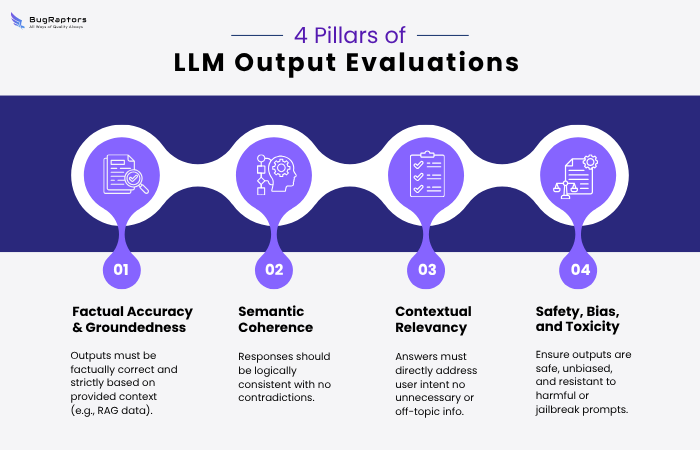
Factual Accuracy & Groundedness
Groundedness is the measure of whether the output is strictly derived from the provided context (e.g., a RAG knowledge base). An ungrounded response might be true in the real world, but "wrong" for the specific business context provided.Semantic Coherence and Logical Flow
Does the response hold up under logical scrutiny? This involves checking for internal contradictions where the model might agree with a premise in the first paragraph but contradict it in the third.Contextual Relevancy
Does the model address the user's intent? Evaluating relevance ensures the model doesn't drift into "tangential hallucinations," where it provides correct facts that were never requested.Safety, Bias, and Toxicity
Beyond facts, the model must be evaluated for "jailbreaking" vulnerabilities and its ability to adhere to safety guardrails. Professional software testing services now include red-teaming as a standard part of LLM evaluation.
Evaluation Strategies for Detecting Hallucinations
Our methodology at BugRaptors involves a multi-layered detection strategy that moves beyond manual spot-checking.
N-Shot Consistency and Self-Check GPT
One of the most effective strategies is "Self-Consistency." By prompting the model multiple times with the same query at a high temperature setting, we can observe the variance in its answers. If the model provides three different factual answers to the same question, it is a high-confidence signal of a hallucination.
NLI (Natural Language Inference)
We utilize NLI models to determine if the "Hypothesis" (the LLM output) is logically entailed by the "Premise" (the source document). If the NLI score shows "Contradiction" or "Neutral," the output is flagged for review.
Entity and Relation Extraction
In LLM optimization services, we often use automated scripts to extract entities (dates, names, prices) from the output and compare them against a structured "source of truth" database. If the LLM generates a price for a SKU that doesn't exist in the ERP system, the hallucination is caught immediately.
Automated Scoring Frameworks: Scaling the QA Process
Manual review is impossible when dealing with production-level traffic. To achieve hallucination detection at scale, organizations must integrate automated scoring frameworks into their software testing services pipeline.
Model-Graded Evaluations (LLM-as-a-Judge)
"LLM-as-a-Judge" is a sophisticated meta-evaluation technique where a high-reasoning model (e.g., GPT-4o) acts as the "evaluator" for a "candidate" model. This process is highly technical and requires:
Strict Evaluation Rubrics: Defining precise criteria (e.g., "Assign a score of 1 if the answer mentions any facts not found in the context").
Chain-of-Thought (CoT) Prompting for the Judge: Forcing the evaluator model to "explain its reasoning" before providing a final score, which significantly reduces "judge bias."
Reference-Based Grading: Providing the judge with the ground-truth document to compare against the candidate output, allowing for granular detection of subtle hallucinations.
The RAG Triad Metrics
For organizations utilizing Retrieval-Augmented Generation, we implement the RAG Triad:
Context Relevance: Evaluates the quality of the retrieval engine. If the retrieved chunks are irrelevant, the LLM has no choice but to hallucinate.
Groundedness: Measures whether every claim in the response can be traced back to the retrieved context.
Answer Relevance: Ensures the final response is helpful to the user's query.
Embedding-Based Similarity (BERTScore)
Traditional metrics like BLEU or ROUGE are often too rigid for GenAI as they rely on exact word matching. Instead, we utilize BERTScore, which leverages contextual embeddings to evaluate the semantic alignment between the generated text and a reference answer.
While BERTScore excels at allowing for natural variations in wording and phrasing, we recognize its limitations in isolated factual verification. Therefore, we use it as a measure of semantic intent rather than a standalone truth-checker, layering it with NLI and entity extraction to ensure that high semantic similarity doesn't mask subtle but critical factual deviations.
Barriers to Reliable Deployment: The GenAI QA Challenges
Scaling GenAI within an enterprise context presents unique hurdles that traditional QA teams often struggle to overcome. This shift is part of the ongoing journey of AI-enhanced engineering and redefining innovation in this ever-evolving QA industry.
Non-Deterministic Nature
Traditional binary assertions are insufficient; evaluation must shift toward probabilistic and tolerance-based validation.
The Latency-Accuracy Trade-off
High-fidelity evaluation methods (e.g., LLM-as-a-Judge or multi-stage validation pipelines) introduce additional inference overhead, creating a trade-off between evaluation depth and real-time responsiveness.
Lack of "Gold Standard" Datasets
Many companies lack verified datasets to benchmark their models against, leading to biased or incomplete evaluation results.
Context Window Limitations
Evaluating very long technical documents or codebases requires advanced chunking strategies to prevent the evaluation model from losing critical context.
How BugRaptors Help in LLM Output Evaluation
At BugRaptors, we recognize that LLMs are "black boxes," and peering inside requires a blend of data science expertise and traditional testing rigor. We don't just find bugs; we provide the roadmap to model reliability.
Custom Test Dataset Generation
We move beyond generic benchmarks to develop curated, validated datasets that are strictly representative of your real-world scenarios. By synthesizing diverse edge cases with your specific business logic, we ensure that the evaluation environment mirrors the actual complexity your users face.
End-to-End AI Testing Solutions
From prompt injection testing to toxicity filtering and groundedness audits, we provide a holistic testing environment. We integrate directly into your CI/CD pipeline, ensuring that every model update is vetted before deployment.
Strategic LLM Optimization Services
Detection is only half the battle. When our testing reveals systemic hallucinations, our team works to optimize the system. This might involve:
Prompt Engineering: Refining system instructions to enforce strict boundaries.
RAG Tuning: Improving the embedding models or chunking strategies to provide better context.
Fine-Tuning Advice: Identifying the specific data gaps that require retraining the model on domain-specific corpora.
Our software testing services are designed to be inclusive; we believe that performance and evaluation tools should be accessible to QA engineers who understand the nuance of end-user expectations.
What the Future Holds for Output Evolution
The "evolution" of LLM output is a moving target. As we move from static text generation to "Agentic Workflows" (in which LLMs take actions within other software), the stakes for LLM testing increase exponentially.
Self-Correcting Loops: Future architectures will likely include "internal critics," secondary models that verify a response before it is even streamed to the user.
Real-Time Grounding: We are seeing a shift toward models that can query the live web or internal APIs in real-time to verify facts, significantly reducing the window for hallucinations.
Standardized "AI Nutrition Labels": We expect to see industry standards emerge where every AI output comes with a "Confidence Score" or "Groundedness Rating," similar to how we view nutritional information today.
Continuous monitoring will be essential. Our software testing services are already evolving to include "drift detection," in which we monitor whether an LLM's accuracy degrades over time due to "model collapse" or changes in underlying data.
Whether you are building a customer-facing assistant or an internal data-mining tool, our robust AI testing solutions will ensure that your journey into GenAI is defined by precision, not fiction.

Prateek Goel
Automation Testing, AI & ML Testing, Performance Testing
About the Author
Parteek Goel is a highly-dynamic QA expert with proficiency in automation, AI, and ML technologies. Currently, working as an automation manager at BugRaptors, he has a knack for creating software technology with excellence. Parteek loves to explore new places for leisure, but you'll find him creating technology exceeding specified standards or client requirements most of the time.


