

Jul 3, 2026
Human Testing vs. AI Testing: Striking the Perfect Balance for Flawless Digital Experiences

Twenty years of boots-on-the-ground testing experience reveals a clear pattern: the industry has moved from tracking manual test cases in Excel sheets, to managing Selenium Grid configurations, to watching algorithms generate scripts in seconds.
Right now, if you are in a managerial role, your feeds are absolutely flooded with pitches promising that AI testing will completely eliminate human error, slash your testing budgets by 90%, and let you release flawless code to production on autopilot.
But out here in the real world? The picture looks a lot different. The latest Capgemini World Quality Report points out that while nearly 90% of organizations are actively piloting or deploying generative AI within quality engineering, only a tiny fraction, about 15%, have actually managed to scale these deployments across their pipelines.
Why? Because there is a massive difference between running a flashy proof of concept and trusting an algorithm in an enterprise deployment pipeline. Let's talk about what happens when the marketing hype hits the brick wall of production reality, and how we actually balance automated speed with human testing without breaking our systems.
Where the Tech Actually Works Across the STLC
Let’s be honest: AI isn't just vaporware. When applied to specific, high-friction points in the Software Testing Life Cycle (STLC), it solves problems that have plagued QA leads for decades. We don’t utilize it as a blanket solution, we inject it when manual execution or legacy programming creates problems.
Breaking Down Ambiguous Requirements
We’ve all been handed a Jira ticket or a product requirement document (PRD) that was completely open to interpretation. Historically, a QA lead had to spend hours sitting with product managers just to figure out the intended branch paths.
Today, Natural Language Processing (NLP) engines can parse those unstructured user stories and instantly spin up functional test scenarios. The trick here isn't letting the tool write the final tests; it’s using it to build a baseline. According to data from Katalon, 72% of QA professionals use AI for test generation and script optimization. It reduces the blank-page syndrome, giving our engineers a structural foundation to build on.
Spotting the Hotspots Before We Code
One of the hardest things about managing enterprise releases is selecting where to focus our regression efforts. We can’t run a 10,000-test suite on every little pull request without stalling the CI/CD workflow.
Predictive analytics engines may analyze previous commit logs, previous Jira defect patterns, and telemetry from production to highlight the precise modules that are at risk when a developer accesses a certain piece of code. Rather than guessing, the orchestration layer optimizes the exact subset of tests allocated to that specific blast radius. It allows our pipeline to be lean and context-sensitive.
Ending the Flaky Test Nightmare
Enterprise automation suites frequently stall when code updates alter the front end. A developer modifies a button ID or tweaks a CSS class, sending immediate false failure signals through the deployment pipeline. Engineers spend hours tracking down these errors, only to find a broken XPath locator. Self-healing frameworks using AI-powered test automation address this specific vulnerability.
Instead of relying on a single static DOM attribute, the execution engine tracks a dynamic signature of each element. This signature analyzes visual rendering, relative structural positions, and semantic context. If an ID changes, the script updates its parameters in real time, adjusts execution, logs the repair, and permits the build to finish.
For an in-depth breakdown of how autonomous agents scale this capability beyond simple scripts, see our perspective on agentic AI in software testing.
The Probabilistic Problem: Testing the Tools That Test the Code
Here is the paradox that keeps veteran testers up at night: We are using deterministic mindsets to test probabilistic systems. Traditional QA is binary. You feed the system Input A, it runs through defined, explicit logic, and it must give you Output B. If a single variable is off, the assertion fails. It’s clean, predictable, and simple.
But modern applications are increasingly built on machine learning models, dynamic recommendation engines, and LLM backends. These systems complement standard software architecture with weights, statistical confidence thresholds, and shifting vector spaces. If you ask an AI-driven system the same question three times, you might get three different answers. All three could be perfectly valid, or one could be an absolute disaster.
When your application adapts autonomously based on live data distributions, your traditional automation scripts become completely blind. We run into three massive vulnerabilities that standard checks will never catch:
Model Drift: Your model can perform beautifully in staging, hitting every precision benchmark. But once it hits production, real-world user behaviors change. The data distributions shift, and the model's accuracy silently degrades over time, even though not a single line of your application code has changed.
The Black-Box Dilemma: When an automated system makes a wrong call, like denying a valid transaction or misclassifying an enterprise data asset, you can’t just open a stack trace to see what broke. The decision-making is distributed across thousands of deep learning nodes, making behavioral auditing incredibly complex.
Data Bias and Compliance: An automated API check can verify that a scoring system responds within 150 milliseconds and returns a clean JSON payload. It will give you a green checkmark every time. What it won't tell you is if the underlying model is systematically penalizing a specific user demographic because its training data was skewed.
Evaluating and securing these non-deterministic layers requires a complete rewrite of the quality playbook. You can explore how enterprise teams approach this specific challenge in our guide on testing autonomous AI agents.
Human Testing: The Cognitive Edge That Scripts Can't Touch
This brings us to the core reality of human testing vs. AI testing. Algorithms are built to replicate historical patterns; human engineers are built to understand intent and context. An algorithm will only ever look where you tell it to look.
Cognitive Exploratory Testing
An automation script performs exactly what you tell it to do, line by line. It will stroll right past a blatant logical defect unless it is expressly trained to check for it.
Human testers do not work in a vacuum. We rely on intuition and exploratory testing to go off the happy path. We deliberately generate crazy state changes and race conditions, and test the assumptions that are never spoken about in the software. A computer can check that an API returns a success code. An experienced human engineer can see a micro-delay in database sync that is a symptom of a broader architectural problem under pressure.
Threat Modeling in Specialized QA
A good example is security testing services. Automated vulnerability scanners are great for the wide, low-hanging fruit. They can scan your code repositories and highlight known SQL exploits, cross-site scripting (XSS) patterns or obsolete libraries in only a few minutes. But serious security breaches aren’t caused by a single isolated issue. Complex risks occur when an attacker strings together a number of little flaws across many varied situations.
Since automated tools analyze code in isolated context windows, they are utterly oblivious to these dispersed, multi-stage attack routes. Human security specialists look holistically at the whole ecosystem, looking at business logic and modelling dangers that a machine would never think of.
Real-User Usability Validation
An automated UI test can verify that a button is exactly 40 pixels wide and matches the hex code specified in the design system. It can do that across fifty device configurations simultaneously.
What it cannot tell you is if that button creates an incredibly frustrating user experience for an enterprise customer trying to complete a transaction on a mobile screen in the field. Humans inject empathy, domain expertise, and operational context into validation, ensuring that the software doesn’t just pass a mechanical check but actually works for real people.
Designing a Multi-Agent Ecosystem for Scalable Human Oversight
Modern QA teams are shifting away from monolithic frameworks toward a multi-agent testing architecture. This approach deploys specialized AI agents operating as autonomous micro-services under a strict Human-in-the-Loop (HITL) orchestration model:
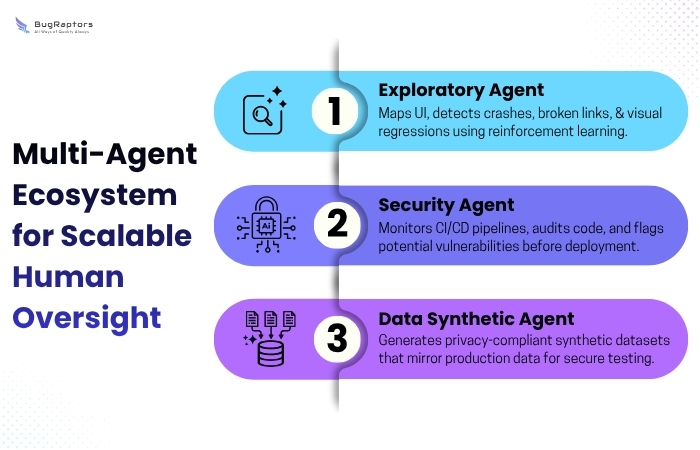
The Exploratory Agent: Uses reinforcement learning to map user interfaces and aggressively search for unexpected crashes, broken links, or visual regressions without requiring pre-written scripts.
The Security Agent: Sits inside the CI/CD pipeline, continuously auditing code changes against vulnerability databases to flag potential exploits before code hits staging.
The Data Synthetic Agent: Automatically builds complex, privacy-compliant, anonymized datasets mirroring real production distributions without exposing sensitive customer data.
These agents do not make isolated deployment decisions. When an anomaly is detected, the agent packages the execution state, metrics, and DOM context, passing it straight to a human tester who acts as the strategic conductor. Instead of viewing human testing and algorithmic scale as opposing forces, this framework unifies them.
By deploying AI-driven test automation for high-volume tasks and reserving human review for logical flaws, threat modeling, and usability, engineering teams can release complex platforms with complete confidence.
Accelerate Your QA Strategy with BugRaptors
To create a balanced QA pipeline, one needs to decide on the right strategy for the chosen architecture. BugRaptors is a specialized quality engineering partner, providing cutting-edge automation infrastructure and human domain expertise to ensure your deployment pipeline is fast, reliable, and secure.
Explore how our dedicated service teams help optimize your current engineering workflows:
Maintain Delivery Momentum: See how our structured regression testing services scale to embrace modern, self-healing frameworks, removing the need for repetitive script maintenance and speeding up continuous integration cycles.
Secure Your Core Systems: Learn how we provide security or vulnerability testing that integrates automated vulnerability scanning with human threat modeling to identify complex security issues across multi-cloud systems.
From scaling test coverage to removing redundant legacy flakiness to auditing critical business workflows, our teams offer the niche expertise needed to release software with complete confidence. Get in touch with our engineering team now to implement a unique validation strategy tailored to your architecture.

Sandeep Vashisht
Mobile, Web Testing
About the Author
Sandeep Vashisht is the Manager – Quality Assurance at BugRaptors. With experience of more than 15 years, Sandeep specializes in delivering mobile, web, content management, and eCommerce solutions. He holds a strategic QA vision and has the ability to inspire and mentor quality assurance. He is an expert with a grip on project plan development, test strategy development, test plan development, test case & test data review.


