

Oct 15, 2026
Why Deterministic Rule-Based Testing Unlocks Enterprise Logic Scale
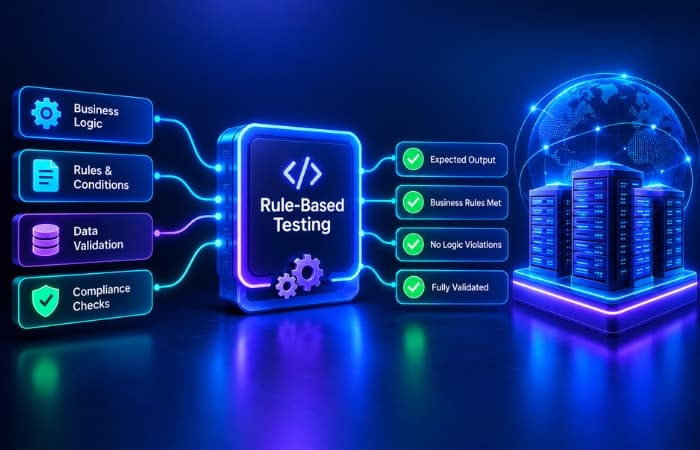
Modern enterprise applications process millions of calculations daily, checking vast combinations of transactional parameters, localized regulations, and internal security architectures. Relying on basic exploratory methods or loosely defined scripts creates severe validation gaps, making structured QA testing and rule-based testing essential for preventing system failure.
When system variables intersect, standard checking paths struggle to verify all potential edge states, exposing companies to calculation errors and compliance failures. For high-growth software architectures, implementing structured validation is a core requirement to protect operational continuity. Discovering structural flaws late in production creates major liabilities.
Mitigating this vulnerability demands a highly systematic approach. Leading organizations rely on rule-based testing to establish absolute operational consistency before introducing broader autonomous testing frameworks.
Rule-Based Logic vs. Machine Learning Models: The Core Distinction
Understanding how to construct an airtight validation pipeline requires separating deterministic verification from modern probabilistic systems. In an enterprise software ecosystem, engineering teams must deploy the appropriate testing strategy based on whether a subsystem relies on explicit logic or predictive pattern matching.
The Deterministic Paradigm
Rule-Based Logic Execution: Rule-based testing functions within a strictly defined environment where explicit logical rules direct test cases, input parameters, and exact expected outcomes. The execution remains fixed: given specific input conditions, the code must yield the same result every time with no variance.
System Predictability and Verification: If the core business parameter dictates that a user in a specific tax bracket pays a specific percentage, the test verifies that the calculation is precise. This absolute predictability makes the method highly effective for validating corporate workflows, financial structures, and security configurations.
The Probabilistic Paradigm
Algorithmic Pattern Analysis: In contrast, machine learning models run on statistical probabilities and floating confidence values. Rather than executing hardcoded rules, these algorithms analyze large training datasets to identify patterns and predict optimal outcomes.
Managing Shifting Behavioral Ranges: The system answers are not binary right-or-wrong statements, but rather statistical ranges. Because an algorithmic engine adapts its output based on historic data shifts, its behavior changes gradually over time.
Selecting a methodology is not an either-or choice. Balancing both models creates an optimal enterprise release pipeline. While learning engines handle complex user predictions and unstructured text classification, deterministic frameworks provide the necessary underlying guardrails to keep core processing functional. Review our complete breakdown of human testing vs. AI testing for a broader perspective on maintaining balance across software quality systems.
The New Frontier: Applying Deterministic Rules to Validate AI Model Outputs
As machine learning systems become core parts of corporate infrastructure, modern quality assurance faces an interesting challenge: How do you reliably test an unpredictable, non-deterministic system? The answer lies in AI application testing. Instead of analyzing the internal code paths of a neural network, specialized QA testing teams build deterministic validation perimeters around the model.
By utilizing explicit rule-based constraints, engineers treat the AI model as a black box and systematically cross-check its real-time outputs against validated ground-truth data matrices. Before approving any microservice deployment, a specialized software testing company implements four core operational testing gates:
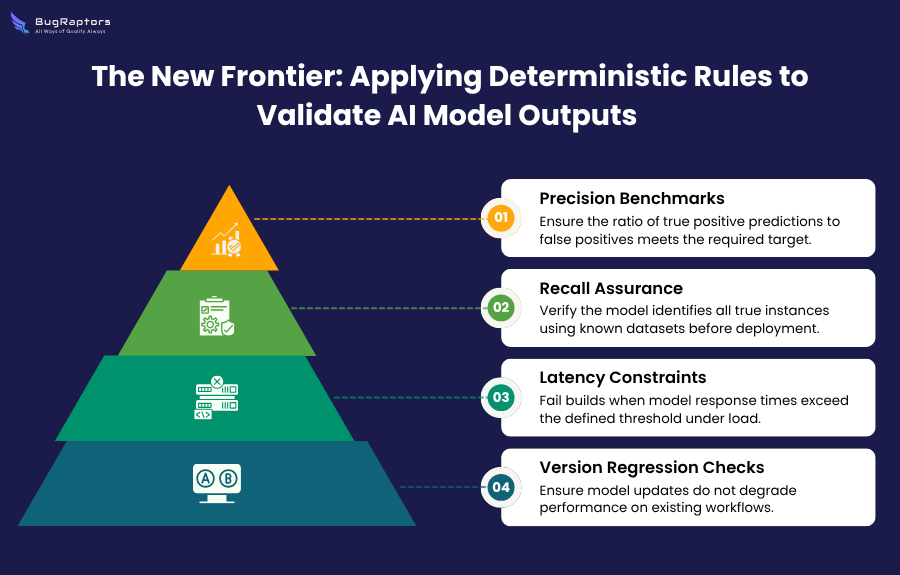
Precision Benchmarks
Precision measures the exact accuracy of positive system predictions. In an automated fraud detection ecosystem, rule-based validations assert that the ratio of true fraudulent alerts relative to false positive notifications meets corporate standards. A strict logic filter flags any build where precision drops below the accepted target, preventing downstream operational fatigue caused by false alarms.
Recall Assurance
Recall evaluates the system's ability to find every true instance within a data cluster. For instance, in a medical imaging or automated document parsing application, missing a true validation point (a false negative) introduces severe risks. Deterministic checks parse the model output against known datasets to ensure the recall score matches the necessary product baseline before deployment.
Latency Constraints
An accurate prediction loses its value if the processing delay breaks the system's user experience. Organizations establish hard logical ceilings within their automated build infrastructure to track performance. If a specialized model takes longer than a fixed threshold (such as 150 milliseconds) to return an inference under load, the framework automatically triggers a build failure.
Version Regression Checks
AI models naturally drift as they ingest new information. When updating a production model, teams pass the new iteration through standard historical data sets. This rule-based comparison confirms that optimizing the engine for new features does not degrade performance on long-standing core operational flows.
Operationalizing the Framework: Decision Matrices & Combinatorial Optimization
Deploying rule-based testing efficiently requires transforming business requirements into structural testing matrices. Engineers avoid writing individual test scripts for every line of text in a requirement document. Instead, they translate those constraints directly into logical decision tables that explicitly map input sets to target outputs.
The Problem of Scaling Logic
While this methodology offers complete functional coverage, managing scale requires careful design. When an enterprise software application features multiple intersecting variables, the number of potential testing scenarios expands rapidly. For example, consider a system with five distinct user input variables where each variable has four unique values. Manually scripting and maintaining over a thousand test variations for a single feature quickly exhausts resources and slows release cycles.
Optimizing via Pairwise Techniques
To bypass this limitation, modern test automation services utilize combinatorial optimization techniques like pairwise (all-pairs) design. This approach relies on mathematical models showing that the vast majority of software defects are caused by either a single input condition or the interaction between two specific parameters.
By applying pairwise optimization, engineers construct an optimized matrix that ensures every single pair of variables is validated at least once. This mathematical approach trims the total number of required test variants significantly:
Optimization Strategy | Total Scenarios Evaluated | Suite Size Reduction | Functional Certainty |
|---|---|---|---|
Brute-Force Permutations | 1,024 cases | 0% (Base Baseline) | 100% |
Pairwise Optimization | 24–32 cases | ~97% Reduction | High Operational Security |
This optimization keeps execution suites fast and manageable, allowing teams to maintain complete validation certainty without creating resource bottlenecks.
The Enterprise Blueprint for Continuous Quality
Integrating these practices into a fast-moving corporate continuous integration and continuous deployment (CI/CD) cycle requires a structured engineering approach. The transformation shifts testing from an isolated phase into a continuous verification layer.
Step 1: Requirements Isolation
System analysts and QA leads evaluate incoming technical specifications to isolate every conditional modifier, business constraint, and regulatory rule. These parameters are pulled out of unstructured text and organized into clean, logic-driven rule sets.
Step 2: Logic Matrix Design
The isolated parameters are converted directly into structured decision tables. This phase acts as an early validation check: mapping out requirements visually often highlights conflicting system paths, missing requirements, or logical dead-ends before developers write any code.
Step 3: Automated Data Provisioning
Using the finalized decision tables, automated systems generate precise positive, negative, and boundary data records. These records are built specifically to trigger every distinct path defined in the logic matrix.
Step 4: Automated CI/CD Execution
The generated data sets are plugged directly into automated test frameworks. As developers commit updates, the testing suite pulls the latest rules from a centralized repository, runs the verification checks against target application interfaces, and reports results immediately.
Read our comprehensive strategy guide on enterprise autonomous testing to learn more about scaling these methodologies across high-performance environments.
Achieving Concrete Business Outcomes
Transitioning to a formalized rule-based testing approach yields significant operational returns for large-scale enterprise systems:
Decoupled Maintenance Architecture: In traditional codebases, updating a business rule (like changing a processing fee or adjusting regional compliance limits) requires manual refactoring across thousands of lines of automated code. By separating business logic into an independent rule repository, teams update a single table cell to modify the testing behavior across the entire environment instantly.
Clear Audit Trails: Regulated industries like banking, fintech, and medical insurance require comprehensive documentation to satisfy external legal reviews. Every execution path within a structured logic matrix maps directly back to a specific requirement, creating clear, automatically generated compliance records.
Deployment Security for Emerging Tech: Integrating machine learning features always introduces some uncertainty into software builds. Implementing strict, deterministic verification parameters around these elements ensures that adding advanced capabilities will not compromise the core performance of your production system.
Maintaining software quality requires combining flexible validation with rigid, reliable logic frameworks. By utilizing rule-based testing, enterprise teams protect their application logic, lower long-term script maintenance overhead, and build stable systems that scale smoothly over time.
Partnering with BugRaptors for Enterprise Logic Scale
Establishing an airtight validation framework requires deep engineering expertise, specialized tools, and a structured approach to quality engineering. As a specialized software testing company, BugRaptors delivers end-to-end QA testing and test automation services designed to safeguard complex business logic and mitigate compliance risks.
Whether your organization is migrating legacy business criteria into decoupled decision matrices or establishing rigorous AI application testing pipelines to validate machine learning model outputs against ground truth, our engineering teams ensure complete operational coverage. By combining advanced combinatorial optimization design with seamless CI/CD integration, BugRaptors helps enterprise platforms achieve faster release cycles, lower script maintenance costs, and absolute functional certainty.
Contact BugRaptors today to schedule a technical consultation with our quality assurance architects and learn how we can secure your release pipelines.

Prateek Goel
Automation Testing, AI & ML Testing, Performance Testing
About the Author
Parteek Goel is a highly-dynamic QA expert with proficiency in automation, AI, and ML technologies. Currently, working as an automation manager at BugRaptors, he has a knack for creating software technology with excellence. Parteek loves to explore new places for leisure, but you'll find him creating technology exceeding specified standards or client requirements most of the time.


