

Oct 13, 2026
Why Declarative Intent-Driven Testing is the Answer to Broken Automation Pipelines
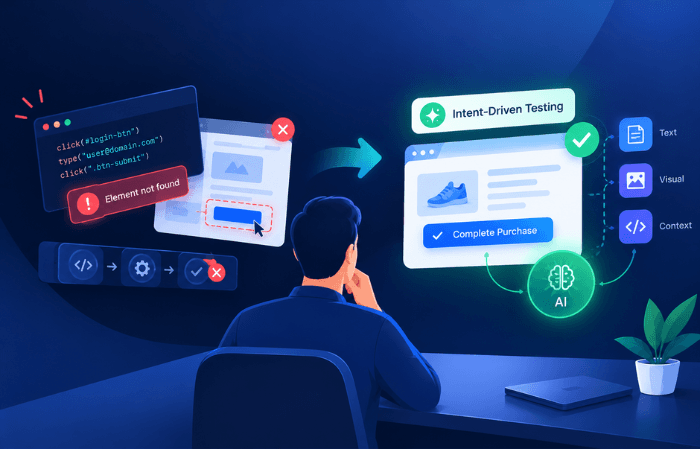
Every software team knows the pain of the 4:00 PM build failure. The application itself is perfectly fine, but a tiny layout update threw off an automated script, triggering a false alarm across the deployment pipeline.
The failure stems not from broken software, but from a brittle script losing its way. By tying validation to volatile implementation details, the QA industry has cornered itself. Teams frequently fall into "test theater," where rigid automation merely verifies that code executes exactly as written, rather than proving it fulfills the actual user objective.
Intent-driven testing re-engineers this dynamic by shifting validation from imperative scripting to declarative intent. Practitioners specify the target goal in plain text, and the runtime testing engine dynamically maps the execution path. For technical QA testing leaders, this transition systematically dismantles the structural inefficiencies crippling modern CI/CD pipelines.
The Imperative Dead-End: Quantifying the Maintenance Tax
The shift to intent-driven architecture is not a cosmetic trend; it is a fundamental need caused by operational inefficiencies in modern CI/CD systems.
The 40% Maintenance Tax: An industry research from Sauce Labs demonstrates that QA teams spend up to 40% of their working hours diagnosing flakiness, rewriting faulty selectors, and updating old scripts.
The Coverage Gap: Writing, debugging, and maintaining complicated UI scripts takes a huge human engineering effort. As a result, automated test coverage for complex user journeys generally maxes out at 35% or less.
Budget Allocation Dilemma: Companies spend 22-25% of overall IT Budgets on Quality Assurance (QA). Testing becomes an operational bottleneck when a large part of that capital is spent only to keep current tests alive, not to provide new coverage.
Declarative vs. Imperative Frameworks: The Technical Divide
Intent-driven testing is often confused with AI script generation, but the distinction is critical. Generating Playwright or Cypress code faster does not solve test fragility; it only produces brittle scripts at scale. True intent-driven frameworks abstract the mechanics of scripting away from the tester. The test definition is simply the expected outcome, leaving the execution path to be resolved dynamically during the run.
Technical Parameter | Imperative Automation (Script-Based) | Declarative Intent-Driven Testing (Agentic) |
|---|---|---|
Test Definition | Explicit coding of UI actions and element locations | High-level declaration of the business goal |
Execution Mechanics | Linear execution of precompiled code blocks | Runtime navigation determined by autonomous loops |
UI Resiliency | Fails if selectors, XPaths, or DOM structures change | Self-heals by evaluating the semantic meaning of the page |
Validation Metric | Syntactic equality (string matches, exact element presence) | Semantic correctness (fulfillment of user objective) |
Skill Barrier | High engineering overhead (SDET specialization) | Accessible across product, QA, and business teams |
The Mechanics of Multi-Modal Element Grounding
An intent-driven testing engine replaces static locators with continuous, real-time contextual loops. It treats the user interface as a dynamic environment to be navigated, rather than a fixed grid of coordinates.
Objective Ingestion & Prompt Validation
The engine processes incoming text or structured requirements (e.g., "Verify that a premium user can apply a 10% coupon code during checkout"). Before any action takes place, the engine runs an initial layer of prompt validation.
By scanning the input to ensure the target objective contains clear boundaries, identifiable success states, and valid operational constraints, this initial step prevents the autonomous agent from entering open-ended loops or executing ambiguous steps.
Multi-Modal Element Grounding
Instead of evaluating the application through a single, fragile lens like an XPath, the agent performs element grounding by synthesizing three distinct data streams simultaneously:
The DOM Tree Structure: Analyzing Tags, Hierarchies, and Properties.
The Accessibility (A11y) Tree: Leveraging semantic roles, names, and states designed for screen readers.
Visual Representation: Evaluating screenshots via computer vision models to understand spatial layouts and contextual groupings.
If a developer alters a button's class ID from .btn-submit to .cta-pay, the agent avoids failure. It recognizes that the element remains a clickable component within the payment container, retains the text label "Complete Purchase," and fulfills the step's exact functional intent.
Dynamic Execution Loops
Traditional scripts execute blind actions: they click a coordinate or selector regardless of what is happening on screen. An intent-driven agent utilizes an observation-action loop. It evaluates the current application state, decides on the next logical action to achieve the goal, executes it, and then re-evaluates the new state.
If an unscripted promotional modal or cookie consent banner interrupts the path, the agent identifies it as an obstacle, closes it contextually, and returns to the primary objective.
AI Test Validation & Semantic Correctness
The final validation phase completely shifts how assertions are made. Instead of simply checking whether an element exists or verifying a literal string match, the engine applies AI-driven test validation to ensure semantic correctness.
This means validating what the system achieved rather than just what text it returned. If a system under test outputs an account summary, the engine checks whether the displayed information logically satisfies the user's intent, catching subtle contextual errors, visual overlaps, and layout regressions that standard assertions ignore.
Strategic Enterprise Use Cases
Transitioning to a declarative testing architecture unlocks new operational strategies across complex software portfolios.
Unified Cross-Platform Journeys
Validating an omnichannel user journey such as initiating a transaction in a web browser, verifying it in an Android app, and completing it in an iOS app traditionally requires three separate automation frameworks, multiple toolchains, and distinct engineering skill sets.
Because intent-driven engines operate on semantic goals rather than implementation code, a single plain-text objective can be reused across platforms with platform-specific execution strategies. The runtime engine automatically adapts its element grounding patterns depending on whether it is parsing a desktop browser DOM or an iOS native UI view.
Resilient Data-Driven Validations
Testing workflows that involve wide variations in input data, such as international formatting rules, localized address variations, or diverse compliance structures, often force QA teams to construct large, static data tables.
Intent-driven agents can evaluate the intent of a form field and dynamically generate, inject, and validate appropriate data variations at runtime, expanding test coverage across edge cases automatically.
Contextual Performance and Load Infrastructure
True system reliability requires evaluating performance across the paths users actually take, not just the paths written into static scripts. Modern performance testing services leverage intent-driven agents to stress-test applications.
By allowing agents to dynamically navigate alternative pathways to achieve a goal during a load spike, engineering teams can uncover hidden API bottlenecks and concurrency deadlocks that linear scripts fail to trigger.
Mitigating Risk: Determinism, Guardrails, and Human Architecture
The primary concern among QA Directors and CTOs regarding autonomous testing agents is non-determinism. If an AI agent takes varying paths or exhibits unpredictable behavior across successive runs, it introduces flakiness back into the CI/CD pipeline, defeating the purpose of automation.
To build trust and stability, enterprise-grade software testing services use a hybrid architecture that establishes absolute deterministic guardrails around agentic flexibility. This reliability is achieved through three architectural pillars:
The Separation of Path and Assertion: While the testing agent retains full autonomy over how it discovers and navigates UI elements to achieve a goal, the success criteria and verification checkpoints remain completely fixed.
Strict Runtime Execution Checks: If the agent takes an alternative navigation route to reach a screen, the final validation does not rely on guesswork. For example, if a workflow requires that a transaction database must record a specific balance change, that checkpoint is enforced deterministically. If the database state fails to match the strict assertion rule, the test fails immediately.
The Evolution to Quality Architects: This shift redefines the role of the human testing engineer. Practitioners move away from writing repetitive selector code to focus on high-value strategy.
As explored in our analysis of human testing vs. AI testing, humans possess the unique domain intuition, product empathy, and security awareness necessary to construct intent boundaries, design verification rules, and optimize prompt validation strategies, while the AI engine handles the execution mechanics.
Implementing a Phased Enterprise Migration Path
No organization can afford to halt production processes to swap out thousands of obsolete regression tests. Moving to intent-driven testing demands a realistic, iterative implementation methodology to minimize the risk of deployment.
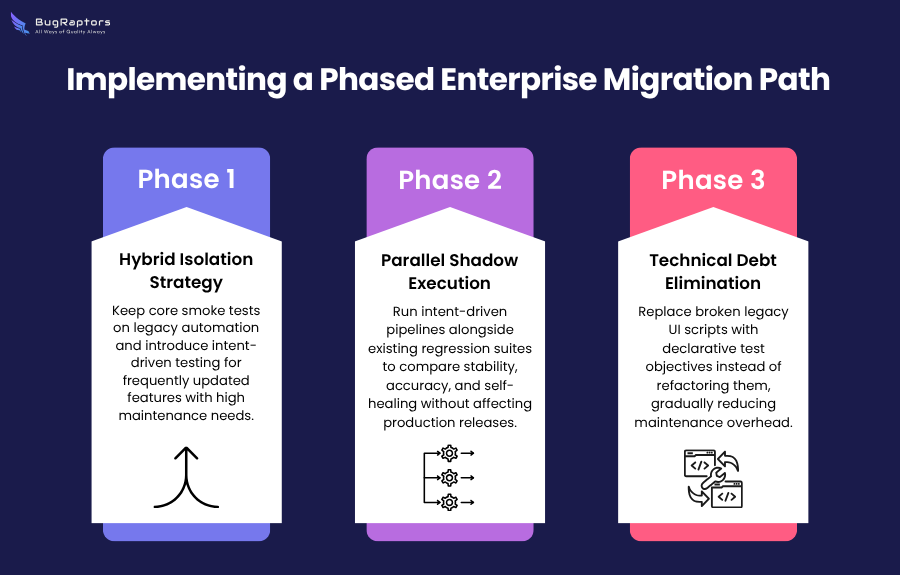
Phase 1: The Hybrid Isolation Strategy
Run your reliable, core smoke tests on your current legacy automation infrastructure. Introduce intent-driven testing frameworks just for fast-moving, high-frequency features where UI structures change frequently and human maintenance overhead is focused.
Phase 2: Parallel Shadow Execution
Run your intent-driven pipelines in parallel to historical regression suites in your CI/CD workflow. This allows teams to compare the agent’s stability, accuracy and self-healing metrics directly to historical scripts without modifying production release guardrails. This parallel execution is highly effective when managing complex, content-heavy systems, such as verifying semantic accuracy during RAG pipeline testing.
Phase 3: Technical Debt Elimination
As legacy UI scripts inevitably break with product updates, deprecate them rather than dedicating engineering hours to refactoring old code. Replace those broken blocks with declarative text objectives to systematically shrink your maintenance footprint over time.
Maximizing Operational Velocity with BugRaptors
Moving away from brittle, imperative scripts to objective-based testing workflows requires deep architectural engineering, robust guardrail deployment, and mature process integration. As a specialized global leader in software quality assurance, BugRaptors provides the expertise required to transition teams into next-generation testing models.
From integrating advanced AI testing services that validate semantic correctness to deploying resilient software testing services across complex enterprise platforms, BugRaptors ensures your validation infrastructure scales alongside your development velocity.

Prateek Goel
Automation Testing, AI & ML Testing, Performance Testing
About the Author
Parteek Goel is a highly-dynamic QA expert with proficiency in automation, AI, and ML technologies. Currently, working as an automation manager at BugRaptors, he has a knack for creating software technology with excellence. Parteek loves to explore new places for leisure, but you'll find him creating technology exceeding specified standards or client requirements most of the time.


