

Apr 21, 2026
RAG Pipeline Testing: How to Validate Retrieval, Context Use & Answer Accuracy
Large Language Models (LLMs) are impressive, but they are not without significant flaws. Their biggest hurdles are "knowledge cut-offs" where they cannot access information created after their training, and a tendency to "hallucinate" or confidently state false information. These models often struggle with the specific or real-time data that modern businesses rely on daily.
Recent benchmarks highlight the severity of this risk: even top-tier models can suffer from hallucination rates between 0.5% and 25% on specialized or technical data without grounding. Retrieval-Augmented Generation (RAG) addresses these limitations by connecting the AI to a dedicated, external knowledge base.
Research indicates that a properly implemented RAG system can reduce hallucinations by up to 71%, ensuring the AI stays current with your specific organizational data. However, simply connecting a database to an LLM does not guarantee accuracy. This is why RAG pipeline testing is the most critical stage of development.
You are no longer just testing a prompt; you are validating a complex ecosystem of data retrieval and synthesis. To move from an experimental tool to a reliable enterprise solution, organizations must implement a structured approach to verify every link in this chain.
Anatomy of a RAG Pipeline: Defining the Test Surfaces
A working RAG system is a modular design with each component having a defined role in the data lifecycle. This implies that the system cannot be regarded as one black box. Rather, we need to consider the points at which data is transformed, in particular, because every step opens up its own possibilities of failure.
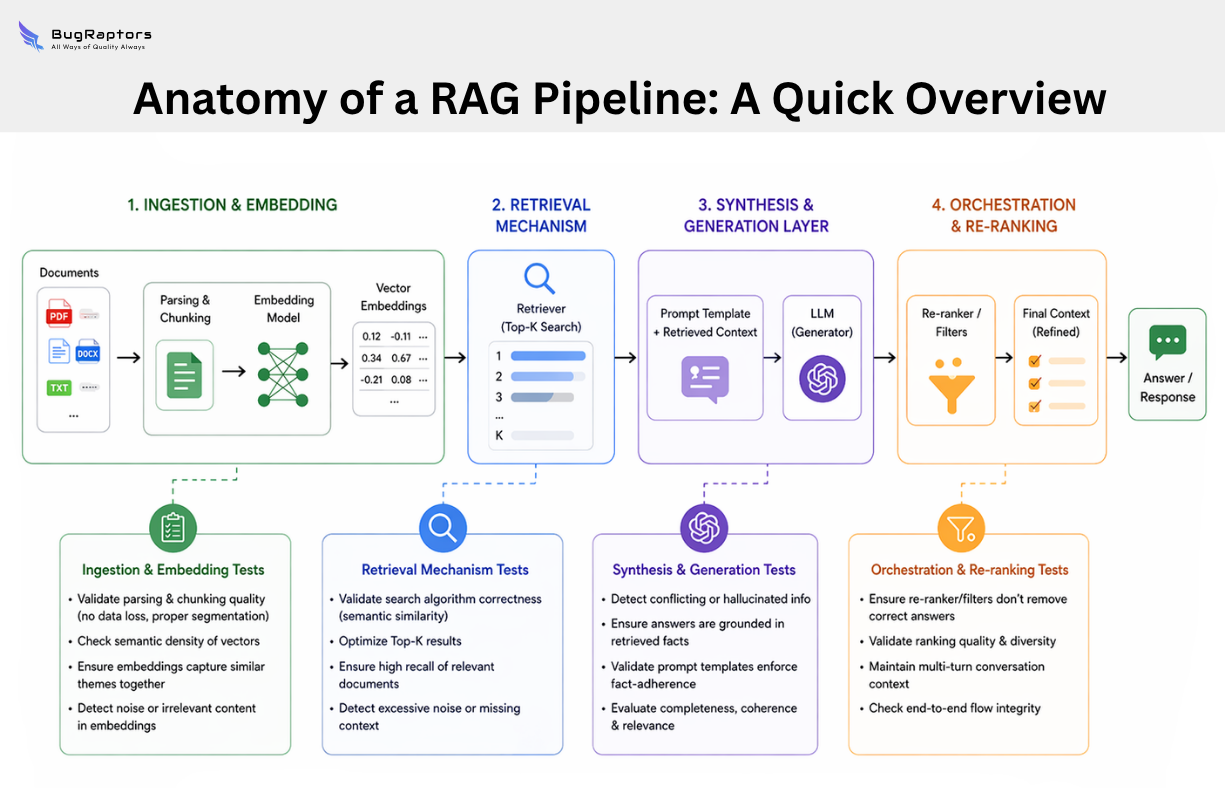
Ingestion and Embedding
Tests start with the parsing and chunking of documents. In this case, testing may be done by checking the semantic density of the vectors that need to be validated so that the embedding model can group comparable themes together.
The Retrieval Mechanism
It is the interface between the user's intention and knowledge. We use RAG testing to test the correctness of search algorithms and optimize Top-K results. When the system draws excessive noise, the model becomes distracted; when it draws too little, the answer will be incomplete.
Synthesis and Generation Layer
In this case, the LLM reads pieces of the text to construct an answer. We test the conflicting info of the model and ensure that "prompt templates" really make the model adhere to facts provided, which is a crucial aspect of the optimization of the LLM and not merely a creative idea.
Orchestration and Re-ranking
Contemporary systems tend to sieve search results prior to their arrival at the LLM. Test automation services based on AI can be used to ensure that these filters do not eliminate the correct answer and that the system can keep an eye on context in a conversation with multiple turns.
Understanding these surfaces is vital because, as we have explored in our look at why AI apps fail in production, the lack of component-level validation is often the primary reason for system collapse after deployment.
Testing the Retrieval Layer: Search and Relevance
The retrieval layer is the part of a RAG system that holds everything together. If the search tool finds data that isn't useful, is out of date, or is "noisy," the LLM will have a hard time giving a good answer, no matter how good its internal logic is. To validate this layer, you need to go beyond just matching keywords and look at how well the user's query matches the stored knowledge base in terms of meaning.
At this point, we need to use the Ragas framework to make sure high-performance requirements are satisfied while doing RAG testing. This means focusing on objective metrics that characterize search quality.
Contextual Relevance
This checks to see if the papers that were found are indeed beneficial for answering the user's inquiry. We check to see if the system is getting "filler" data or useful information.
Context Precision
This tells you the signal-to-noise ratio of the top $k$ chunks that were found. High accuracy keeps the LLM focused on the facts that matter and keeps it from being sidetracked by data items that don't matter.
Context Recall
This checks if the retriever found all the information required to address a complex query. If a user asks for a comparison and the system only finds one side of the argument, the recall is insufficient.
Testing these metrics allows a software testing company to offer tangible LLM optimization services. By analyzing retrieval failures, we can determine if the system needs a different chunking strategy, a more sophisticated embedding model, or a re-ranking step to prioritize the most vital information.
Testing the Generation Layer: Faithfulness and Accuracy
Once the retrieval layer delivers the correct data chunks, the final responsibility lies with the LLM to synthesize a clear and accurate answer. However, even with the right information, models can still fail by hallucinating or misinterpreting the context. Validating this stage is a cornerstone of RAG AI application development.
At BugRaptors, we look at the synthesis through a multi-dimensional lens to ensure "enterprise-grade" quality:
Faithfulness (Groundedness)
We verify if the answer is strictly based on the retrieved context. This is measured by the Answer Groundedness Score, which quantifies how well the response aligns with the source documents.
Answer Relevancy
This ensures the response actually addresses the question asked. A factually correct answer that misses the user's intent is still a system failure.
Answer Correctness & Hallucination Rate
We track the percentage of responses containing unsupported info (Hallucination Rate) and compare the output against ground-truth data to confirm factual accuracy.
Completeness & Conciseness
A professional output must cover all required aspects of the query without unnecessary verbosity. We test to ensure the response is clear, direct, and exhaustive.
By applying these AI application testing services, a software testing company can ensure the final output isn't just a fluent sentence, but a technically accurate reflection of the source data. This level of RAG testing is what transforms a generic chatbot into a reliable corporate tool that stakeholders can trust for critical decision-making.
Advanced Test Scenarios & End-to-End Evaluation
Although component-level measurements are crucial, there is also a need to have a production-ready system that can withstand real-world variability. High-quality AI application testing services should consider the situations when the happy path of a query fails. This is done by stress-testing the pipeline on noisy data and adversarial examples in a handful of technical perspectives:
Negative Rejection Validation
An effective RAG system should be smart enough to state "I don't know" if it doesn't know the answer. We also pretend that we are asking an Out-of-Distribution query so that the model is not tempted to give in and hallucinate an answer.
Semantic Drift Monitoring
As your knowledge base expands, the vector space becomes more crowded, which can lead to "False Positives" in retrieval. Continuous RAG testing helps identify when a previously accurate system begins to degrade due to data volume or overlapping topics.
Operational Benchmarking
Accuracy is only one part of the equation. We measure the trade-off between retrieval depth and total latency. Tracking "Time to First Token" (TTFT) ensures the system balances factual depth with the speed required for a professional user experience.
Adversarial Resilience
To determine which source data is most reliable, we test the system's capability to disregard “so-called distractor" chunks of information. These are semantically similar to the query but are factually inaccurate.
The RAG Evaluation Stack (Tools & Tech)
To scale RAG pipeline testing, you must leverage a specialized stack of tools that automate the collection of the metrics we've discussed. These tools generally fall into three categories: automated scoring libraries, observability platforms, and synthetic data generators. The most widely adopted tools in current AI-powered test automation services include:
Ragas & DeepEval
These are the main models used to compute the RAG Triad. Ragas is better at research-supported retrieval scoring, and DeepEval offers a "unit-testing" methodology, which can be integrated directly into CI/CD pipelines, which is more convenient to developers to identify regressions early.
Arize Phoenix & LangSmith
In the case of LLM optimization services, there can be no observability. Visualizing embeddings and finding clusters of failed queries is done well by Arize Phoenix, whereas deep tracing is provided by LangSmith to reveal which part of a document resulted in a particular hallucination.
G-Eval & Luna-2
These are the LLM-as-a-Judge patterns. With models of high-reasoning (such as GPT-5 or specialized models of Luna) to score the output of smaller production models, we can scale high-speed, cost-effective evaluation.
Promptfoo
This is an essential red-teaming and security tool. It enables us to execute adversarial test cases to make sure the RAG pipeline does not leak sensitive information or fall prey to immediate injection through documents recovered.
Strategic Outlook: Filling the RAG Testing Gap
In 2026, about 40-60% of implementations of RAG do not go beyond the pilot phase, not due to lack of features, but due to "Reliability Gaps." At BugRaptors, we are aware that the market does not have a common point of reference in domain-specific RAG performance, where one-size-fits-all evaluation fails to capture the fine details of specialised industries. Our strategic direction is based on three pillars:
Standardizing the Evaluation Lifecycle
We shift from anecdotal evidence to empirical "Golden Datasets." We achieve this by making sure that RAG testing is a proactive quality driver and not an afterthought by ensuring that clear and measurable KPIs are defined prior to the commencement of development.
The Transition to SLMs
Although massive LLMs are well-suited to general reasoning, they can be excessive when it comes to specific corporate tasks. Our clients are making the transition to SLMs in QA, using the services of LLM optimization. These models have superior accuracy, lower cost, and faster inference times when combined with an optimally tuned RAG pipeline.
Human-in-the-Loop Governance
Automated measures are essential, although they cannot substitute for the work of experts. Our AI testing services are a combination of automated scoring and human-managed validation to identify the slightest mistakes in logic that machines may miss.
Conclusion
RAG pipelines represent the future of business intelligence, but their success depends entirely on the rigor of their validation. Moving beyond simple prompts to test the entire data ecosystem, from embedding density to agentic reasoning, is how you transition from experimental tools to enterprise-grade reliability.
To secure your GenAI investment, begin by auditing your retrieval metrics and establishing "Golden Datasets" that reflect your actual production environment. Whether you are refining a legacy system or building new RAG applications, the priority must remain on factual grounding and architectural robustness.
Don't let hallucinations and retrieval errors undermine your GenAI investments. Get in touch with our experts to get specialized testing frameworks and technical expertise required to turn "black box" models into transparent, high-performing corporate assets.

Sandeep Vashisht
Mobile, Web Testing
About the Author
Sandeep Vashisht is the Manager – Quality Assurance at BugRaptors. With experience of more than 15 years, Sandeep specializes in delivering mobile, web, content management, and eCommerce solutions. He holds a strategic QA vision and has the ability to inspire and mentor quality assurance. He is an expert with a grip on project plan development, test strategy development, test plan development, test case & test data review.


