

May 18, 2026
Proven QA Practices for Healthcare Platforms: Built for Real-World Complexity and Scale

Healthcare IT systems operate in environments where even a minor failure can create clinical risks and regulatory consequences. Modern healthcare ecosystems depend on microservices, legacy databases, and multiple third-party integrations, creating vulnerabilities that traditional testing approaches often fail to detect.
Engineering teams are managing sensitive information at high-velocity, ensuring that a failed connection or a missed rule never gets in the way of patient treatment. This calls for a holistic approach to verification of data integrity, API contracts, and performance of the system under severe concurrency.
At BugRaptors, we see healthcare software testing as an extension of clinical safety. We help healthcare platforms bridge the gap between innovation and the production-grade reliability modern medicine demands.
Why Quality Assurance is Non-Negotiable in Healthcare
In medical technology, the margin for error disappears because software performance correlates directly with patient safety. When platforms manage e-prescriptions or diagnostic AI, a logic flaw is no longer a technical glitch; it is a clinical risk that can lead to medication errors or misdiagnosis. The following are the reasons why we need full-fledged quality engineering:
Patient Safety is the Bottom Line
When a drug-drug interaction alert doesn't fire after a data sync issue, it’s not simply a technical failure. It’s a hazard to human life.
The Cost of Non-Compliance
Regulatory requirements like HIPAA, SOC2, and state-specific laws call for more than a secure server; they call for a verified procedure that verifies that data is uncorrupted and private.
Preserving Provider Trust
Clinicians already operate in high-pressure environments. Slow or inconsistent data from a platform forces providers to resort to manual workarounds that defeat the digital transformation aims of the enterprise.
Scale Without Chaos
As healthcare platforms expand to handle millions of records, minor logic flaws that were invisible at a small scale can trigger systemic outages.
Systematic Quality Protocols for Medical Ecosystems
To bridge high-level industry challenges with technical execution, we must look at the specific engineering layers that define a clinical-grade ecosystem. Securing a platform against architectural vulnerabilities requires a systematic validation of the data pipelines, state logic, and integration protocols that form the backbone of modern medicine.
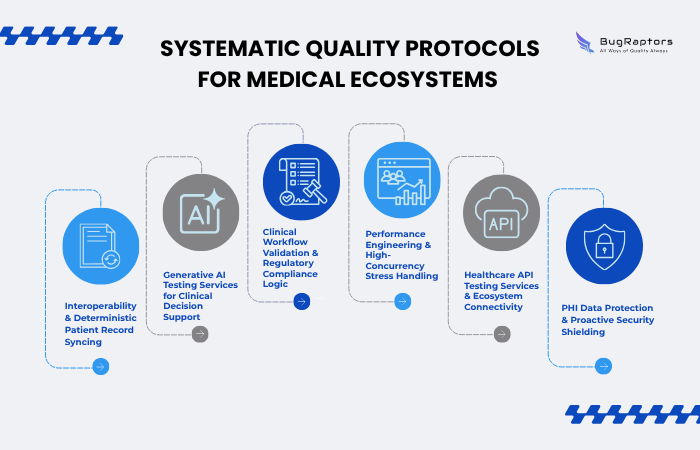
The following framework outlines the core technical pillars required to move a healthcare platform from basic functionality to production-grade resilience.
1. Interoperability & Deterministic Patient Record Syncing
Aggregating patient records from disparate clinics requires precise algorithmic handling to avoid data entropy. When data arrives from multiple sources, it often carries conflicting identifiers. For instance, a medication history system might receive pharmacy data using mismatched schemas for National Drug Code (NDC) identifiers. If deduplication logic is non-deterministic, the system risks failing to recognize life-threatening drug-drug interactions. Unverified merges that drop historical data or create duplicate profiles are significant liabilities for any software testing company tasked with securing sensitive health data.
QA Approach
We utilize standards-compliant mock servers for the deterministic simulation of multi-source merges. Engineers test exact parsing rules against HL7 and FHIR payload structures to verify correct identifier mapping. For legacy systems with conflicting schemas, we deploy targeted scripts to intercept payloads, inject malformed data, and validate the application's error-handling and data-recovery routines.
Real-World Impact
Applying this methodology during our medication history system QA testing engagement allowed our team to isolate structural flaws in the data aggregation pipeline. By testing the boundaries of deduplication algorithms, we reduced medication data inconsistencies by 30%.
2. Generative AI Testing Services for Clinical Decision Support
Intelligent medical systems that predict patient outcomes or suggest contraindications require a non-traditional testing paradigm because functional automation cannot evaluate probabilistic outputs. The risk with clinical AI lies in "hallucinations" or factual deviations where a mathematically perfect vector alignment in an LLM might still result in a fatal dosage recommendation. Relying on linguistic similarity metrics like BERTScore provides quantitative insight but does not guarantee clinical safety.
QA Approach
Specialized AI testing services require Rigorous Model Validation Testing (MVT). We feed thousands of clinical cases into algorithms and measure accuracy, precision and recall by scoring outputs against predicted medical baselines. We have review workflows that include a combination of automated semantic tests and tight human-in-the-loop checks to assure factual conformity with curated and validated medical datasets.
Real-World Impact
With MVT frameworks, we empower health care professionals to confidently implement AI-powered triage and diagnostic solutions. This keeps intelligent systems anchored in medical reality, avoiding unvalidated claims or biased results from reaching the point of treatment.
3. Clinical Workflow Validation & Regulatory Compliance Logic
Clinical workflows function as complex state machines where failures often occur during the "hand-off" between authorization gates. Before fulfillment of an e-prescription, it must be verified by physician identity verification, allergy cross-checks, and pharmacy network handshakes. A latency issue in a credentialing database might leave a prescription in a “pending” condition with no indication to the user, creating a serious clinical blind spot. Embedding these compliance checks in the program results in monolithic liabilities that are difficult to update when rules change.
QA Approach
Teams need to use continuous automation testing services that plug the dynamic compliance matrices directly into the regression suite. Engineers may use behavior-driven development (BDD) frameworks such as Serenity to test end-to-end handshakes based on simple language clinical principles. These scripts imitate the precise multi-factor authentication procedures required by EPCS, so silent data transfer failure is avoided.
Real-World Impact
This technique has worked quite well for us in our deployment of e-prescription software QA testing. We mapped the automation testing framework directly to state compliance standards and achieved 100% synchronization success rate for Surescripts integrations.
4. Performance Engineering & High-Concurrency Stress Handling
Healthcare systems are expected to operate reliably at an extreme scale, yet typically suffer from severe impasse situations during the shift from low to high number of users. Monday mornings often have huge traffic increases in clinical environments, as physicians log in at the same time, and pharmacies are processing weekend refill requests. When the infrastructure cannot cope with such unanticipated bursts, system-wide disruptions happen during the most important hours of clinical operation.
QA Approach
Our engineers replicate these stressful conditions by simulating high volumes of electronic health record (EHR) transactions across the application using distributed load-generating networks. We can see exactly what thresholds cause databases to start throttling queries, tracking CPU thread contention, and database lock escalations. The telemetry helps us enhance backend performance before launch.
Real-World Impact
Effective healthcare software testing procedures focused on load degradation have kept major healthcare portals up and running during peak enrollment periods, preventing outages. Early identification of infrastructure bottlenecks allows for constant system responsiveness at 10x typical traffic levels.
5. Healthcare API Testing Services & Ecosystem Connectivity
The external connectivity of modern medical platforms functions as an aggregator of third-party services, making the application layer entirely dependent on integration stability. A simple timeout from an insurer’s eligibility endpoint can block an entire provider queue. Standard testing often ignores the nuances of payload structure, but in a regulated environment, a change in an external pharmacy database’s API can break a release if the system cannot handle the new schema.
QA Approach
A comprehensive API testing solution must go beyond just looking for an HTTP “200 OK” status. We have stringent contract testing across microservices to make sure that the JSON schemas are in line. Load-generating tools to mimic connection pool depletion to verify that the core program properly handles deteriorating external dependencies, such as delivering explicit fallback messages rather than crashing the system.
Real-World Impact
Verifying payer engine rules and coverage mapping under simulated traffic spikes exposed critical database bottlenecks in our healthcare drug coverage QA testing initiative. Resolving these barriers enabled near-immediate copay computations for providers and patients.
6. PHI Data Protection & Proactive Security Shielding
Medical platforms are prime targets for sophisticated data interception and ransomware. Securing protected health information (PHI) requires more than just a firewall; it requires continuous vulnerability scanning embedded directly into the software development lifecycle (SDLC). Common risks include injection vulnerabilities in raw source code, authentication bypass methods in the running environment, and accidental data leakage between different clinics in a multi-tenant architecture.
QA Approach
Quality engineering teams run Static Application Security Testing (SAST) against source code and Dynamic Application Security Testing (DAST) on the live application. We verify that all data remains encrypted at rest via AES-256 and in transit via TLS 1.3. Furthermore, we conduct strict multi-tenant isolation audits to confirm that database queries from one organization can never return another organization's patient records.
Real-World Impact
By integrating security validation into the deployment pipeline, we ensure that platforms remain compliant with HIPAA, HITECH, and SOC2 frameworks. This proactive shielding has protected millions of patient records from unauthorized access during routine system updates and third-party integrations.
Automated Quality Pipelines via Shift-Left QA
Modern medical systems demand zero-fault-tolerance, which means quality engineering cannot be the last gate. It has to be incorporated into the very fabric of the development lifecycle. The most successful teams in the healthcare area are those that have shifted from sporadic testing cycles to continuous, automated validation.
Ephemeral Testing Environments and IaC
False positives are common in medical software validation in standard static contexts due to configuration drift. Infrastructure-as-Code (IaC) creates an ephemeral test environment for every change. These ideal and isolated settings let our automated testing services to be executed against a clean database state, so findings are repeatable and not affected by past test cycles.
Real-Time Feedback Loops
Adding healthcare software testing to the CI/CD pipeline allows you to catch logic errors in medication coverage rules or e-prescription state transitions as soon as they are written. This “shift-left” approach significantly reduces the chances of buggy code reaching into the main branch, which ultimately decreases the “mean time to detect” (MTTD) of serious vulnerabilities.
The Strategic Value of Engineering Discipline
Quality engineering is the ultimate line of defense for patient safety and data integrity. It needs a systematic process that covers data formatting, state transitions, API testing services, and algorithmic models. Yashu Kapila, CEO of BugRaptors, reinforces this approach:
“Quality engineering in medical technology is a direct extension of patient care. In this space, we have to recognize that behind every line of code is a human life. Unverified software logic and untested edge cases carry the same weight as a clinical error; a technical oversight in a medical platform can compromise diagnostic accuracy or delay life-saving treatment. We are building a culture of accountability where software reliability is synonymous with clinical safety.”
Partnering with an experienced software testing company provides the technical scaffolding engineering teams need to expand high-availability systems. Secure and dependable medical apps are built on thorough testing of data pipelines, integration points, and clinical algorithms. Ultimately, proper healthcare software testing guarantees that innovation never comes at the expense of human health.

Vivek Rana
Manual & Automation Testing
About the Author
With rich experience of more than 10 years in the industry, Vivek Rana is a QA enthusiast working as a Team Lead at BugRaptors. Starting his journey as a system Analyst, Vivek over the years not only developed a strong grip on manual and automation testing services in different domains and different testing types but also ensures the release of quality of software products and system and manage software test teams. His fun-loving approach and whole-hearted dedication make him a perfect team player. He is a highly driven expert to improve the QA process and loves to travel to mountains escaping the city hustle and bustle whenever he longs for some leisure.


