

Sep 29, 2026
How to Build an Effective Database Testing Strategy for Reliable Releases
Green build pipelines lie. Your automated unit suites can execute without a single failure, API contracts can validate cleanly, and browser regression sweeps can pass with pristine checkmarks. Yet the moment a release hits production, software must interact with state.
A single unindexed foreign key, an overlooked lock escalation on a high-throughput table, or an uncalibrated default constraint will bring an entire platform to a halt while your CI dashboards remain reassuringly green.
Modern engineering organizations have mastered stateless test automation, but persistent storage remains a costly blind spot. Moving past emergency rollback bridges requires embedding disciplined database testing across every stage of the software delivery lifecycle.
Moving Beyond the API Layer: What Actually Breaks in Production
A common architectural misstep among modern delivery teams is verifying databases exclusively through application programming interfaces.
The assumption seems reasonable enough: if an HTTP POST endpoint creates a record and a subsequent GET request returns a 200 OK, the persistence tier is presumed healthy. In high-concurrency systems, this abstraction hides catastrophic data rot:
Silent Truncation & Coercion: ORMs routinely mask field overflows, dropped microsecond timestamps, or misconfigured nullables, leaving corrupted records in storage.
Orphaned Relational State: Omitting foreign key constraints to speed up development produces parentless records that bloat indexes and trigger downstream runtime exceptions.
Concurrency & Deadlocks: Single-threaded staging rarely catches lock contention. Under concurrent workloads, uncalibrated transaction isolation triggers race conditions, balance overwrites, or sudden deadlocks.
Executing direct database testing evaluates structural constraints, stored logic, and ACID compliance independently of the API layer, catching persistent corruption before it reaches production.
Automating Database Testing: Managing Stateful Architectures in CI/CD
Stateless application testing is simple: boot a container, run assertions, and destroy the environment. Databases, however, are stateful. Historically, this statefulness made continuous validation slow, unstable, and prone to cross-test pollution.
Solving this bottleneck requires modern automation testing services that incorporate data-layer validation directly into build pipelines:
Ephemeral Containerization
Testing against shared, persistent staging databases creates unpredictable builds and false positives. Modern delivery workflows resolve this by provisioning ephemeral database containers on demand using tools like Testcontainers. Every continuous integration runner spins up an isolated, dedicated database instance that runs schema migrations, executes assertions against fresh state, and tears down in seconds upon completion.
Synthetic Test Data Orchestration
Relying on scrubbed copies of production databases introduces major regulatory liabilities under GDPR, HIPAA, and PCI-DSS, while masking extreme boundary cases. Progressive engineering organizations implement enterprise autonomous testing frameworks that dynamically synthesize production-like datasets. These engines parse schema definitions to generate thousands of structurally sound records, injecting character boundary extremes, null values, and complex parent-child hierarchies without exposing sensitive consumer records.
Deterministic State Verification for Modern Pipelines
As applications integrate automated workflows, background workers, and machine learning components, persistent data serves as the final arbiter of truth. When evaluating multi-step processes or conducting LLM output evaluation and hallucination detection, checking UI output alone is insufficient. Asserting the exact database mutation provides empirical proof that business logic executed correctly and persisted data according to established domain rules.
Database Migration Testing: The Blueprint for Zero-Downtime Releases
Enterprise engineering teams deploy updates multiple times a day, yet schema changes remain high-anxiety events. A misconfigured migration script can lock core tables during peak traffic, break backward compatibility for active microservice pods, and trigger extended outages. Rigorous database testing during schema transitions ensures changes deploy predictably without service interruption.
To ensure zero-downtime releases, migration scripts managed through engines like Flyway or Liquibase must clear structured verification phases prior to deployment:
The Expand-and-Contract Pattern
Destructive schema updates must never occur within a single deployment window. Multi-phase migrations decouple schema changes from application updates:
Expand: The migration introduces new columns, tables, or indexes as nullable fields or with safe defaults.
Parallel Run: Automated integration suites verify that both the active application version (V1) and the pending release (V2) execute concurrently against the shared schema without exceptions.
Contract: Once all instances run V2 cleanly, a secondary cleanup script removes the obsolete, deprecated columns without service disruption.
Automated Forward and Rollback Validation
Every forward migration script committed to source control requires an automated rollback test. Continuous delivery pipelines execute the forward migration (migrate up), validate structural integrity, execute the corresponding rollback (migrate down), and re-assert the baseline schema. If a rollback fails or leaves dangling constraints, the pipeline blocks the pull request immediately.
Strategic Test Review Gates
Automated checks catch syntax errors and missing primary keys, but they cannot assess whether a migration aligns with broader business operations. Aligning automated test suites with experienced domain oversight prevents structural data loss during major cross-system cutovers. Balancing automated execution with expert engineering reviews—as outlined in our breakdown of human testing vs AI testing ensures mission-critical migration plans receive the technical scrutiny they demand.
Database Performance Testing: Concurrency, Contention, and Latency
A query that completes in two milliseconds on a developer machine can paralyze a system when run fifty thousand times a minute under real user concurrency. Incorporating dedicated performance testing services into your release pipeline uncovers query degradation and throughput limits before code enters production:
Performance Bottleneck | Underlying Cause | Profiling & Verification Strategy |
|---|---|---|
Index Contention & Full Scans | Missing composite indexes; uncalibrated cardinality | Profiling EXPLAIN ANALYZE plans under load; blocking unindexed queries on large tables. |
Connection Pool Exhaustion | Unbounded connection allocation; transaction leaks | Stressing pool capacity with distributed traffic spikes to identify connection starvation. |
Lock Escalation & Deadlocks | Conflicting isolation levels; out-of-order write loops | Running concurrent multi-row write transactions to isolate lock wait timeouts. |
Buffer Cache Eviction | Inefficient pagination; unbounded SELECT * queries | Tracking disk read spikes and buffer pool hit ratios during sustained data access. |
Specialized performance testing services ensure that indexing strategies, connection pools, and query execution plans are stressed under peak simulated traffic, preventing catastrophic latency spikes during major business events.
Integrating Database Verification into DevOps Pipelines
Reliable releases require making data-tier verification a standard phase within continuous delivery pipelines. Leading teams integrate end-to-end DevOps testing services to embed automated schema validation, migration dry-runs, and regression suites directly into daily developer workflows:
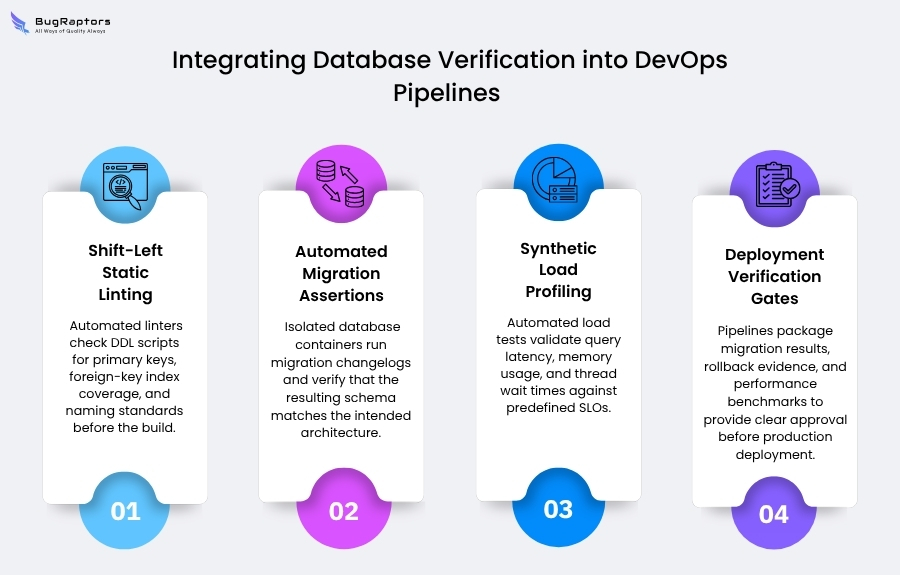
Shift-Left Static Linting: When an engineer opens a pull request, automated linters inspect DDL scripts against corporate database standards, checking for primary keys, foreign key index coverage, and consistent naming conventions before any build occurs.
Automated Migration Assertions: Pipeline runners boot isolated database containers, run migration changelogs sequentially, and confirm that the resulting schema matches the intended architecture.
Synthetic Load Profiling: Automated suites execute high-throughput transactional load tests, validating that query latency, memory utilization, and thread wait times stay well within predefined Service Level Objectives (SLOs).
Deployment Verification Gates: Continuous pipelines package migration telemetry, rollback receipts, and performance benchmarks into build artifacts, providing engineering leads with clear sign-offs before production deployment.
Pairing automated pipelines with broader digital assurance services guarantees that schema changes uphold data security, regulatory compliance, and cross-platform integrity across every tier of the enterprise stack.
Establishing Release Predictability with BugRaptors
The persistence tier’s stability is directly proportional to sustainable delivery velocity. Fast feature velocity without vetting underlying data structures lets technical debt sneak in under the hood, eventually creating production outages, unindexed query bottlenecks, or unsuccessful schema migrations.
By making database testing a core engineering practice, high-risk deployments become predictable, non-eventful releases. Automated schema linting, containerized test instances, zero-downtime migration methods, and proactive query profiling all come together to give software firms the confidence to scale platforms rapidly.
BugRaptors helps enterprise teams reach this level with specialized quality engineering approaches. Our experts partner with delivery teams to build automated schema-validation gates, organize privacy-compliant synthetic datasets, and protect transactional integrity across complex distributed systems. BugRaptors delivers fast releases without compromising data dependability, supported by organized DevOps testing services.

Girish Chawla
API, Database, Mobile, Manual & Security Testing
About the Author
Girish is Principal Consultant working at BugRaptors. He has experience in API Testing, Database Testing, Mobile Testing, Manual Testing, Application Testing, Security Testing, GUI Testing, and having deep understanding of all aspects of SDLC, STLC, Agile.


