

Oct 30, 2026
AI Observability in Production: How It Secures Modern Agent Workflows

Traditional software monitoring builds reliability by tracking uptime, latency, and error rates. As artificial intelligence moves into core enterprise operations, establishing robust observability in AI becomes essential to measure what systems do once live, moving far beyond basic prediction accuracy and server health.
Modern non-deterministic models and autonomous AI agents act rather than just predict. They execute multi-step workflows: querying databases, evaluating context, executing APIs, and triggering downstream actions. Watching surface-level metrics is no longer sufficient when an autonomous component can execute an unreviewed, real-world action.
Comparing Monitoring Paradigms Across System Layers
Monitoring Dimension | Traditional System Monitoring | Standard ML Monitoring | Deep Decision-Tracing AI Observability |
Primary Focus | Server health, uptime, CPU and memory usage | Model output accuracy, latency, endpoint errors | Step-by-step reasoning, context retrieval, tool execution, action verification |
Scope of Coverage | Infrastructure and network layers | Static input features and final output metrics | Multi-step agent chains, data access paths, decision logic, system-wide lineage |
Diagnostic Capability | Detects system crashes and traffic spikes | Identifies quality decay after outputs degrade | Traces upstream logic failures to exact execution steps before user impact |
Actionable Outcome | Alerts infrastructure teams to scale resources | Flags models needing scheduled retraining | Intervenes in real time, pauses rogue workflows, isolates flawed context sources |
Achieving comprehensive observability in AI requires moving past output monitoring to full decision tracing. Peeling back execution layers allows organizations to analyze reasoning pathways, verified context, tool calls, and subtle behavior shifts before flawed decisions reach an end-user.
The Blind Spot of Surface-Level Metrics in Modern AI Workflows
Evaluating an AI system purely by its final output creates a dangerous false sense of security. A model can return a statistically acceptable response or a high confidence score while relying on flawed, hallucinated, or biased internal logic.
Consider a financial services agent processing credit limit adjustments. If the system approves a request, a standard monitoring tool marks the transaction as successful based on latency and payload completion. However, if the decision resulted from an incorrect vector retrieval step that accessed outdated policy documents, the underlying logic remains flawed.
Output-only evaluation misses the structural vulnerability entirely, leaving the organization exposed to systemic risk that compounds over time. Understanding system behavior requires instrumenting three specific stages of the operational flow:
Data Ingestion and Context Retrieval: Modern enterprise applications rely heavily on external knowledge bases. Implementing robust RAG application development grounds generative models in accurate internal data. Observability at this layer verifies vector search relevance, chunk retrieval accuracy, and context fidelity, ensuring the model receives correct inputs before generating a response.
Reasoning Steps and Intermediate Logic: Between receiving an input and taking an action, an agent breaks complex objectives into sub-tasks. Decision tracing monitors these internal execution paths, evaluating prompt performance, chain-of-thought logic, and decision gates to detect logic loops or prompt injection vulnerabilities.
Tool Execution and Downstream Actions: When an agent invokes external tools, such as firing an API call, executing a database write, or initiating a customer refund, the observability layer captures the exact payload, target system, and authorization state. This ensures every action aligns strictly with enterprise policy boundaries.
Research across machine learning deployments indicates that 91% of production models experience performance degradation over time due to unmonitored shifts in real-world data distributions and environment variables. Without deep decision tracing, identifying the root cause of that degradation becomes an exercise in manual speculation.
Core Dimensions of AI Observability Below the Surface
Achieving complete operational visibility requires evaluating AI systems across four internal dimensions rather than relying on high-level availability dashboards.
Decision and Reasoning Tracing
When an AI system generates a complex output, quality teams need visibility into why that conclusion was reached. Decision tracing captures prompt assembly, retrieved documents, model parameters, and step-by-step intermediate thoughts. Incorporating feature attribution methodologies converts black-box inference into auditable logic paths. This level of auditability allows internal review teams to verify that decisions stem from sound domain logic rather than statistical artifacts.
Detecting Signal and Output Drift Early
Production environments change. Live inputs are inherently different from the original baseline training data in statistical aspects.
Data Drift: Happens when the input distributions drift over time, e.g., owing to external variables such as changing user language, market conditions, or changes to upstream data pipelines.
Concept Drift: Occurs when the mathematical relationship between input features and target variables shifts, resulting in incorrect inferences about the real world based on previously accurate model patterns.
Behavioral Drift: Like autonomous processes, behavioral drift manifests as small changes in how an agent builds tool payloads, executes multi-step plans, or responds to unexpected edge events.
Modern observability in AI systems regularly calculates drift scores, warning engineering teams as soon as distribution alterations endanger the dependability of output.
Flawed Feedback Loops and Model Staleness
User interactions are typically part of the training or retrieval repositories in autonomous learning systems. If a model delivers a marginally skewed or erroneous response that is consumed again as legitimate context, the defect is compounded exponentially in future processes. Continuous observability enables early detection of feedback loop corruption and triggering of automated retraining based on degradation of observed performance, rather than an arbitrary calendar date.
Data Access, Ethics, and Policy Posture
Current regulatory landscape, including the EU AI Act, NIST AI Risk Management Framework, and upcoming industry security baselines, demand tight control of automated decision systems. Observability solutions monitor data access events in real time and ensure that model instances do not return Personally Identifiable Information (PII) or query data storage outside of their authorized levels.
Managing Observability Overhead: Telemetry Sampling and Retention
Capturing every detail of an AI pipeline introduces networking overhead, token costs, and storage expansion. Unmanaged full-text span logging increases operational infrastructure costs significantly in high-throughput production environments. Enforcing structured telemetry retention policies maintains complete visibility while containing resource consumption.
Telemetry Payload and Resource Allocation Framework
Sampling Tier | Target Traffic Volume | Captured Telemetry Payload | Latency Impact | Storage Overhead |
High-Value Transactions | 100% of Financial or Admin Operations | Full Spans, Prompts, Vector Chunks, Arguments | Minimal (+12ms to +18ms) | High |
Standard Production Workflows | 5% to 10% Uniform Random Sampling | Token Counts, Latency, Similarity Scores | Negligible (+1ms to +3ms) | Low |
Anomaly and Drift Triggers | 100% upon Threshold Breach | Context Snapshots, Full Call Traces, State Logs | Event-Driven (+15ms) | Variable |
Asynchronous Telemetry Exporting
Synchronous telemetry transmission stalls inference pipelines. Transmitting trace spans to collectors requires non-blocking background workers. Thread pools queue span records in memory, flushing batches at defined intervals to isolate main execution threads from network latency.
Adaptive Tail-Based Sampling
Head-based sampling decides whether to log a trace at initialization, frequently dropping critical failure records. Tail-based sampling evaluates the entire execution path in a memory buffer before making a retention decision:
Deterministic Metric Collection: Always emit lightweight numeric counters like token usage, latency, similarity scores, and status codes.
Trace Payload Retention: Store raw prompt text, vector embeddings, and tool arguments for a fixed baseline percentage of successful runs.
Error-Driven Fallback: Retain complete trace data whenever an exception occurs, a similarity score drops below safety thresholds, or a tool schema validation fails.
Giving QA and Development Teams Visibility Below the Surface
Building trustworthy enterprise systems requires integrating visibility mechanisms directly into engineering and testing workflows. Robust observability in AI gives development teams the diagnostic clarity needed to maintain reliability across non-deterministic systems.
Empowering QA Beyond the Black Box
Quality assurance in classical software relies on predictable, deterministic inputs yielding fixed outputs. AI applications break this paradigm through probabilistic responses. Software evaluation strategies must shift toward specialized AI testing services that assess probabilistic outcomes, safety guardrails, and behavioral boundaries under load. As systems scale in autonomy and complexity, exploring frameworks for AI testing AI becomes vital for deploying automated meta-evaluators and synthetic supervisors that continuously audit other models for hallucinations, bias, and policy drift.
Deep decision tracing gives testing teams the exact execution state associated with a failure. When an agent produces a hallucinated answer or invokes an improper tool call during regression testing, QA engineers do not need to guess what failed. They examine the exact decision trace to isolate whether the root cause was a poorly parsed retrieval chunk, an ambiguous system prompt, or an unhandled edge case in tool response schema.
How BugRaptors Drives Quality Engineering Operations
Integrating continuous observability in AI into CI/CD pipelines requires specialized quality engineering services. BugRaptors serves as a strategic quality partner, building automated validation hooks and custom testing frameworks that evaluate model behavior across the entire lifecycle:
Synthetic Edge-Case Injection: Stress-testing decision boundaries using adversarial inputs to ensure safety filters activate correctly.
Pre-Deployment Behavioral Baselining: Generating initial execution traces across standardized benchmark datasets to set baseline thresholds for latency, token usage, and accuracy.
Automated Policy-as-Code Enforcement: Embedding automated validation rules that evaluate every live tool call against defined enterprise policy rules.
How Do Runtime Policy Engines Enable Active Interventions in AI Workflows?
Logging traces and alerting on metric breaches is fundamentally reactive. When autonomous agents operate across critical business systems, observability in AI tools must integrate directly with policy engines to pause or reroute execution paths in real time.
Policy-as-Code Enforcement
Policy engines evaluate incoming tool call payloads against security rules before execution occurs on target systems. If an agent attempts a transaction that violates security boundaries, the policy engine intercepts the execution span, blocks the call, and returns a structured error to the agent loop.
Active Intervention Mechanics
Linking tracing data to runtime control gates allows for three active risk containment strategies:
Automated Circuit Breaking: If an agent’s error or hallucination metrics of an agent surpass a defined threshold over a rolling time window, the agent’s access to its external tool is disabled.
Human-in-the-Loop Rerouting: Stop execution and forward retrieval requests with low confidence to human operators before mutating the database.
Fallback Strategy Execution: Switch to a deterministic, rule-based microservice for execution if input drift signals beyond safety limits are detected by autonomous agent.
Key Features to Evaluate in an AI Observability Platform
Choosing the right solution depends on the platform capabilities relative to the complexity of the production environment. Engineering teams doing AI observability should look for solutions that offer:
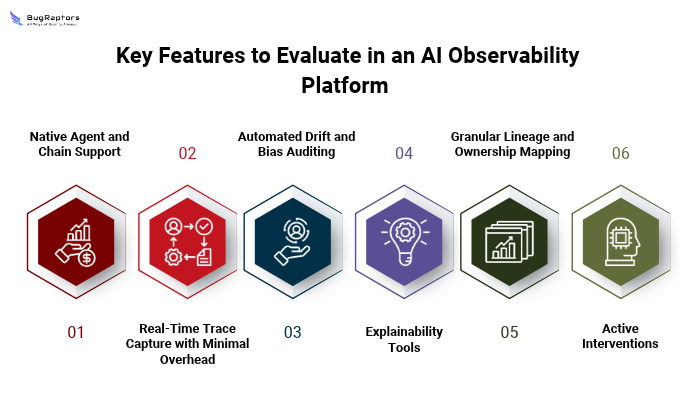
Native Agent and Chain Support: The platform should be able to track multi-step reasoning paths, tool calls, and agent-to-agent delegation events, not just single-inference API endpoints. To support rapid iteration, teams frequently adopt AI-native CI/CD testing pipelines that connect automated pre-merge evaluation harnesses directly with production observability metrics.
Real-Time Trace Capture with Minimal Overhead: Telemetry collection must not add significant latency overhead to production inference pipelines.
Automated Drift and Bias Auditing: Algorithms need to automatically detect feature distribution movements, concept drift, and demographic skew without the need for manually maintained thresholds.
Explainability Tools: Native integration of feature attribution methods to simplify compliance reporting and root-cause analysis.
Granular Lineage and Ownership Mapping: Each signal, model artifact, and trace log must be mapped to a named owner, risk categorization tier, and governing policy.
Active Interventions: Take action instead of passively notifying, allowing for automatic workflow halts, throttling, or traffic redirection in response to policy violation signals.
Building a Transparent AI Infrastructure
Artificial intelligence is an impenetrable black box, and treating it as such poses unmanageable operational, legal, and financial risk. Enterprise systems relying on basic uptime measures or quarterly accuracy checks are subject to silent logic drift, unmonitored tool execution mistakes, and cascade failures across autonomous processes.
Deep decision tracing turns AI operations from a risky, unpredictable force into an auditable, controlled corporate tool. Deploy time, context retrieval quality, intermediary reasoning stages, and tool actions are instrumented to give companies complete operational clarity.
Partner with BugRaptors to achieve end-to-end observability in AI to ensure that your apps stay accurate, transparent, and adhere to corporate quality requirements as they expand in production.

Prateek Goel
Automation Testing, AI & ML Testing, Performance Testing
About the Author
Parteek Goel is a highly-dynamic QA expert with proficiency in automation, AI, and ML technologies. Currently, working as an automation manager at BugRaptors, he has a knack for creating software technology with excellence. Parteek loves to explore new places for leisure, but you'll find him creating technology exceeding specified standards or client requirements most of the time.


