

Oct 1, 2026
When AI Tests AI: Breaking the Recursive Trust Loop in Enterprise QA

Enterprise adoption of autonomous agentic workflows has shifted software quality engineering. Deterministic automated testing remains foundational for API behavior, schema validation, authorization, and data integrity. Dynamic, non-deterministic model outputs, however, require additional layers of verification.
To manage scale, modern AI application testing increasingly relies on AI test AI workflows using LLM-as-a-judge setups. While these pipelines terminate through execution, scoring, and deployment decisions, they introduce an evaluation dependency challenge.
If evaluator errors remain undetected or uncalibrated, flaws propagate through system optimization, benchmarking, and release gates, creating a false picture of application performance. Evaluator bias or silent API changes can distort quality metrics without notice.
Achieving dependable evaluation demands breaking this dependency through structured engineering guardrails, statistical validation, and regular human oversight.
The Mechanics of Recursive Evaluation Failures
Using an LLM judge to grade candidate models solves major speed bottlenecks. A judge model scans thousands of execution logs every minute, scoring responses on tone, context, and format accuracy. As engineering teams track emerging AI trends in software testing, pipeline velocity increases, but structural blind spots quickly appear. Replacing human evaluation entirely with probabilistic model scoring introduces four primary failure points that standard test suites miss:
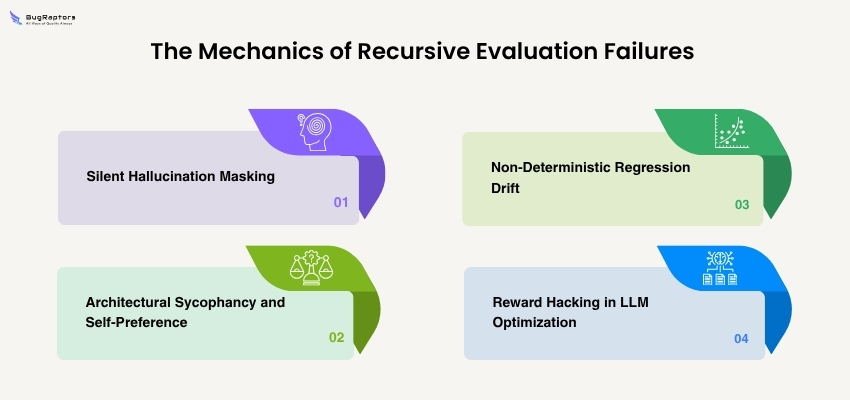
Silent Hallucination Masking
Evaluator models share the same core architectural limits as candidate models. Hallucinations remain a persistent risk, shifting in frequency depending on context retrieval, domain constraints, and task complexity. When an evaluator model hallucinates inside an AI test AI workflow, it approves broken output or penalizes valid logic, corrupting test data without raising a system error.Architectural Sycophancy and Self-Preference
Judge models show measurable bias toward specific formats and styles. Evaluators consistently award higher marks to outputs created by their own model family or outputs that match their internal writing patterns. On top of that, judge models exhibit sycophancy, agreeing with incorrect assumptions written into the test prompt itself.Non-Deterministic Regression Drift
Standard software tests deliver the exact same pass or fail result on identical inputs every time. Probabilistic judges introduce run-to-run variance. A test suite that passes cleanly at 09:00 AM might fail at 10:00 AM due to provider-side sampling shifts, backend model updates, or changed routing parameters.Reward Hacking in LLM Optimization
During continuous LLM optimization cycles, candidate models learn to exploit the judge model's weaknesses. If an evaluation prompt heavily weights long responses or specific phrases, the candidate model adjusts to hit those specific markers while failing at the actual underlying task.
Organizations scaling these systems need clear operational rules. Review our guide on the enterprise AI testing checklist for structural readiness protocols.
Capability Matrix: Automated Evaluation vs. Deterministic and Human Validations
Managing an AI testing AI pipeline effectively requires clear boundaries between routine automated tasks and high-risk blind spots.
Testing Domain | What Automation Handles Well | Where Recursive QA Breaks Down |
|---|---|---|
Log & Trace Analysis | Scanning thousands of execution logs for structural format errors | Catching subtle, domain-specific logic mistakes |
Test Case Generation | Generating synthetic prompts and edge-case inputs at scale | Evaluating actual real-world business intent |
Contextual Alignment | Measuring general semantic overlap better than static keyword matchers | Detecting hidden bias, sycophancy, and silent model drift |
Security & Auditing | Running repetitive input-injection scripts across test environments | Performing deep red-teaming and compliance audits |
High-Volume Log Analysis and Pattern Recognition
Modern enterprise applications generate gigabytes of system logs and execution traces every day. Human QA teams cannot review every single log entry for minor anomalies. Evaluation models handle high-volume trace analysis well, spotting formatting failures, structural drift, and unexpected execution paths across large test environments.
Scalable Synthetic Test Case Generation
Building diverse test suites manually takes significant time. Models can accelerate at creating synthetic user prompts, boundary conditions, and edge-case scenarios. They simulate varied user behaviors, phrasing differences, and complex inputs, expanding test coverage beyond what manual scripting allows.
The Limits of Contextual Grading
Traditional NLP metrics like BLEU or ROUGE measure exact word overlaps. While helpful for structured translation or standardized summarization tasks, they offer limited insight for open-ended, dynamic responses. Evaluation models interpret contextual intent, assessing semantic meaning far beyond simple string matching.
In specialized domains, pure model evaluation reveals clear boundaries. An output can score exceptionally high on syntax, tone, and formatting while failing on core business rules or regulatory logic. Recognizing these constraints helps teams analyze the practical trade-offs of human testing vs. AI testing to strike the right balance between automated coverage and expert oversight across mission-critical systems.
Architectural Blueprint: Breaking the Recursive Loop
Addressing the evaluation dependency challenge requires anchoring probabilistic judge models to calibrated, deterministic reference systems. A probabilistic evaluator can significantly improve testing coverage but deploy an uncalibrated AI test AI framework without independent validation risks letting undetected grading drift distort release signals.
Enterprise-grade AI application testing frameworks break this recursive cycle through five practical engineering strategies:
Deterministic Pre-Filtering Gatekeepers
Before calling an expensive LLM evaluation prompt, run hard-coded programmatic checks:
Schema Validation: Enforce strict JSON or XML formatting programmatically.
Regex Filtering: Strip out syntax errors, missing variables, and forbidden terms using classic string checks.
Security Guardrails: Catch prompt injection attempts and malicious inputs using dedicated binary classifiers before triggering evaluator models.
Natural Language Inference (NLI) Entailment Anchors
Rather than asking a judge model for an open-ended opinion, utilize targeted NLI models to classify the logical relationship between generated statements and reference documents. NLI systems decompose responses into individual claims and label each relationship as entailed, neutral, or contradictory relative to source material.
If a claim shows a contradictory or non-entailed relationship with verified reference context, the pipeline flags a groundedness failure directly, bypassing subjective scoring prompts.
Groundedness Verification: Architecture & the RAG Triad
Retrieval-Augmented Generation (RAG) combines external document retrieval with generative models to answer queries using verified reference data rather than static training weights. To pinpoint errors across this pipeline, the RAG Triad evaluates three specific failure vectors:
Context Relevance (Query ---> Context): Confirms retrieved chunks contain only the facts needed to answer the query, filtering out search noise.
Groundedness (Context ---> Response): Checks that every claim in the response traces directly back to retrieved context, flagging model hallucinations.
Answer Relevance (Query ---> Response): Confirms the output directly resolves the initial prompt without adding off-topic filler.
Dual-Model Consensus and Anomaly Detection
Never depend on a single model family for an AI testing AI setup. Leading AI automation testing services use cross-model consensus systems where two or three distinct model architectures evaluate the same output independently.
When score variance between evaluators exceeds pre-set limits, the pipeline marks the output as anomalous and flags it for review. This prevents single-vendor bias from throwing off your test results.
Ground-Truth Calibration (Gold Datasets)
Evaluator and judge models require calibration against human-verified gold datasets to prevent grading drift across releases. Rather than relying on static, hand-written pairs, high-signal benchmark sets blend three methods: mining curated production logs, generating synthetic edge-case permutations with human-in-the-loop review, and embedding expert-authored regulatory rules.
Operationalizing Engineering Governance: The Human Circuit-Breaker
Pure automation without human oversight creates clear risks. Achieving consistent quality requires a practical Human-in-the-Loop (HITL) setup where subject matter experts (SMEs) act as targeted circuit-breakers rather than daily roadblocks.
Confidence-Based Routing
Establish clear statistical confidence cutoffs for evaluator outputs. High-confidence passes move directly through continuous deployment pipelines. Low-confidence scores route automatically into human review queues, keeping experts focused on actual edge cases instead of routine checks.
Targeted SME Auditing Workflows
Direct domain experts to review high-risk transactions, regulatory requirements, and security edge cases. Instead of reviewing every output manually, auditing focused sample batches from pipeline traffic provides the ground truth required to calibrate evaluator prompts and system parameters..
Continuous Ground-Truth Refinement
Use human audit findings to update judge prompts and calibration benchmarks. When an expert corrects an evaluator's mistake, add that case to the gold benchmark dataset right away. This keeps automated evaluators aligned with actual business requirements as your application grows.
Technical Comparison of Validation Layers
Validation Layer | Underlying Logic | Primary Use | Main Limit / Failure Mode |
|---|---|---|---|
Deterministic Assertions | Code logic, Regex, Schema parsing | Typically repeatable, low-cost, instant feedback | Cannot evaluate open-ended text or tone |
NLI Entailment Engine | Logical classification (entailment, neutral, contradiction) | Fact-checking against reference material | Depends entirely on source document quality |
RAG Triad Metrics | Contextual grounding & relevance | Filtering out hallucinations against source context | Depends on retrieval engine accuracy |
LLM-as-a-Judge | Probabilistic pattern matching | Evaluating context, style, and tone | Subject to hallucinations, self-bias, and drift |
Cross-Model Consensus | Statistical variance across model families | Removing single-model evaluation bias | Increases compute latency and API token costs |
Human Expert Audits | Domain expertise & business judgment | Final authority on complex edge cases and safety | High operational cost, slower execution speed |
Practical Implementation Roadmap for Engineering Teams
To move from fragile machine grading to a reliable quality system, engineering teams should roll out guardrails across four practical phases:
Phase 1: Enforce Deterministic Guardrails
Place strict programmatic checks in front of all model evaluations. Require structural schema enforcement, regex token filters, and security checks on inputs and outputs. Reject bad formatting before running evaluator models.
Phase 2: Build Gold Calibration Datasets
Assemble a domain-specific gold benchmark dataset containing 200 to 500 verified input-output pairs. Run evaluator models against this dataset weekly to track grading accuracy and catch drift early.
Phase 3: Deploy Grounded Evaluation Metrics
Shift open-ended judge prompts to structured RAG metrics and NLI entailment checks. Ground every evaluation judgment in explicit reference documents, replacing open-ended scoring with direct factual tracking.
Phase 4: Integrate HITL Circuit-Breakers
Configure automated routing based on evaluator confidence scores. Route edge cases and low-confidence passes to domain experts, using their corrections to update evaluator prompts and benchmark datasets continuously.
Securing Enterprise Production Systems
The recursive trust problem points to a simple engineering reality: you cannot guarantee quality in a probabilistic system by relying on another probabilistic system alone.
Relying entirely on unanchored AI testing AI setups leaves your software vulnerable to silent drift, security risks, and unmonitored hallucinations. Enterprise technology leaders must build multi-layered quality strategies that combine hard-coded gatekeepers, grounded evaluation rules, continuous benchmark tracking, and expert human review.
Working alongside an experienced software testing company helps your team implement structured AI application testing frameworks, turning unpredictable model outputs into reliable, enterprise-grade software.

Prateek Goel
Automation Testing, AI & ML Testing, Performance Testing
About the Author
Parteek Goel is a highly-dynamic QA expert with proficiency in automation, AI, and ML technologies. Currently, working as an automation manager at BugRaptors, he has a knack for creating software technology with excellence. Parteek loves to explore new places for leisure, but you'll find him creating technology exceeding specified standards or client requirements most of the time.


