

Oct 20, 2026
AI-Native CI/CD Testing: Building Reliable Release Pipelines for AI Applications

Traditional CI/CD pipelines relied on determinism, assuming code produced an exact, repeatable output. Generative models and agentic workflows break this model. A single prompt edit or model checkpoint update can pass standard unit tests while causing silent regressions like truncated API payloads or missing parameters five steps downstream.
To ship probabilistic AI reliably, engineering teams must redefine what counts as a passing test. Modern software delivery requires AI-native CI/CD testing, a methodology that integrates continuous behavioral evaluation, model drift detection, and automated regression gates directly into deployment pipelines.
Why Traditional CI/CD Pipelines Fail Non-Deterministic Code
Standard build pipelines evaluate code structure and explicit output matching. They verify whether unit tests pass, endpoints respond, and linting rules hold. These technical checks remain necessary, but they prove insufficient when validating probabilistic outputs.
The Limits of String-Matching Assertions
In conventional test automation, assertions use strict equality: assert result == expected_value. In LLM applications and agentic systems, exact string matches produce false negatives. An output reading "Order processed successfully" conveys the exact same intent as "Your order has been completed." Standard assertion engines mark valid semantic variations as failures, creating brittle test suites.
Conversely, broad assertions allow severe functional regressions to slip into production. Checking only whether a response returns an HTTP 200 status code or a non-empty string misses critical issues like hallucinations, tool schema mismatches, or safety policy breaches. Modern quality strategies require specialized AI testing services to evaluate semantic accuracy rather than relying on binary pass/fail checks.
Distributed Artifact State
Traditional software updates deploy compiled binaries or container images derived directly from source code. AI system behavior depends on a complex web of interrelated artifacts:
System Prompts & Few-Shot Examples: Version-controlled text files defining core instructions.
Model Checkpoints & Parameters: Specific model builds, temperature settings, top-p thresholds, and seed values.
Tool & Schema Definitions: JSON schemas dictating how the model interacts with external APIs.
Retrieval Configurations: Vector database index versions, embedding models, and chunking parameters.
Guardrail & Safety Policies: Content moderation filters and operational boundaries.
Modifying any single element alters overall performance. A small change to a system prompt can degrade function calling accuracy across third-party tools without triggering a compiler error or standard test failure.
The Five-Gate Architecture of AI-Native CI/CD Testing
To establish reliable release cycles, engineering teams deploy a multi-layered evaluation framework within their delivery pipelines. Rather than relying on a single test execution step, AI-native CI/CD testing introduces five sequential gates before code reaches production.
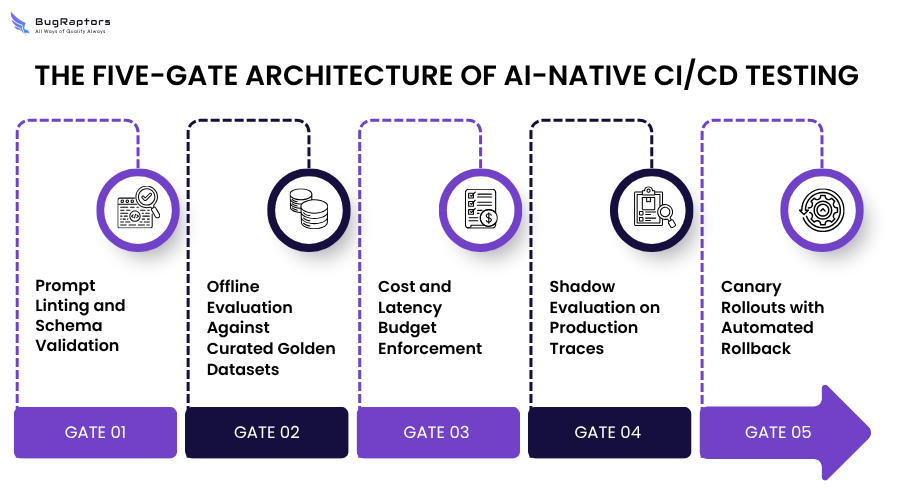
Gate 1: Prompt Linting and Schema Validation
Static analysis serves as the initial, fast checkpoint. Before running compute-heavy evaluation suites, the pipeline validates text templates and schema files:
Placeholder Verification: Validates that required variables (such as {user_input} or {context}) are correctly formatted and present in prompt templates.
Schema Conformance: Confirms tool specifications match expected API function-calling formats.
Policy Compliance: Scans prompts for disallowed phrasing, system instruction conflicts, or insecure formatting.
Executing Gate 1 takes seconds and prevents invalid prompt commits from consuming API credits in subsequent evaluation stages.
Gate 2: Offline Evaluation Against Curated Golden Datasets
When a pull request alters a prompt, model version, or retrieval parameter, AI-native CI/CD testing triggers an automated offline evaluation run against a curated golden dataset.
A golden dataset contains representative input samples paired with behavioral evaluation rubrics rather than strict string expectations. These rubrics use LLM-as-a-Judge frameworks, semantic similarity scoring, and deterministic checks (such as valid JSON parsing) to assess performance across several key metrics:
Task Completion: Evaluates whether the model correctly answered the query or achieved the objective.
Tool Calling Accuracy: Verifies whether the agent invoked the correct tool with valid argument structures.
Constraint Adherence: Confirms the output maintained formatting restrictions, tone rules, and safety boundaries.
For teams building complex autonomous systems, comprehensive testing autonomous AI agents requires evaluating long-running multi-step trajectories to confirm that early reasoning steps do not cause downstream task failures.
Gate 3: Cost and Latency Budget Enforcement
Non-deterministic models present operational risks beyond functional correctness: cost and latency inflation. A prompt change that adds detailed chain-of-thought instructions might raise output quality by 3% while increasing token usage by 150% and doubling response latency. Gate 3 measures financial and performance impact:
Token Consumption Tracking: Calculates prompt and completion token usage across all test runs in the golden dataset.
Latency Benchmarking: Monitors P95 and P99 response times across simulated network conditions.
Threshold Gates: Blocks pull requests if average cost per execution exceeds a set boundary (such as a 10% increase) without explicit authorization.
Gate 4: Shadow Evaluation on Production Traces
Offline golden datasets reflect historical test cases and rarely capture real-world shifts in user interaction. Gate 4 runs candidate agent versions against live production traffic using asynchronous shadow execution:
Traffic Capture: Production inputs are mirrored to a replay queue.
Parallel Execution: The candidate version processes incoming requests in an isolated execution environment without sending outputs back to the user.
Comparative Evaluation: Automated evaluators score outputs from both the active production version and the candidate version, comparing quality metrics, schema compliance, and failure rates.
To prevent shadow runs from triggering unauthorized real-world side effects, pipelines utilize a mock interface layer. Shadow agents execute API calls against dry-run environments, preventing duplicate database writes, external emails, or financial transactions.
Gate 5: Canary Rollouts with Automated Rollback
Passing offline and shadow gates earns a candidate configuration a controlled release. Canary deployment routes a small fraction of live traffic (e.g., 5%) to the new agent bundle while monitoring real-time operational metrics:
Tool Failure Rates: Exception rates thrown by external API calls.
Guardrail Interventions: Frequency of input and output safety filter triggers.
User Feedback Signals: Explicit thumbs-down votes, task cancellation rates, or session drop-offs.
If real-time error rates exceed configured thresholds during the canary window, the pipeline triggers an automated rollback.
Artifact Bundling and Prompt Versioning
In traditional software, release artifacts are tracked as immutable container images or Git commit hashes. In AI software delivery, teams bundle all execution components into unified configuration manifests:
Configuration Layer | Tracked Component | Validation Focus |
|---|---|---|
Prompt Layer | System instructions, few-shot examples | Tone, formatting, context bounds |
Model Layer | Checkpoint version, temperature, top-p, seed | Determinism boundaries, capability fit |
Tooling Layer | API schemas, function arguments | Payload integrity, type safety |
Retrieval Layer | Vector index version, embedding model | Context relevance, chunking accuracy |
Policy Layer | Guardrails, safety filter rules | Moderation compliance, prompt injection defense |
Treating configuration manifests as first-class deployable artifacts ensures that the exact combination of prompt, model version, retrieval index, and tool schema evaluated in CI/CD is what gets deployed to production. When issues occur, operations teams perform rollbacks by updating the active manifest pointer. This restores previous system behaviors across all dependent services without requiring code re-compilation.
Failure Recovery: Atomic Boundaries and Compensating Actions
Standard software rollbacks revert code execution to an earlier state. Rollbacks in autonomous agent systems present unique challenges because agents perform real-world actions during execution. Reverting a model configuration does not automatically delete an incorrect database entry or reverse an API call made by a previous execution.
Engineering teams address this challenge using two principal architectural patterns:
Atomic Transaction Boundaries
Where technical constraints permit, agent actions are isolated within transactional boundaries. File updates write to temporary staging directories and commit only when all steps pass verification. Database modifications execute within uncommitted transaction blocks until an evaluation monitor validates output integrity.
Compensating Action Workflows
For actions that cannot be contained within database transactions, such as external webhook calls, payment requests, or email dispatches, the system maintains paired compensating logic for every tool:
Primary Action: Create Calendar Event ---> Compensating Action: Delete Calendar Event
Primary Action: Write Database Record ---> Compensating Action: Execute Soft Delete / Reversion Query
Primary Action: Dispatch API Payload ---> Compensating Action: Trigger Cancellation / Webhook Rollback
In enterprise environments, pairing pipeline validation with sophisticated self-healing capabilities helps isolate and mitigate execution anomalies before they impact end users. Integrating specialized self-healing test automation practices allows test frameworks to adapt dynamically to minor UI or schema variations during continuous delivery runs.
Measuring Impact: Data and Industry Metrics
Implementing dedicated testing frameworks for probabilistic software yields measurable operational improvements across key delivery metrics.
According to industry benchmarks from the Continuous Delivery Foundation (CDF) State of CI/CD Report, enterprise organizations integrating continuous model evaluation and automated release gates into deployment pipelines report clear efficiency gains:
Reduction in Production Incidents: Automated evaluation gates catch silent prompt regressions and tool schema mismatches before deployment.
Improvement in Deployment Frequency: Automated regression checking replaces manual quality assurance reviews, enabling teams to release model and prompt updates multiple times per day.
Reduction in Token Expenditure: Cost-budget gates identify inefficient prompt structures and runaway token loops early in development.
Implementing Modern QA Solutions for AI Delivery Pipelines
Transitioning to automated AI evaluation requires modernizing software quality practices across the entire software development lifecycle. High-velocity enterprise teams balance deployment speed with runtime reliability by partnering with BugRaptors for end-to-end quality engineering services that span conventional architectures and non-deterministic AI systems.
BugRaptors organizes and executes this modern validation strategy by integrating specialized service pillars with proprietary testing platforms:
AI Testing Services: Validates model performance, evaluates response drift, verifies safety guardrails, and audits prompt effectiveness against real-world scenario datasets.
DevOps Testing Solutions: Integrates automated evaluation suites, canary analysis tools, and cost-monitoring gates directly into GitHub Actions, GitLab CI, or custom delivery pipelines.
Automation Testing Services: Builds resilient, scalable test suites that validate underlying API structures, database states, and system integrations supporting AI workloads.
By unifying these testing capabilities under a structured AI-native CI/CD testing strategy, BugRaptors helps organizations establish closed-loop feedback across the full engineering lifecycle. Engineering teams can update prompts, fine-tune models, and expand agent capabilities with confidence that automated evaluation gates, backed by modern DevOps testing solutions, will safeguard system quality, operational costs, and user experience.

Prateek Goel
Automation Testing, AI & ML Testing, Performance Testing
About the Author
Parteek Goel is a highly-dynamic QA expert with proficiency in automation, AI, and ML technologies. Currently, working as an automation manager at BugRaptors, he has a knack for creating software technology with excellence. Parteek loves to explore new places for leisure, but you'll find him creating technology exceeding specified standards or client requirements most of the time.


