

Feb 20, 2026
Building Unshakeable Trust in Web3 with Automation QA Testing
The traditional web can't fulfill the promise of ownership and openness that decentralization promises. But the Web3 space has a big problem: not enough trust. People are afraid to link their wallets or make transactions on new platforms because of so many instances of smart contract attacks, frozen funds, and poor user experiences in the past.
For every business that wants to build in this area, quality is more than simply a technological need. This is the only method to let your users know they are safe. If your code is the law, it has to be perfect before it ever goes live on the mainnet. This is when a strategic partner, like a specialist software testing company, becomes your most important asset.
This article talks about the specific hazards that come with blockchain technology and how thorough automation QA testing may help reduce them. We will also look at a real-life example of how we made a social token ecosystem safe and ready for the limelight.
The Unforgiving Nature of Blockchain Development
Web2 development often allows a "move fast and break things" approach where a quick patch fixes production bugs. Blockchain operates differently. Traditional smart contracts are immutable by design, meaning you cannot simply overwrite the code to repair a security hole. Modern development often uses proxy patterns, such as OpenZeppelin upgradeable contracts, to introduce controlled flexibility. This setup allows developers to update logic, yet it heavily increases the difficulty of validation.
A single logical error can lead to irreversible financial loss and ruined platform reputations. Manual testing plays a part in early exploratory phases, yet securing these upgradeable systems at scale requires comprehensive automation QA testing. Integrating industry-standard security analysis tools directly into your automated pipelines strengthens your defense. Utilizing static analyzers like Slither and MythX alongside established OpenZeppelin frameworks helps identify vulnerabilities long before deployment.
Security remains the highest priority, yet performance follows closely behind. Users expect rapid execution, but blockchain transactions rely heavily on network congestion and gas costs. Through automation QA testing, teams can simulate thousands of transactions under various network conditions. This proactive strategy keeps the platform stable and cost-effective, even during massive traffic spikes.
Why Web3 Testing is Different
You must alter your perspective on evaluating a decentralized application (dApp). You are not only assessing the functionality of a button; you are also scrutinizing cryptographic interactions and economic incentives. The environment is fragmented. Your program may function on Ethereum, but it may also be compatible with wallets like MetaMask, storage solutions like IPFS, and maybe cross-chain bridges.
A manual technique can't handle this complicated set of variables well. Here, automation testing services are quite important. They let sophisticated test scenarios run over and over again. This includes everything from basic token transfers to complex governance voting systems.
As these settings get more complicated, many teams are looking at more advanced methods, such as Software Testing with AI Agents, to manage the complicated logic that regular scripts could overlook. Without this extra degree of authentication, you're basically putting user assets at risk.
Common Challenges in Blockchain QA
Navigating the testing landscape for Web3 projects involves specific hurdles that differ from standard web applications.
Identity and Wallet Management: You check login forms in Web2. You check the wallet connection in Web3. Testers need to verify that the dApp works properly with different wallet providers. For enterprise-grade efficiency, teams often rely on wallet simulation instead of full UI automation. This approach bypasses the clunky interface of browser extensions, allowing automated tests to sign transactions and manage session states directly via code.
Smart Contract Logic: The smart contract is what makes a dApp work. There is no way around testing this logic. Under all feasible conditions, developers must ensure the contract works exactly as intended. This means looking for weaknesses in access control, integer overflows, and reentrancy attacks.
Gas Optimization: People don't like paying exorbitant fees. QA teams need to look at how much gas smart contract functionalities use. People will leave the platform if a function costs too much to perform. A big element of the evaluation process is optimization.
Data Consistency: A blockchain is a ledger that is spread out. It takes time for writing info to spread. Tests must take into consideration how long it takes to confirm a block. A test that passes right away in a local context could not pass on a testnet due to network lag.
Integrating Automation for Scale
Automation makes things bigger, while manual testing helps with exploratory work. You need to ensure you haven't damaged any existing features during the upgrade of your dApp.
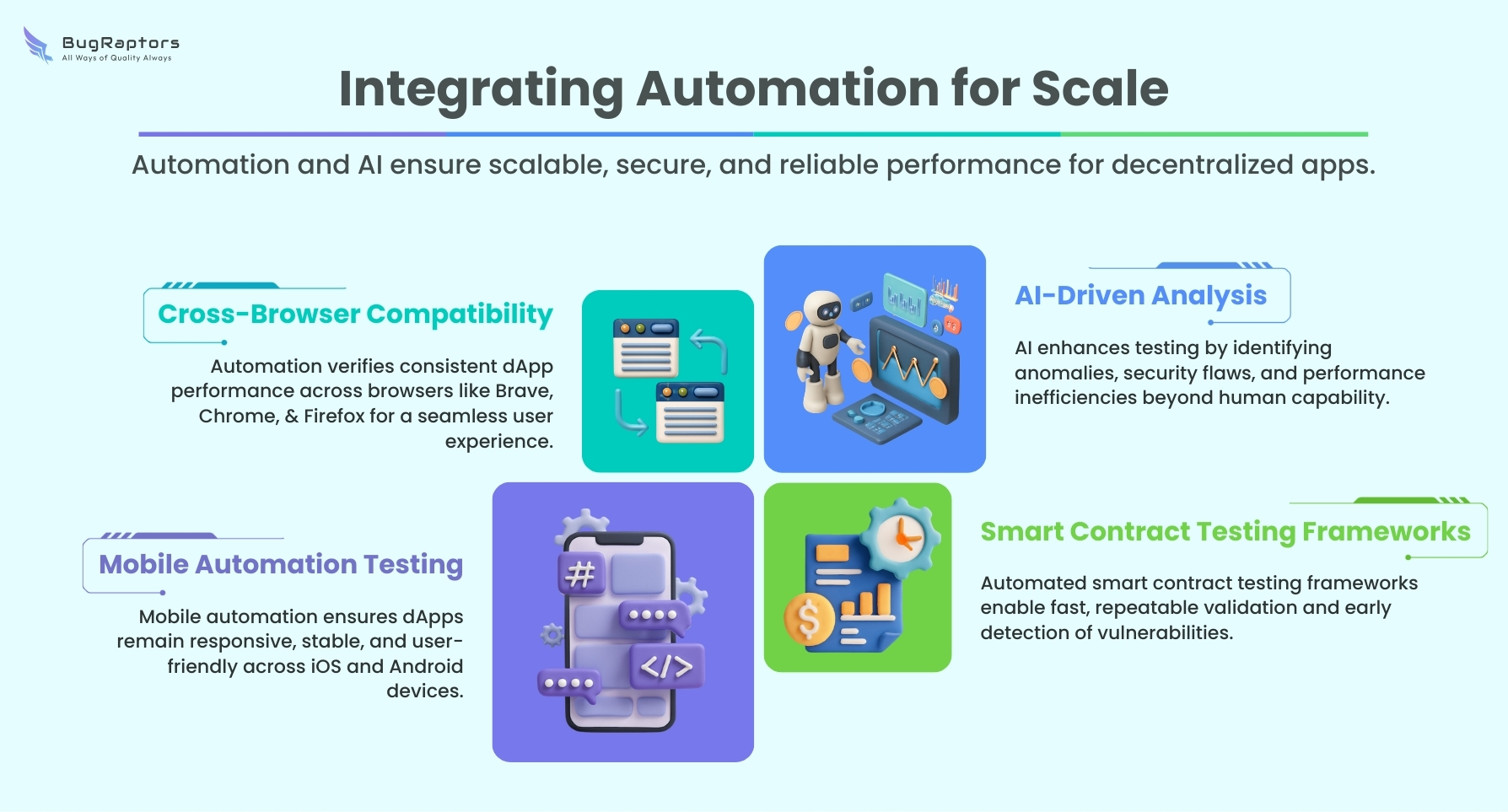
Cross-Browser Compatibility
Decentralized applications must perform consistently across diverse environments. Automation testing verifies that dApps function flawlessly on privacy-focused browsers like Brave, as well as industry standards like Chrome and Firefox, ensuring a seamless user experience regardless of the access point.
Mobile Automation Testing
Widespread adoption depends on a "mobile-first" approach. Dedicated mobile automation testing ensures software stability across iOS and Android devices. By automating interactions on various screen sizes and operating systems, developers guarantee that the interface remains intuitive and responsive for users on the go.Smart Contract Testing Frameworks
For unit testing smart contracts, Hardhat and Truffle are common tools. Using deterministic test chains, like the Hardhat network, allows teams to run predictable, repeatable tests in a highly controlled local environment. Adding these to a comprehensive CI/CD pipeline takes skill. We put up pipelines that run all the tests automatically whenever a developer uploads code. This detects problems right away, instead of weeks later during a planned audit.AI-Driven Analysis
The industry is shifting toward specialized AI testing services for deep technical oversight. Beyond basic monitoring, AI executes anomaly detection in transaction patterns, fuzz testing for smart contracts to uncover vulnerabilities, and gas usage regression detection to prevent cost spikes, identifying structural risks that human testers often overlook.
Usability: The Forgotten Element of Web3
People say that Web3 is the hardest to use. Mainstream users are turned off by confusing language and poor transaction times.
This is what usability testing services look at. We look at the app from the point of view of someone who isn't a techie. Is the error message obvious when a transaction doesn't go through? Does the UI refresh properly while you wait for block confirmations?
Making these tiny changes makes a big difference in keeping users. People are more inclined to come back if they feel protected and know what's going on at all times.
Key Considerations for Your Testing Strategy
If you are planning a Web3 project, keep these questions in mind:
What is your coverage strategy?
Don't just use unit tests. You need integration tests to make sure that your smart contracts and your frontend work together.
Are you testing on the right networks?
Testing on a local blockchain is quick, but it doesn't show how things really work. For a more accurate representation, enterprise teams utilize forked mainnet testing. This copies the exact state of the live blockchain at a specific block, letting you test against real liquidity pools and existing smart contracts without spending real gas. You need to deploy and test on public testnets like Sepolia or Goerli to see how your app works in real-world network settings.
How do you handle third-party integrations?
Oracles are probably used by your dApp to get price feeds or other data that isn't on the blockchain. Implementing RPC mocking is highly effective here. By intercepting and simulating the responses from network nodes, automation QA testing can verify how your application handles dropped connections, delayed block confirmations, and data errors without relying on unstable third-party endpoints.
Case Study: Securing a Social Token Ecosystem
Theory is useful, but putting a method into action shows how useful it is. We just helped a customer establish a platform enabling creators to make their own social tokens. The idea was to provide artists the tools they needed to establish digital economies around their brands.
The Challenge
The client needed to ensure that creators could mint, distribute, and manage tokens without technical friction. More importantly, the financial transactions had to be bulletproof. Any error in the token vesting schedules or payout mechanisms would have destroyed trust immediately.
The Solution
We implemented a comprehensive strategy centered on automation QA testing. Our team worked on functional testing to make sure that the user flow worked, from linking a wallet to minting a token. We also did thorough security checks to find any weaknesses in the logic of the contract.
The Outcome
The platform launched successfully with zero critical defects. The automated suite we built allowed the client to deploy updates and new features rapidly, knowing that the core financial logic remained secure. This stability was crucial in helping them attract high-profile creators to the platform.
You can read the full breakdown of this project here: QA for Social Token Ecosystem.
The Future is Automated
The complexity of decentralized applications will only increase. We are seeing the rise of Layer 2 solutions, cross-chain bridges, and more sophisticated DeFi protocols. As these technologies evolve, the testing strategies must evolve with them.
We are already exploring how AI testing company capabilities can further enhance security, predicting attack vectors before they are exploited. For now, the foundation remains solid engineering and comprehensive automation QA testing.
To support this foundation, you need the right technology stack; we recommend checking our guide on the best automation testing tools to see what we use to keep platforms secure.
Final Thoughts
Trust is what makes the decentralized web work. You earn it by giving them a platform that always works, keeps their money safe, and makes things easy. Don't leave your launch up to chance. You protect your project by putting automation and usability testing at the top of your list.
Quality assurance is the link between a good concept and a successful product, whether you're starting a new coin, a DeFi protocol, or an NFT marketplace. We are ready to assist you protect your Web3 platform.

Shaifali Sharma
Web Automation Testing
About the Author
Shaifali Sharma is an ISTQB certified web automation lead with a passion for ensuring software quality through robust testing methodologies. With a strong background in automation testing frameworks and tools, she excels in designing, implementing, and executing automated test suites to streamline the software development process. Her dedication to continuous learning and staying updated with the latest trends in automation testing enables her to deliver high-quality solutions that meet the evolving needs of the industry. Shaifali's commitment to excellence and her collaborative approach makes her a valuable asset to any software automation team.


