

Nov 25, 2026
Testing Machine Learning Systems: A Practical Guide to ML Testing

Traditional software testing relied on deterministic guarantees: hard assertions linked explicit inputs to predetermined outputs. Machine learning completely turns that paradigm on its head. It is rare for production failures to result in runtime crashes or HTTP 500 errors, because ML systems are probabilistic and constantly changing.
Instead, they return clean HTTP 200 responses while silently creating catastrophic business defects such as defective fraud classifications and biased credit approvals. Relying solely on academic benchmark scores creates a false sense of security. True resilience requires shifting from siloed model evaluations to holistic, end-to-end ML system tests across data pipelines, software integrations, and live production environments.
Why Is Testing Machine Learning Systems Hard?
The core challenge of machine learning testing stems from the tri-artifact problem. In conventional applications, software behavior is dictated almost entirely by code. In machine learning, production behavior is an emergent property governed by three interacting layers:
The Code: Deterministic feature transformation scripts, data loaders, orchestration DAGs, and inference microservices.
The Data: Dynamic, non-stationary ingestion pipelines that drift across distributions, seasonal variations, and schema mutations.
The Model: A statistical artifact generated through opaque optimization surfaces that behaves non-linearly to minute perturbations.
Because of this coupled reality, you can deploy flawless, clean code that passes every unit test, yet still witness the system fail completely because the input data distribution shifted or the model developed brittle behavioral blind spots.
Traditional testing asserts that the code is built right. Rigorous AI application testing proves that the system produces dependable business outcomes in an unpredictable, open-ended operational environment.
What Should Be Tested in an ML System?
Treating a machine learning model as an isolated black box during staging is a common operational pitfall. A production-grade validation strategy splits testing across three operational surfaces:
Data Pipeline Integrity & Ingestion Defense
A machine learning system is only as sound as its ingestion pipeline. The most common production bugs are not algorithmic flaws, but silent data corruption upstream:
Schema Validation & Drift: Verifying explicit data types, categorical values, null-rate bounds, and expected boundary constraints on incoming feature tables before training or inference begins.
Distribution Shift & Covariate Drift: Statistical distances between baseline training sets and real-world inputs (e.g. Kolmogorov-Smirnov statistics, Wasserstein distances).
Partition Leakage Auditing: Zero target or temporal leakage across training, validation, and test splits. Leaking future information into training sets creates deceptively stellar staging evaluations that degrade immediately upon deployment.
By placing continuous gates at ingestion, teams can shift ML system testing from reactive triage to automated input defense.
Model Behavioral & Algorithmic Quality
Relying only on aggregate benchmark metrics, such as F1-score, Root Mean Squared Error (RMSE), or Area Under the Curve (AUC), to evaluate models is dangerous. Aggregate scores conceal catastrophic edge-case failures within sub-cohorts.
Minimum Functionality Tests (MFT): Targeted behavioral checks that isolate specific model capabilities rather than code paths. Using small, curated sets of clear inputs and unambiguous expected outcomes, MFTs verify that the model reliably handles fundamental domain tasks and critical edge cases.
Invariance Tests (INV): Checking those irrelevant transformations of the domain (e.g., swapping names, adding neutral adjectives, or changing whitespace) do not change the model prediction.
Directional Expectation Tests (DIR): Proving Monotonic Business Logic. For example, all things being equal, increasing an applicant’s savings account balance should never decrease their credit score.
Fairness & Bias Audits: Probe model behavior across sensitive demographic cohorts to ensure disparate impact ratios and equalized odds meet enterprise standards and governance mandates. For deeper architectural frameworks on this, review our guide to AI model validation strategies.
Implementing structured ML testing across these behavioral dimensions exposes hidden algorithmic blind spots long before candidate weights reach customer-facing environments.
System Integration & Serving Infrastructure
A production liability is a model that computes an accurate vector but violates latency ceilings or results in memory leaks:
API Contracts & Schema Validation: Requiring that inference services produce strictly typed outputs, adhere to JSON schemas, and supply deterministic error codes for malformed requests.
Resource Profiling & Concurrency: Measuring memory footprint, GPU utilization, and high-percentile latency (p95, p99) under simulated production traffic spikes.
Graceful Degradation: Make sure that the application has a graceful degradation in case of third-party upstream dependencies, failures, or timeouts, and instead of freezing up, it falls back to cached fallbacks or deterministic rule-based systems.
Teams that neglect serving infrastructure quickly find that testing ML systems requires verifying network timeouts and serialization speeds just as strictly as prediction tensors.
Key Types of Machine Learning Testing
Standard regression suites must be paired with specialized test designs engineered for statistical logic:
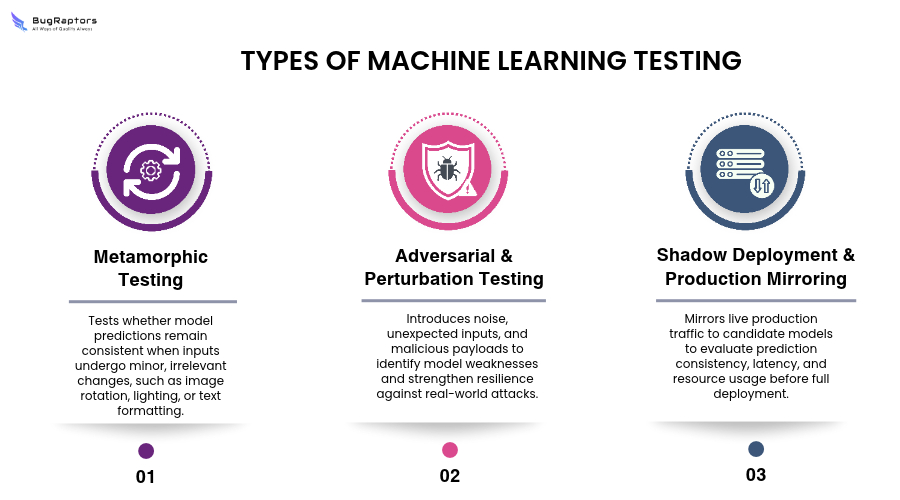
Metamorphic Testing
In traditional software, we rely on a "test oracle," a mechanism that knows the exact expected output for an input. In complex ML workflows (e.g., search engines, fraud classifiers), an exact oracle often does not exist.
Metamorphic testing resolves this by focusing on relationships between outputs across multiple transformed inputs. If you test an image recognition model, rotating a medical scan by two degrees or shifting the lighting slightly should not cause the model to switch its diagnosis from benign to malignant.
Adopting metamorphic principles lets engineering teams advance testing ML systems when collecting manual ground-truth labels in real time is impossible.
Adversarial & Perturbation Testing
Adversarial testing deliberately introduces mathematical noise, out-of-distribution inputs, or boundary perturbations to identify where the model's decision boundaries collapse. This includes fuzzing numeric inputs to catch arithmetic underflows, injecting typos into NLP tokenizers, and simulating malicious prompt injections in retrieval-augmented workflows.
Subjecting candidate architectures to stochastic noise and unexpected payloads strengthens end-to-end AI automation testing against real-world adversarial attacks.
Shadow Deployment & Production Mirroring
You cannot replicate messy enterprise production traffic entirely within staging environments. Shadow deployments solve this by mirroring sanitized live production requests to candidate models in real time, with downstream write operations disabled.
This lets engineering teams compare output distributions, measure inference latency, and evaluate resource consumption under real concurrency before cutting over live user traffic. Practitioners running live shadow evaluations find that ML testing is incomplete until a model processes uncurated production data streams without human supervision.
How to Test Machine Learning Models: A Pipeline-Level Implementation
To operationalize testing, embed verification gates directly into continuous integration and continuous delivery (CI/CD) pipelines:
1. Pre-Commit / Ingestion Gate
Execute automated checks on data loaders, feature definitions, and container configurations. Fail the pull request immediately if null rates spike, schemas mismatch, or unapproved package dependencies are introduced.
2. Model Training & Evaluation Gate
Evaluate candidate model weights against version-controlled golden datasets—curated domain baselines composed of verified production edge cases and regression scenarios. Run behavioral test suites (MFT, INV, DIR) alongside standard accuracy metrics.
3. Automated CI/CD Deployment Gates
Make use of AI automation testing to execute integration suites that will validate API contracts, validate fallback mechanisms, and validate that latency is within p99 thresholds under simulated load. Modern pipelines are increasingly using enterprise autonomous testing frameworks to dynamically select test cases based on pipeline code diffs.
4. Post-Deployment Telemetry & Observability
Testing continues long after code is released. Continuously capture live inference traces and track distribution metrics like the Population Stability Index (PSI) to detect covariate drift. When real-time monitors identify anomalous or low-confidence predictions, automated guardrails redact the payload, trigger deterministic fallback responses, and route the failed trace directly into the pre-production golden regression suite for continuous remediation.
Automating these feedback loops ensures that testing ML systems operates as an active, continuous feedback cycle across the full software lifecycle.
Engineering Certainty into Probabilistic Systems
Treating machine learning as an unmanageable black box is an operational liability. While machine learning introduces probabilistic behavior, it doesn't exempt software from engineering discipline, architectural contracts, or deterministic safety bounds.
Achieving production reliability requires partnering with specialists who can unite data validation, model behavioral auditing, and automated pipeline governance. At BugRaptors, our specialized quality engineering services help forward-thinking organizations transition machine learning prototypes into resilient, enterprise-ready systems.
By deploying our proprietary tools and frameworks alongside advanced continuous integration pipelines, we help enterprise engineering teams eliminate silent runtime failures, safeguard compliance, and release mission-critical intelligent applications with complete operational certainty.

Prateek Goel
Automation Testing, AI & ML Testing, Performance Testing
About the Author
Parteek Goel is a highly-dynamic QA expert with proficiency in automation, AI, and ML technologies. Currently, working as an automation manager at BugRaptors, he has a knack for creating software technology with excellence. Parteek loves to explore new places for leisure, but you'll find him creating technology exceeding specified standards or client requirements most of the time.


