

Jul 29, 2026
Orchestrating Runtime Resilience: The Definitive Guide to Self-Healing Test Frameworks

Enterprise teams depend on automated testing to sustain rapid release cycles, yet scaling quickly reveals a major bottleneck: the maintenance footprint.
Consider a financial enterprise running a nightly regression suite of 3,000 scripts. A developer updates the checkout UI, renaming a submit button’s class from #btn-submit to #checkout-primary. The core payment logic stays completely untouched, yet 400 test cases fail overnight. Instead of shipping code, QA engineers waste half their morning updating brittle element selectors.
This scenario plays out daily across engineering organizations. Traditional automation scripts break over minor structural tweaks, creating false alarms that stall delivery pipelines and drain ROI. To eliminate this tax, progressive teams are moving toward self-healing test automation transitioning from brittle script maintenance to dynamic ecosystems that adapt to application changes on the fly.
What is a Self-Healing Test Suite?
Think of traditional test automation like a GPS with old maps. If a road closes or a street sign changes, the system stops and reports a dead end. Self-healing automation acts like a modern navigation system: it instantly finds an alternate route and keeps you moving toward your destination without needing you to pull over and reprogram it.
In software testing, traditional scripts rely on exact address tags (like a specific button ID or CSS code). If a developer changes a button’s tag from id="submit-order" to id="place-order", a standard test breaks instantly even if the button is still in the exact same spot on the screen.
A self-healing test suite avoids these unnecessary stops. When it encounters a changed tag, it looks at surrounding clues like the button's text, relative position, visual shape, or parent container to recognize that it is still the same action item. It automatically updates its reference on the fly, clicks the button, and keeps the test suite running smoothly.
How Does Self-Healing Test Automation Work?
In a typical continuous integration pipeline, the operational mechanics of a self-healing engine transform software testing from fragile, pass-or-fail instructions into an adaptive cycle. Implementing AI-powered test automation allows continuous integration runs to unfold smoothly across five core phases:
Phase 1: Baseline Creation
During initial successful runs, the engine builds a multi-dimensional profile of every interactive element. Instead of saving just a single CSS class or ID, it records a full footprint: relative DOM positions, text values, visual coordinates, surrounding parent tags, and accessibility labels.
Phase 2: Runtime Exception Interception
When an update changes an element's path, the primary script lookup fails. Instead of throwing a hard error and stopping the build, the self-healing wrapper intercepts the exception mid-execution and pauses briefly to evaluate the current page state.
Phase 3: Deep Contextual Scan & Fuzzy Matching
The engine scans the modified page to evaluate alternative locators against the saved baseline footprint. It assigns a weighted confidence score to each potential match based on attributes that remained constant:
 // Conceptual logic inside a self-healing wrapper (e.g., Playwright / Node.js context)


async function findSelfHealedElement(page, baselineFootprint) {

  // Primary selector failed

  const candidates = await page.$('button, input, a');

  let bestMatch = null;

  let highestScore = 0;


  for (const element of candidates) {

    const text = await element.innerText();

    const area = await element.boundingBox();

    const ariaLabel = await element.getAttribute('aria-label');


    // Calculate confidence score against stored baseline attributes

    let score = 0;

    if (text === baselineFootprint.text) score += 40;

    if (ariaLabel === baselineFootprint.ariaLabel) score += 30;

    if (isSimilarPosition(area, baselineFootprint.boundingBox)) score += 30;


    if (score > highestScore) {

      highestScore = score;

      bestMatch = element;

    }

  }


  // Threshold check to avoid false positives on genuine bugs

  const CONFIDENCE_THRESHOLD = 70;

  if (highestScore >= CONFIDENCE_THRESHOLD) {

    return { element: bestMatch, score: highestScore };

  }


  throw new Error("Element not found: Confidence threshold not met.");

}
Phase 4: Dynamic Fallback & Execution
If a candidate element meets or exceeds the required safety threshold (for instance, 70% match confidence), the framework automatically substitutes the new locator on the fly. The click or input action completes seamlessly, allowing the test suite to keep moving forward without manual intervention.
Phase 5: Automated Feedback Loop & Remediation
Once the test run concludes, the system flags the temporary runtime repair in a dashboard. It highlights the suggested code updates, allowing QA engineers to review and approve permanent fixes to the underlying repository in a single click.
Key Operational Types of Self-Healing Automation
Organizations can deploy self-healing mechanisms across different layers of their software infrastructure to build a comprehensive safety net:
Dynamic UI Locator Healing
This approach tracks an element's structural properties simultaneously such as ID, XPath, CSS selectors, text strings, and accessibility labels. If a developer swaps an HTML tag or updates a class name for styling, the engine evaluates remaining contextual attributes to target the correct input field without breaking the build.
Industry Examples: Testim and mabl use Smart Locators to calculate a confidence score across multiple DOM attributes. For open-source Selenium frameworks, Healenium acts as a proxy interceptor that catches locator failures, queries a historical database, and substitutes a fallback selector at runtime.
Visual Recognition and Pixel-Matching
This strategy blends visual computer vision models with pixel-matching logic. When DOM structures shift radically, such as during a migration from React to Vue, the framework locates components based on visual features, spatial proximity, and layout patterns rather than code tags.
Industry Examples: Applitools Visual AI identifies buttons, icons, and text blocks visually regardless of underlying DOM changes. Functionize uses visual AI models to verify interface elements across responsive screen sizes and mobile layouts.
Intelligent Timing and Page Stabilization
This mechanism replaces arbitrary delay statements (like sleep(5000)) with adaptive wait conditions. The engine monitors active network calls, pending AJAX requests, and rendering activity, executing actions only when the page reaches a stable state.
Industry Examples: Modern web drivers like Playwright feature built-in auto-waiting for actionability checks. Low-code platforms like mabl layer machine learning on top of test runs to detect page load drift and automatically scale wait intervals during high server latency.
API Schema Self-Correction
This expands self-healing past the browser into integration layers. When downstream microservices introduce non-breaking payload adjustments like adding optional parameters, restructuring JSON keys, or updating field types, the adapter updates parameter maps on the fly.
Industry Examples: Tools like Keploy generate and update API mocks from real application traffic. Platforms like Katalon Studio dynamically adapt request parameters against updated OpenAPI specifications, ensuring integration tests run continuously while alerting teams to schema updates.
To explore how autonomous workflows build upon these localized self-correcting mechanisms, explore our comprehensive guide on software testing with AI agents and MCP to see how agentic ecosystems communicate across systems.
Business Benefits of Self-Healing Test Automation
Implementing self-healing test automation suites brings clear, measurable operational advantages to enterprise development pipelines:
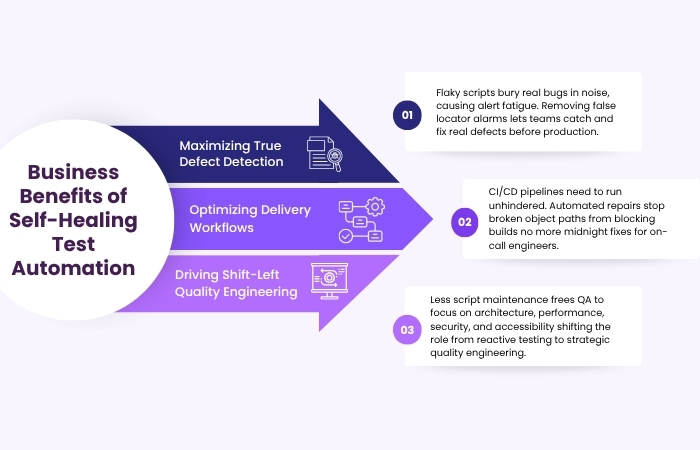
Maximizing True Defect Detection
Flaky scripts create noise that hides real system regressions. When a pipeline fails ten times a day due to minor UI adjustments, engineering teams develop alert fatigue and start ignoring test failures. Removing false locator alarms allows engineering groups to quickly isolate and resolve valid functional bugs before code reaches production environments.
Optimizing Delivery Workflows
Modern software delivery depends on unhindered continuous integration and continuous deployment pipelines. Automated repairs prevent broken object paths from halting build gates during off-hours, ensuring code moves steadily through delivery pipelines without requiring midnight interventions from on-call release engineers.
Driving Shift-Left Quality Engineering
Reducing manual script adjustments allows quality teams to move away from constant maintenance and focus on architecture design, performance boundaries, security vulnerabilities, and accessibility compliance. Modern organizations frequently partner with specialized enterprise quality engineering services to elevate the QA role from reactive testers to strategic software architects.
Practical Deployment Use Cases in Enterprise Environments
Cross-Platform Environment Validation
Interface components often exhibit distinct behaviors, rendering paths, and structural layouts when running across various operating systems, browsers, or physical devices. Multi-attribute detection systems and layout-aware analysis modules adjust automatically to these variations. Consequently, a unified verification flow runs reliably across multiple target environments, removing the need to build or support distinct script variants for every individual platform.
Large-Scale Digital Storefronts
Online storefronts require frequent structural adjustments to accommodate temporary promotional campaigns, pricing alterations, variable banner layouts, and checkout optimizations. Minor changes in container structures or CSS properties often break fragile end-to-end regression suites. To mitigate this, autonomous stabilization engines focus on user intent rather than rigid technical selectors. By assessing contextual relationships, text alignments, and adjacent component behavior, the system validates the complete transactional path.
Single Page Architectures
Modern software frameworks regularly assign dynamic or shifting element properties during automated build cycles. When development cycles move quickly, traditional static locators break immediately because they cannot track these non-persistent strings. Integrating advanced AI testing services enables autonomous frameworks to address this by ignoring randomized variable paths entirely. Instead, the verification engine analyzes the hierarchy between structural elements, semantic header linkages, and standardized accessibility identifiers.
Operating at this level of algorithmic adaptability is a core milestone in modern software lifecycles, an evolution thoroughly explored in our deep dive into AI-enhanced engineering that is redefining innovation.
Best Practices for Strategic Implementation
Deploying self-healing capabilities requires clear operational guidelines & governance structures to ensure the automated system remains reliable, trusted, and performant over time:
Establish Strict Multi-Factor Confidence Scoring
Relying on a single similarity metric often leads to false-positive test executions. The self-healing engine should combine multiple validation layers, such as XPath structural depth, visual coordinate proximity, and DOM property overlap, before applying a runtime correction.
Heuristic Thresholds: Set an explicit minimum threshold of 92% across all combined validation vectors.
Fallback Routing: Any candidate mutation that falls between 70% and 91% must be paused immediately and routed to a deterministic review system (such as a localized fallback script or an isolated debug queue) to prevent corrupted test outcomes.
Run Weekly Predictive Flakiness Audits
Frequent background corrections obscure fundamental design issues in the application source code. Treat frequent self-healing events as technical debt metrics rather than automated successes.
Actionable Trigger: Audit centralized orchestration logs every seven days.
Refactoring Rule: If a single test step triggers an autonomous repair more than three times within a single sprint, the test architecture must be locked. The development team should immediately refactor the component by embedding dedicated, non-functional testing markers, such as specific data-qa or data-test tracking attributes.
Integrate Real-Time Telemetry and Version Control Tracking
Every autonomous structural correction must be treated with the same governance as an engineering code change. Invisible runtime modifications degrade visibility during system audits.
System Integration: Connect the self-healing validation framework directly to centralized logging endpoints and code repository webhooks.
Audit Automation: When a selector modification occurs, the engine should automatically post an alert payload to a dedicated engineering notification channel and log a structural delta report. This ensures full compliance visibility for security verification and pipeline monitoring.
Define Strict Boundaries for Business Logic Mutation
Autonomous stabilization systems can resolve locational changes, timing inconsistencies, or structural shifts, but they cannot interpret alterations in operational logic.
Operational Limit: When a multi-step user flow collapses into a single interface block, or an identity verification step is removed from a sequence, the system must abort.
Corrective Path: The framework should explicitly fail the assertion and flag the pipeline. Engineers must manually adjust the test script to align with the revised user journey, protecting the application against silent product failures.
Scaling Quality with BugRaptors
Maximizing the value of automated testing requires a deliberate combination of modern platforms, clear governance, and specialized expertise. While standalone self-healing tools offer functional answers, driving long-term testing efficiency across enterprise software applications requires a structured framework designed by experts.
As a trusted provider of global quality engineering services, BugRaptors helps organizations transition away from fragile, high-maintenance testing frameworks that stall release velocities. Our structured AI testing services address the underlying causes of test flakiness, stabilize continuous delivery flows, reduce engineering resource waste, and maximize your software infrastructure investment.
Enterprise teams looking to expand their engineering capabilities or accelerate their digital transformation initiatives can seamlessly hire QA testers from BugRaptors. Our engineering professionals bring deep expertise in modern object recognition models, multi-locator strategies, CI/CD integration, and continuous quality management.

Kanika Vatsyayan
Automation & Manual Testing, QA Delivery & Strategy
About the Author
Kanika Vatsyayan is Vice-President – Delivery and Operations at BugRaptors who oversees all the quality control and assurance strategies for client engagements. She loves to share her knowledge with others through blogging. Being a voracious blogger, she published countless informative blogs to educate audience about automation and manual testing.


