

Jun 19, 2026
Architecting Reliable AI: The Complete Technical Framework for Multi-Agent System Testing
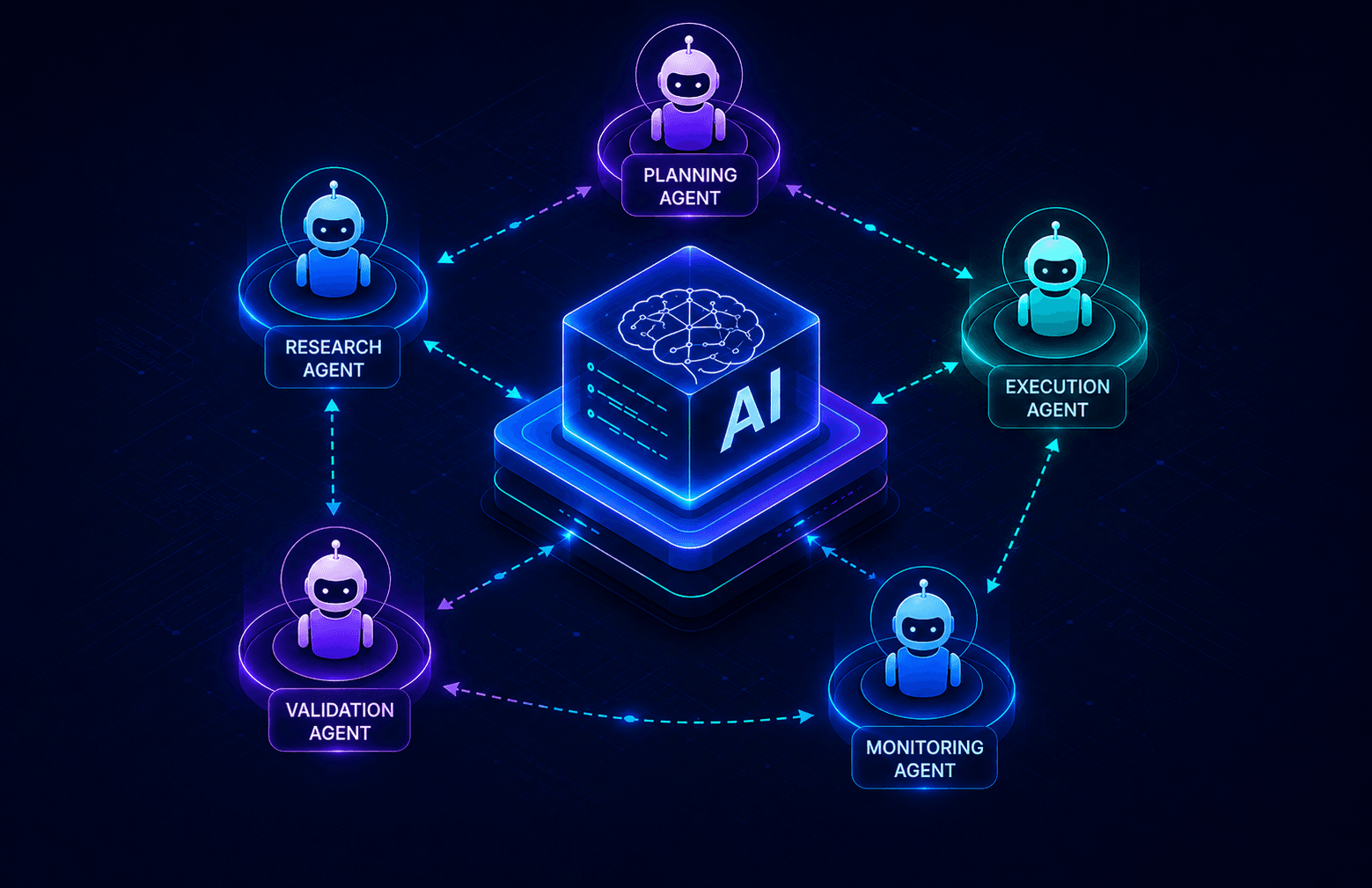
The conversation around AI validation has rapidly outgrown simple prompt engineering and single-turn model checks. While the industry spent the last few years establishing baseline protocols for individual AI agent testing, enterprise automation has already advanced to the next engineering frontier: the Multi-Agent System (MAS). The challenge is no longer about verifying how an isolated agent interprets a single request, but rather how a distributed network of specialized autonomous entities interact, negotiate, and perform actions collectively.
When software applications shift from standalone probabilistic agents to decentralized, multi-agent orchestration networks, standard quality assurance practices become obsolete. Moving past isolated AI testing to comprehensive multi-agent system testing (MAS testing) requires complete re-engineering of validation practices to handle complex emergent behaviors and protect enterprise-grade stability.
The Technical Reality of Multi-Agent Architectures
A multi-agent system is an architectural framework where multiple autonomous AI agents interact within a shared environment to achieve distributed goals. Unlike traditional software modules or even modular single-agent applications that rely on a centralized controller, a true MAS features decentralized execution. Each agent possesses localized memory, specialized tools, specific system prompts, and independent decision-making capabilities.
Common Multi-Agent Topologies
Before you can test a multi-agent system, you must understand its coordination pattern, because each topology fails differently and therefore demands a different testing emphasis:
Supervisor / Orchestrator: A central router agent delegates sub-tasks to specialized workers and aggregates their outputs. Testing focuses heavily on delegation accuracy and handoff schema compliance.
Hierarchical (Teams of Teams): Supervisors manage sub-supervisors, who in turn manage workers. Testing must validate error propagation across multiple delegation layers.
Sequential / Pipeline: Agents execute in a fixed chain where each output feeds the next input. Testing prioritizes contract validation between adjacent stages.
Network / Swarm (Decentralized): Any agent can hand off to any other agent. Testing emphasizes loop detection, deadlock prevention, and termination guarantees.
Blackboard / Shared-State: Agents read and write to a shared memory store rather than messaging directly. Testing prioritizes concurrency, race conditions, and state-consistency checks.
Frameworks commonly used to build these patterns include LangGraph, Microsoft AutoGen, CrewAI, the OpenAI Agents SDK, and Semantic Kernel. The testing strategy must adapt to whichever orchestration engine and topology your system uses.
Multi-Agent Operational Mechanics
The life cycle of a MAS is based on cooperative intelligence and is structured in three fundamental layers:
Intent Routing & Delegation: The user inquiry is intercepted by a principal router or supervisor agent, which assesses the needed capabilities and assigns particular sub-tasks to different worker agents.
Autonomous Execution & Tool Use: Worker agents understand their assigned task, create localized step-by-step plans, and execute these plans by accessing external APIs, searching databases, or executing code sandboxes.
Inter-Agent Negotiation & Handoffs: Worker agents communicate data and sub-task resolutions to other worker agents in normal language or structured data formats (e.g., JSON schemas). They negotiate inputs and outputs until the collective objective is reached.
Why Multi-Agent Systems Fail: Core Failure Modes
The non-deterministic nature of foundational LLMs, combined with the compounding complexity of multi-agent interactions, introduces entirely new failure modes. Unlike traditional software bugs that produce explicit stack traces, MAS failures are often silent, behavioral, and emergent.
Cascading Hallucinations
If Agent A hallucinates a data point, that error is passed downstream as absolute truth to Agent B. This triggers an unchecked error cascade across the system, corrupting the final output. Preventing these shared errors requires boundary verification. Read our engineering guide on LLM Output Evaluation and Hallucination Detection for validation protocols.Infinite Loops & Cross-Agent Deadlocks
Agents use self-correction loops when a task fails. However, when multiple agents interact, they can trap each other in structural deadlocks, such as repeatedly rejecting each other's data formatting rules. This bounces correction requests back and forth endlessly, stalling the workflow without ever completing the task.
Token Thrashing & Cost Spikes
When agents enter recursive communication loops or repeatedly retry failing tool actions, context windows bloat rapidly. This causes a compounding explosion in resource consumption, known as token thrashing, which drives severe spikes in AI performance testing costs within minutes without converging on a resolution.Tool Selection Ambiguity
Structural validation ensures an agent calls an API using the correct argument type, but it cannot verify semantic accuracy. Agents frequently face confusion when selecting tools, invoking the wrong database connection or API endpoint because two distinct tool descriptions share similar vector space embeddings.
Context Drift
As conversations extend across multiple turns, context windows fill up. When systems process deep data environments, which highlights the importance of incorporating specialized Big Data testing services, agents suffer from context degradation, dropping initial system rules or changing operational priorities mid-workflow.Handoff Failures
When a supervisor agent delegates work, the payload must match the exact schema the receiving agent expects. If an agent changes its output format slightly, downstream worker agents fail to parse the information, leading to unhandled message drops and silent task abandonment.
Memory Poisoning & Shared-State Corruption
In systems that use shared memory or persistent vector stores, a single agent can write incorrect or adversarial data that every other agent later trusts. Because the corrupted entry looks identical to legitimate data, the poisoning silently propagates across future trajectories until results become systematically wrong.
Categorizing the Multi-Agent Testing Strategy
To systematically address these risks, engineering teams must implement a structured, multi-agent system testing architecture. Mirroring traditional software engineering but rebuilt for probabilistic systems, the Four-Level Testing Model for MAS isolates and tests every layer of agentic execution.
Level 1: Unit-Level Checks (Determinism and Reproducibility)
The baseline layer isolates individual agents to verify consistency and foundational competency.
Focus: Determine if an individual agent responds consistently and predictably with the same inputs in isolation, a prerequisite for system debugging and structural validation.
Core Checks: Testing quick stability and tool-calling consistency This guarantees that the agent delivers the same result for the same prompt and that the proper tool is always invoked when triggered.
Methodology: Deterministic verification methods to enforce tight structural constraints on single-turn interactions. For instance, if a Recipe Planner Agent is requested to "Plan a healthy lunch under 500 calories", a high fluctuation in the response suggests delusion or inadequate grounding. Similarly, an agent whose task is to convert currencies is tested to ensure that it always maps arguments to the convert_currency(amount, from, to) tool and that it always correctly parses the returned payload.
Level 2: Unit + Integration (Context Management and Grounding)
This level tests a single agent’s capability to manage state, interact with its immediate environment, and orchestrate its allocated tools over extended multi-turn trajectories. Failures here typically stem from insufficient grounding or poorly structured system descriptions.
Focus: Avoid hallucinated replies, verify correctness of tool-grounding and retention of context instead of invoking allowed tools.
Core Checks: Tests for agent failure owing to context length restrictions, constraint drops or failure to match the proper tool due to unclear functional specifications. Simulating tool errors and exceptions and testing the agent's handling of them.
Methodology: Mocking backend tool dependencies to test agent behavior against error logs, non-numeric strings, or incorrect data inputs while retaining operational footing. If a Weather Forecast Agent makes a guess about the weather in London instead than calling a live weather API, it fails grounding verification. If a Data Analysis Agent presents the non-numeric array ["a", "b", "c"] to a calculate_mean() tool, for example, the framework tests whether the agent handles the error output graciously or crashes.
Level 3: Integration Testing (Inter-Agent Communication and Handoffs)
It examines the collaboration contract between different agents. Rather than tracking individual entities, it looks at the interfaces and coordinating contracts between autonomous units.
Focus: How to coordinate, define roles, and successfully transfer data amongst separate organizations.
Core Checks: Ensuring agents may delegate tasks to other agents without failure Changes to prompt tone or syntax do not impair handover execution Agent roles and persona descriptions are expressive enough in the vector space to enable reliable task delegation.
Methodology: Golden data sets for multi-agent transcripts simulation to validate job delegation according to systems intent. For instance, in a network of Travel Planning Agents, when a Trip Planner Agent delegates an operation to a Hotel Booking Agent, the test reports a failure when the receiving agent cannot understand the input format or when it fails due to its poorly defined or misnamed function.
Level 4: System-Level Validation (Error Propagation and Output Verification)
The final tier evaluates the end-to-end multi-agent network operating in production-grade environments, focusing on how errors are surfaced, managed, and communicated throughout the system.
Focus: Systemic resilience, financial restrictions, security limits and ways to validate final output against expected metrics.
Core Checks: Checking for infinite loops, monitoring runaway token consumption, ensuring protection against cross-agent prompt injection attacks, ensuring underlying tools have strict error checking and output format validation, and ensuring agents can detect and communicate null or failed outputs from other nodes.
Methodology: Running long-tail assessment suites that blend normal happy pathways, severe edge situations, adversarial prompt injections, and environment failures. This level also comprises the configuration of defined assessment layers such as a human-in-the-loop process or a supervisor model to evaluate final results. For instance, if a Finance Agent generates a raw cost summary string such as £400 instead of £350, a specialized Reviewer Agent for cost Reports must identify the mathematical inconsistency and mark the data for repair.
Mapping Failure Modes to Tests, Metrics, and Tooling
The table below condenses the strategy into an at-a-glance reference, connecting each failure mode to the testing level that catches it, the metric that quantifies it, and the category of tooling that detects it in production.
Failure Mode | Testing Level | Primary Metric | Detection Tooling |
Cascading hallucinations | Level 2 & 4 | Goal Fulfillment Rate | LLM-as-a-judge, RAG groundedness evals |
Infinite loops & deadlocks | Level 4 | Oscillation & Deadlock Frequency | Trace monitoring, recursion-limit guards |
Token thrashing | Level 4 | Token Budget Adherence | Cost tracing, per-trajectory budget caps |
Tool selection ambiguity | Level 2 & 3 | Tool Mismatch Rate | Tool-call assertions, embedding audits |
Context drift | Level 2 | Invariant Violation Rate | Long-context regression suites |
Reliability Engineering: Preventing Failures, Not Just Detecting Them
Detection is only half of the discipline. Production-grade multi-agent systems should also embed runtime guardrails that stop failure modes before they cascade:
Hard iteration and recursion caps that terminate a trajectory once it exceeds a defined step budget.
Per-task token and cost budgets enforced by the orchestration layer, with automatic cutoffs.
Timeouts, retries with exponential backoff, and circuit breakers around every external tool call.
Strict schema validation (JSON Schema or Pydantic) on every inter-agent handoff payload.
Deterministic fallbacks and human-in-the-loop approval gates for high-risk actions.
Idempotent tool actions so retried operations never duplicate side effects such as double-charging a customer.
A Concrete Example: Guarding Against Infinite Loops
The most common production incident in a MAS is the runaway loop. The example below illustrates a minimal recursion guard in a LangGraph-style orchestration, paired with a Promptfoo-style assertion that enforces a tool-call budget during CI.
# Orchestration-layer guard (pseudo-code, LangGraph style)
graph.compile(checkpointer=memory)
result = graph.invoke(
{"messages": [user_input]},
config={"recursion_limit": 12} # hard cap: abort runaway loops
)
# CI assertion (Promptfoo style) - fail the build if the agent
# exceeds its tool-call budget on a known scenario
tests:
- vars:
query: "Plan a healthy lunch under 500 calories"
assert:
- type: javascript
value: "output.toolCalls.length <= 3"
- type: llm-rubric
value: "Response stays under 500 calories and calls the nutrition tool exactly once"
This combination - a runtime cap plus an automated regression assertion - turns "the system sometimes loops forever" into a deterministic, testable boundary.
Observability and Tracing for Agent Networks
You cannot debug what you cannot see. Because MAS failures are emergent and silent, distributed tracing is non-negotiable. Every agent step, tool call, and handoff should emit a span that is correlated end-to-end across the trajectory.
Span-level tracing: Capture each reasoning step, tool invocation, latency, and token count as an individual span.
Correlation IDs: Propagate a trajectory ID across agent handoffs so the full path can be reconstructed.
Standardization: The OpenTelemetry GenAI semantic conventions are emerging as the vendor-neutral standard for instrumenting LLM and agent telemetry.
Tooling: Observability platforms such as Arize Phoenix, LangSmith, and Langfuse provide trace-level and span-level views purpose-built for agent debugging.
Security Hardening for Multi-Agent Systems
Multi-agent architectures dramatically expand the attack surface: each agent, tool, and shared memory store is a potential entry point. Security testing should map directly to the OWASP Top 10 for LLM Applications and the OWASP Agentic AI threat guidance.
Prompt injection: Test both direct injection and indirect injection, where malicious instructions are hidden inside documents or tool outputs that an agent later reads.
Excessive agency: Verify that agents cannot invoke tools or take actions beyond their explicitly authorized scope.
Identity & tool governance: Enforce least-privilege credentials per agent so a compromised worker cannot reach unauthorized systems.
Cross-agent injection: Confirm that a malicious payload from one agent cannot hijack the reasoning of a downstream agent.
Data privacy boundaries: Validate that sensitive data does not leak across agent or tenant boundaries during handoffs.
Benchmarks and Golden Datasets
Beyond bespoke regression suites, established public benchmarks help calibrate agent capability and catch regressions against the broader field. Useful references include the Berkeley Function-Calling Leaderboard (BFCL) for tool-use accuracy, tau-bench for tool-agent-user interaction, AgentBench for multi-environment reasoning, GAIA for general assistant tasks, and WebArena for web-navigation agents. Pairing these with your own domain-specific golden datasets gives both external calibration and internal coverage.
Key Evaluation Metrics for Multi-Agent QA
Quantitative tracking for multi-agent networks requires moving beyond static text-matching benchmarks. Because these architectures are collaborative and probabilistic, evaluation frameworks must analyze system capabilities across three distinct vectors: trajectory execution, interaction safety, and operational economics.
Trajectory & Execution Dynamics
Goal Fulfillment Rate (GFR): Measures end-to-end task completion against explicit, multidimensional constraints (e.g., resolving a support ticket while successfully updating the internal CRM database). This replaces simple text-based accuracy with validation of real-world state changes.
Trajectory Efficiency (TE): Counts the overall number of reasoning cycles, tool invocations, and inter-agent communications until resolution. Low trajectory efficiency is an indicator of "thrashing," when an agent circles through useless API calls or reasoning stages before discovering a solution.
Oscillation & Deadlock Frequency: How often autonomous agents become stuck in cycles of correcting each other (e.g., Agent A keeps rejecting Agent B's data format), wasting token budgets without progress toward job completion.
Communication & Safety Governance
Handoff Schema Compliance: Checks the structural and semantic correctness of data flows between autonomous entities. It analyzes the frequency of downstream worker agents failing to interpret payloads sent by supervisor routers.
Invariant Violation Rate: Captures the system's adherence to key organizational principles, security baselines, and data privacy limits across long-tail, multi-turn transcripts.
Tool Mismatch & Selection Confusion: Measures the accuracy of autonomous tool routing. This allows detection of when agents execute inappropriate database queries and call incorrect API endpoints due to overlapping descriptions in the vector embedding space.
Operational & Economic Sustainability
Token Budget Adherence: Monitors the total number of input and output tokens utilized per completed trajectory to detect abrupt increases induced by extended context histories or complicated self-correction sequences.
Time-to-Resolution (TTR): Quantifies end-to-end latency with multi-agent hand-offs, exposing bottlenecks in production operations.
Compute-to-Value ROI: Calculates the actual dollar cost of the API calls for the underlying model and tool executions for each successful job, guaranteeing that the multi-agent system is economically sustainable at scale.
Governance and Compliance
As autonomous agents perform acts in the actual world, validation must extend to governance. Align your MAS testing program to the NIST AI Risk Management Framework and the EU AI Act where relevant. Maintain immutable audit trails of agent decisions, enforce human-in-the-loop approval gates for consequential actions, and document risk assessments so that automated behavior remains explainable and accountable to stakeholders and regulators.
The BugRaptors Advantage
Systematic validation is required to bring multi-agent networks to production. BugRaptors provide dedicated AI testing services integrated into your development lifecycle to address non-deterministic workflows using three major technical pillars:Automated Trajectory Replay & CI/CD Pipelines: Instead of manually inspecting prompts, we use automated regression suites to mimic simultaneous talks. At each deployment, we rigorously test code against edge situations, injection attacks, and failures of tools using programmatic tools and LLM-as-a-judge patterns.
Live Trace & Loop Monitoring: We build deep tracing into your orchestration layer to prevent overruns. Our monitors monitor inter-agent handoff schemas, trace operational pathways, and immediately eliminate communication deadlocks or token thrashing before they enter production.
- Data-Layer & Guardrail Auditing: Our AI suites are complemented with specialist Big Data testing services to ensure your agents stay aligned with company data. We assess vector embeddings, validate their conformance to the live database schema and provide safety guardrails to protect production systems.

Prateek Goel
Automation Testing, AI & ML Testing, Performance Testing
About the Author
Parteek Goel is a highly-dynamic QA expert with proficiency in automation, AI, and ML technologies. Currently, working as an automation manager at BugRaptors, he has a knack for creating software technology with excellence. Parteek loves to explore new places for leisure, but you'll find him creating technology exceeding specified standards or client requirements most of the time.


