

Nov 16, 2026
API Contract Testing: Balancing OpenAPI Validation with Consumer-Driven Contracts
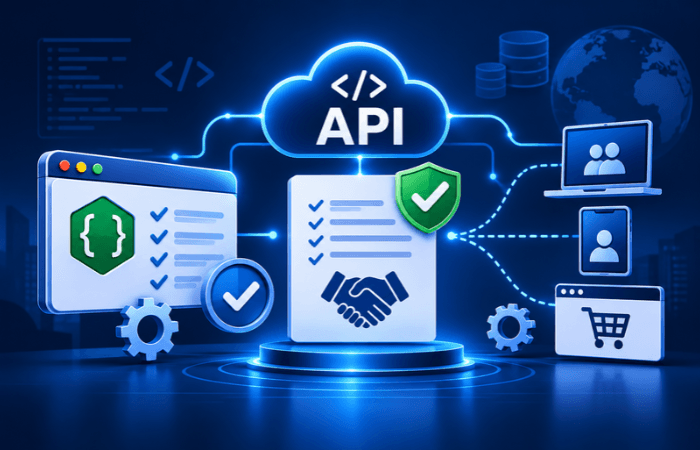
In distributed architectures, independent release trains break the traditional safety net of integration testing. A provider refactors an endpoint; unit tests pass, and its build goes green. Hours later, a downstream service crashes in production because an expected integer arrived as a string. End-to-end staging environments are too slow, flaky, and expensive to prevent these regressions at scale.
This is where API contract testing steps in. Rather than testing internal business logic or provisioning complex multi-service staging clusters, contract testing isolates the communication boundary between systems. It programmatically verifies that providers and consumers agree on payload schemas, data types, headers, and status codes before code ever merges into main.
Contract Testing vs. Functional API Testing
A common misconception among engineering teams is assuming that payload schema verification replaces standard functional test automation. They address two fundamentally different layers of system health.
Functional API validation evaluates business logic, security authentication, and database state. It asks: Given these query parameters, does the server calculate the right balance, execute the debit, and return a 200 OK?
API contract testing steps away from server-side business rules entirely. It isolates the communication boundary to answer a single question: Do the consumer and provider agree on the structure, required fields, data types, headers, and status codes traveling across the network?
Testing every edge-case business flow across a sprawling distributed web creates massive pipeline bottlenecks. Mature teams rely on dedicated API testing services to validate end-to-end business behavior, while using fast, decoupled contract testing to ensure those independent components can safely talk to each other.
Consumer-Driven Contracts and the Pact Framework
In a decoupled architecture, providers rarely understand how every downstream application uses their output. When a provider team guesses what consumers need, breaking changes are guaranteed. This operational friction led the industry toward consumer-driven contracts (CDCs).
Instead of the provider setting rules in isolation, the consumer writes tests that define the precise slice of data it actually relies on. This is where the open-source Pact framework serves as the industry standard. During the consumer's local build run, Pact spins up an in-memory mock service. The consumer executes its component tests against this mock, asserting against expected responses. Pact records these interactions into a versioned JSON contract artifact, the "pact."
The consumer publishes this contract to a central registry, typically the Pact Broker. When the provider runs its continuous integration build, it pulls active consumer pacts, executes the exact recorded requests against its active code endpoints, and verifies compliance. Adopting specialized contract testing for microservices brings crucial operational advantages:
True Team Independence: Frontend and backend squads validate contracts locally without spinning up shared staging clusters.
Safe Deprecations: Providers know exactly which consumers use specific payload fields, eliminating the fear of deprecating legacy attributes.
Rapid Build Feedback: Contract verifications run within isolated unit pipelines in seconds rather than waiting through hours-long staging runs.
OpenAPI Spec Validation: Preventing Provider Drift
While consumer contracts confirm what client applications require, they don't guarantee the provider will honor its published architectural standard. This is where OpenAPI Specification (OAS) validation enters the pipeline. The OpenAPI file is your provider’s public commitment. Yet in the real world, implementation drift happens constantly.
Developers add unmapped response fields, modify query parameter requirements, or tweak nullable properties directly in code without updating the OAS documentation. If your documentation lies about your service boundary, consumer teams build integrations on faulty assumptions. Modern pipelines solve this by using the OpenAPI spec as an active test harness.
Instead of treating Swagger as passive documentation, teams run schema linters and contract validators directly in CI pipelines. Tools like Prism or Dredd intercept provider responses during test passes, asserting every payload against the OAS definition. If code changes introduce an undocumented parameter, alter an enum value, or skip a mandatory property, the build fails before pull requests merge.
OpenAPI validation enforces the provider's structural blueprint, while Pact verifies downstream consumer compatibility. By using both of these together, they can significantly close the contract gap. However, because contracts verify structure rather than business outcomes, engineering teams combine them with a broader guide to API test automation to ensure data transformations and multi-step workflows remain equally stable across releases.
Preventing Breaking Changes in CI/CD Pipelines
The ultimate payoff of API contract testing surfaces directly at your deployment gates. Fast teams do not cross their fingers and wait for production alerts; they enforce programmatic deployment checks.
Pact’s can-i-deploy CLI tool is the gold standard for this verification. Before any service deploys, the CI pipeline queries the contract broker to confirm compatibility between the artifact version and the versions currently deployed in production. If a provider introduces a schema change that violates an active consumer contract, the deployment gate blocks the release.
Decoupling integration verification from complex test environments allows engineering squads managing high-velocity microservices to deploy multiple times daily without triggering downstream outages.
Building a Resilient API Quality Strategy
High-velocity engineering does not mean abandoning rigor; it means shifting verification where it delivers the highest return. Combining consumer-driven Pact contracts with automated OpenAPI spec validation eliminates integration guesswork across modern deployment cycles.
Embedding disciplined API contract testing across your build pipelines catches breaking boundary shifts minutes after code is committed, long before it impacts end users.
At BugRaptors, we help organizations navigate this shift. Our quality engineering specialists work directly with development teams to design end-to-end testing architectures, implement Pact frameworks, and automate schema governance inside existing pipelines.
By augmenting internal teams with focused software engineering services, we eliminate test maintenance bottlenecks and give engineering leaders the confidence to ship complex distributed systems without fear of production drift.

Vivek Rana
Manual & Automation Testing
About the Author
With rich experience of more than 10 years in the industry, Vivek Rana is a QA enthusiast working as a Team Lead at BugRaptors. Starting his journey as a system Analyst, Vivek over the years not only developed a strong grip on manual and automation testing services in different domains and different testing types but also ensures the release of quality of software products and system and manage software test teams. His fun-loving approach and whole-hearted dedication make him a perfect team player. He is a highly driven expert to improve the QA process and loves to travel to mountains escaping the city hustle and bustle whenever he longs for some leisure.


