

Oct 28, 2026
How AI Is Changing the Role of the Modern QA Engineer
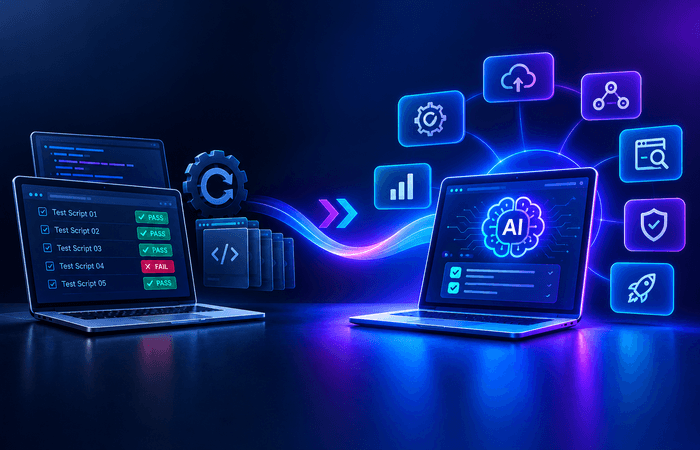
If you started in quality engineering decades ago, your whole mental model was forged in deterministic logic: assert(actual === expected).
You took a business requirement specification, mapped out boundary values, wrote explicit test steps in TestRail or Jira, and automated them in Selenium, Cypress, or Playwright. In traditional QA testing, if an input of 2 + 2 yielded anything other than 4, you opened a severity-1 blocker, attached the stack trace, and kicked the build back to the developers. The system was predictable. A green test run meant the software worked as written. A red test run meant an assertion failed.
That world is gone. Over the past few years, the software architectures landing in test environments have shifted from deterministic state machines to probabilistic, non-deterministic decision engines. When a banking client integrates an agentic RAG assistant, or an enterprise SaaS platform introduces generative workflows, there is no longer a static "expected string" to assert against.
A query run ten times might return ten syntactically different responses: eight helpful, one subtly incorrect, and one a catastrophic compliance breach. The old playbook of checking locators and running rigid regression sweeps is crumbling under this unpredictability. The work of QA engineers has fundamentally mutated. We are no longer script executors clicking buttons or writing static assertions; we have become system evaluators, statistical arbiters, and safety architects.
The Breaking Point of Deterministic Verification
To understand why the QA discipline is in the middle of its biggest structural shift in three decades, look at where traditional automation pipelines fail when confronted with modern, intelligent applications. In classic testing architectures, a test fails when a button is out of place, or an API returns an unhandled error code.
Deterministic test suites run cleanly when the codebase is static and rules-based. Now, introduce an autonomous agent that handles dynamic pricing or personalized cart recommendations. The agent inspects user history, queries a vector database, checks inventory via function calling, and generates a tailored response.
Traditional test automation fails on three distinct fronts:
The Assertion Crisis: If a checkout bot suggests "You might like this protective sleeve for your 15-inch laptop" instead of "Suggested accessory: 15-inch laptop sleeve," a standard string comparison fails. If you loosen the assertion to check only for HTTP status codes, you pass garbage responses straight to production.
The Flakiness Illusion: In the past, a flaky test was an environmental defect—a race condition, an unresolved promise, or a slow network socket. In model-driven systems, variability is inherent to the technology. Treating semantic variance as a test-runner defect misses real system drift.
The Hidden Hallucination Surface: A test run can report all green while the model quietly fabricates non-existent discount codes or exposes internal database schema details in its reasoning traces.
When your test framework can no longer rely on rigid assertions to catch regressions, running more of the same legacy scripts only compounds test suite debt. Resolving this disconnect requires fundamentally upgrading the testing apparatus itself. To test systems powered by modern data models, quality teams must adopt toolchains built on the very same algorithmic principles.
What Machine Learning Adds to the Testing Suite
Machine learning has entered the test engineering workflow from two directions: as a target that must be verified, and as a toolchain that changes how we run our infrastructure.
When engineering teams implement AI-driven test automation, the goal is not to have an algorithm write generic, low-value test scripts that no one maintains. The actual value lies in eliminating operational drag:
Dynamic Locator Healing: Traditional UI suites break when class names or DOM structures shift during front-end refactors. Modern validation frameworks parse the semantic hierarchy of the visual tree, allowing test runners to identify target UI components without failing on cosmetic layout shifts.
Intelligent Test Impact Analysis: Running a 15,000-test regression suite on every pull request is costly and slow. Machine learning models map historical failure data against git diffs and execute the top slice of test paths most likely to catch regressions.
Synthetic Boundary Synthesis: Creating millions of valid, sanitized test records that mimic edge-case production anomalies used to take weeks of manual database seeding. Modern data generation pipelines create domain-specific synthetic datasets while maintaining strict data masking standards.
Replacing Binary Checks with Evaluation Metrics
Faster test selection and self-healing UI locators keep pipelines running smoothly, but improving test execution speed doesn't solve the underlying verification dilemma. Accelerating a broken assertion model simply delivers flawed feedback faster. Once your test runner handles DOM shifts without crashing, you face the real technical hurdle: how do you measure the correctness of a system whose responses fluctuate by design?
You cannot run a binary string comparison on probabilistic output. Doing so creates two bad outcomes: your tests fail constantly on harmless phrasing variations, or your assertions become so loose that hallucinations slip into production unnoticed. To fix this, modern testing replaces static assertions with multi-dimensional evaluation vectors:
From String Matching to Groundedness Scoring: Instead of asserting that an answer contains an exact phrase, we measure faithfulness against retrieved reference chunks. If a customer support bot answers a policy question, the pipeline verifies that every statement maps mathematically to source documentation, stopping the model from fabricating return windows or non-existent discounts.
From API Status Codes to Retrieval Precision: An HTTP 200 on a vector search query means nothing if the underlying retrieval engine pulled five noisy, irrelevant chunks. Modern validation scores context recall and precision, ensuring the model gets the exact context it needs while keeping token costs and latency under control.
From Static Regression Runs to Drift Detection: When a team tweaks a system prompt or switches underlying model versions, legacy test suites cannot detect subtle shifts in tone or logic. We track semantic similarity deltas across standardized golden datasets, catching silent performance drops before users encounter them.
From Input Sanitization to Adversarial Stress-Testing: Standard SQL injection and XSS fuzzing will not catch prompt injections or indirect jailbreaks. Quality teams run automated adversarial suites to see if carefully crafted user inputs can force the model to bypass its guardrails or trigger unauthorized backend API calls.
Rather than asserting equality, modern CI/CD pipelines run automated evaluation batches across curated golden datasets. If an aggregate faithfulness score drops below 0.90, or automated adversarial scans detect prompt leakage, the build fails before deployment.
This transformation mirrors the industry's previous move toward the full-stack QA tester, where QA engineers expanded their scope from black-box manual checks to API protocols, database internals, and CI/CD pipelines.
Yet, implementing statistical metrics reveals an immediate operational trap. Mathematical scores show that an output shifted, but they cannot tell you why that shift matters to a customer, or whether a statistically acceptable answer breaches regulatory standard. Relying solely on automated scoring creates a false sense of security.
Why Algorithms Cannot Replace Human Critical Thinking
There is a widespread misconception that autonomous evaluation systems will make quality engineers obsolete. In practice, automated evaluation without human expertise creates an echo chamber. Algorithms excel at computational scale. An automated runner can execute 10,000 prompt permutations overnight and score their semantic similarity against baseline vectors.
What the algorithm cannot do is evaluate whether the output aligns with real-world enterprise context, regulatory guidelines, or complex user psychology. When an automated model judges another model, it shares the same underlying blind spots. Without strict human calibration, automated judges drift and approve plausible-sounding output that violates domain rules.
The analysis of human testing vs. AI testing explores the distinction between programmatic speed and human analytical depth. When software transitions into complex agentic behaviors such as an assistant taking actions across third-party APIs based on user intent, human engineers design the sandbox safety limits.
The Engineering Shift: Core Competencies for Modern QE
If you are leading an engineering organization or seeking to upskill your team, the required technical profile looks very different from what it was five years ago. When enterprises evaluate talent, the baseline expectation is no longer just writing boilerplate browser scripts.
Teams increasingly look to hire AI and ML testers who bring statistical literacy, data engineering foundations, and systems thinking to the table.
Core Focus Areas for the Modern Quality Engineer
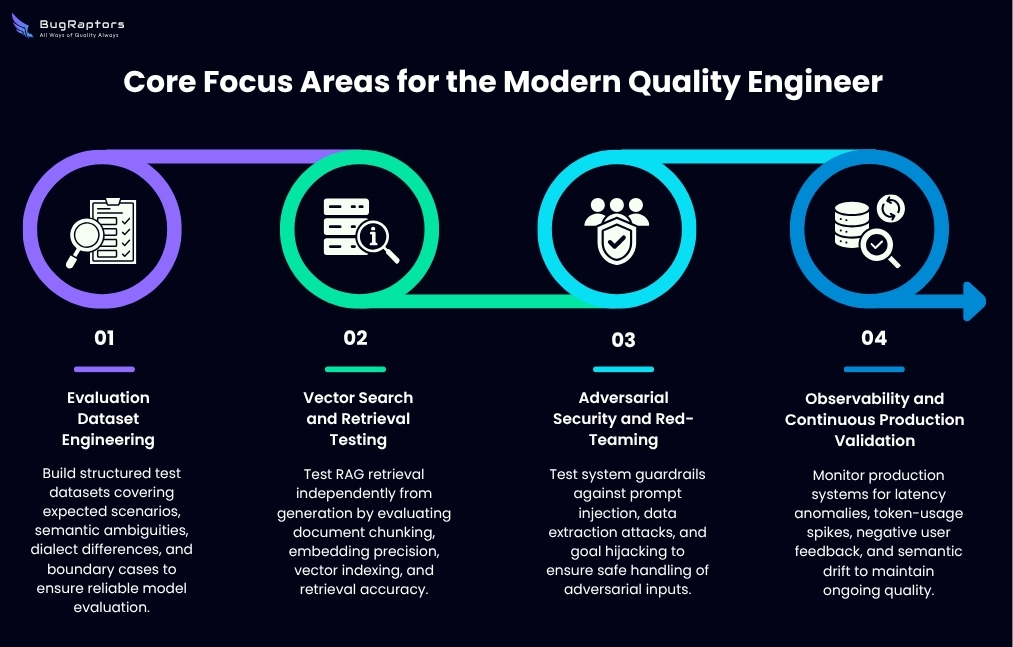
Evaluation Dataset Engineering: The quality of any model evaluation depends on the quality of the golden evaluation dataset. Modern QA engineers curate stratified test datasets that cover happy paths, semantic ambiguities, dialect differences, and boundary edge cases. Designing these evaluation datasets requires systematic boundary-value analysis.
Vector Search and Retrieval Testing: Validating RAG applications requires testing the information retrieval step independently from the generation step. QA professionals inspect document chunking sizes, embedding model precision, vector indexing strategies, and retrieval accuracy to identify errors before context ever reaches the inference layer.
Adversarial Security and Red-Teaming: Quality assurance now encompasses safety and security testing. Modern QA engineers actively attempt to break system guardrails via prompt injection, systemic data extraction attacks, and goal hijacking, ensuring the application handles adversarial inputs safely.
Observability and Continuous Production Validation: Testing does not stop once the code is merged. Quality engineers instrument production tracing to track latency anomalies, token-usage spikes, negative user-feedback patterns, and semantic drift across live production traffic.
BugRaptors’ Delivery Framework: Quality Engineering for Modern Architectures
Adapting to non-deterministic systems requires modernizing testing processes, tools, and technical competencies. Testing intelligent platforms with legacy manual workflows leads to delayed releases, hidden production incidents, and runaway cloud costs.
At BugRaptors, we offer specialized software testing services to help engineering teams build, validate, and scale resilient applications:
Hybrid Automation Ecosystems: We build maintainable test automation infrastructures that integrate modern UI and API automation with automated model evaluation frameworks.
Model & RAG Validation Pipelines: Our specialists implement structured evaluation pipelines to measure faithfulness, retrieval precision, latency, and hallucination rates in CI/CD environments.
Adversarial Red-Teaming & Security Audits: We evaluate applications against prompt injection attacks, sensitive data leakage, and compliance vulnerabilities before code reaches production.
Enterprise Modernization Strategies: We help organizations transform legacy testing teams into modern quality engineering units, reducing test maintenance overhead while expanding coverage.
The shift from manual tester to AI validator does not diminish the need for quality assurance; it elevates it. As systems grow more complex and unpredictable, the need for rigorous, analytical, and structured quality validation becomes the foundation of dependable software.
The Road Ahead: Taking Control of the Quality Shift
The move from manual script executor to AI validator is the natural maturation of our trade. Systems have outgrown static assertions. Quality is no longer measured by how many binary test scripts pass before release; it is defined by how well software behaves when handling unexpected, real-world data.
Organizations that modernize their pipelines with evaluation frameworks will ship faster and safeguard brand trust. Those relying purely on legacy assertions risk stalled release cycles from false positives and undetected drift.
Whether you are upgrading existing frameworks or looking to hire automation testers who understand probabilistic validation, now is the time to rethink your validation foundation and build release confidence for modern architecture.

Kanika Vatsyayan
Automation & Manual Testing, QA Delivery & Strategy
About the Author
Kanika Vatsyayan is Vice-President – Delivery and Operations at BugRaptors who oversees all the quality control and assurance strategies for client engagements. She loves to share her knowledge with others through blogging. Being a voracious blogger, she published countless informative blogs to educate audience about automation and manual testing.


