

Dec 16, 2024
Hyperautomation in QA: The Next Big Leap in Automation Testing Services
Businesses nowadays are forced to continuously look for methods to improve their operations due to the unrelenting pace of business. In this environment, hyperautomation emerges as an effective solution that minimizes manual assistance, lowers costly errors, and automates complex procedures. Additionally, it offers businesses a competitive advantage in the marketplace if they can implement automation swiftly and effectively.
Hyperautomation is a catalyst for enhanced productivity and optimized procedures that go beyond traditional automation testing services. Its transformational potential is shown by Gartner's projection that by the end 2024, enterprises would reduce operational expenses by 30% by integrating hyperautomation technology with redesigned operational procedures.
The complex nature of these hyperautomated systems calls for a thorough approach to quality assurance (QA). That is precisely where hyperautomation testing arises as a specialist discipline to ensure your systems' security, performance, and dependability.
What is Hyperautomation Testing?
Hyperautomation testing is a combination of automation and AI testing services that goes beyond automating individual activities to test big, interconnected systems from beginning to end. It's a clever combination of state-of-the-art technologies that complement one another to revolutionize the testing process. The main elements of hyperautomation testing are broken down as follows:
Extensive Scope: It includes every stage of the software development lifecycle, from designing and gathering requirements to deploying and maintaining the system.
Integrated Technologies: Hyperautomation builds a strong and intelligent testing framework using AI, ML, RPA, and other cutting-edge technologies.
Continuous Learning: Over time, hyperautomation testing systems optimize test coverage and efficiency by continually learning and adapting in response to test results and feedback.
Data-Driven Approach: It makes use of AI and data analytics to spot trends, foresee possible problems, and organize testing activities.
Emphasis on business Results: Hyperautomation testing ensures that applications fulfill user demands and provide value by aligning with corporate objectives.
How does Hyperautomation Work?
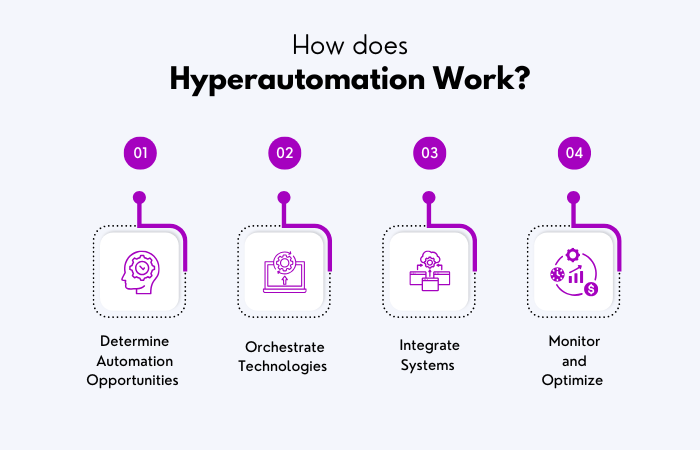
Hyperautomation is an approach to automating as many organizational tasks as possible, going beyond simple task automation. Creating intelligent, learning, and flexible systems is the aim. Here's an illustration of how it works:
Determine Automation Opportunities
Specify which processes are prepared for automation first. This might entail everything from data input and invoice processing to client service and report creation.
Orchestrate Technologies
Hyperautomation makes use of a number of technologies, each of which is essential. RPA, or robotic process automation, manages repetitive, rule-based tasks. Making decisions and addressing problems is made feasible by artificial intelligence (AI). The system can analyze data, learn from it, and get better over time with the use of machine learning (ML).
Integrate Systems
Hyperautomation is not a standalone process. It facilitates the smooth transfer of data between various platforms and software. This dismantles data silos and establishes a cohesive and effective process.
Monitor and Optimize
Hyperautomation systems undergo ongoing monitoring and analysis once they are put into place. This enables continuous optimization, guaranteeing their continued efficacy and efficiency as well as their ability to adjust to shifting business requirements.
Organizations can make sure their hyperautomation projects are solid & dependable and produce the intended results by utilizing the top AI automation testing tools, along with automation testing services and thorough QA testing
Advantages & Limitations of Hyperautomation Testing
Although it presents a strong route to improved software quality and effective delivery, hyperautomation testing is not without its challenges. The advantages and difficulties are broken down as follows:
Advantages –
Elevated Quality: Thorough testing ensures high-quality software applications that meet user expectations and business requirements.
Enhanced Efficiency: Compared to manual testing, automated tests run more quickly and often, which speeds up development and feedback cycles.
Decreased Expenses: Costly rework is minimized, and total development expenses are reduced by early fault discovery and resolution.
Enhanced Customer Satisfaction: Better user experiences and higher customer satisfaction are the results of high-quality apps.
Faster Time-to-Market: Organizations may launch goods more quickly thanks to efficient testing procedures that facilitate speedier release cycles.
Improved Scalability: As applications develop and get more complicated, hyperautomation testing may readily grow to meet expanding testing requirements.
Limitations –
System Complexity: Careful planning and coordination are necessary to handle the complexity of linked systems and technology.
Specialized Skillset: For the implementation and management of hyperautomation testing, a workforce with knowledge of many technologies and testing techniques is necessary.
Test Data Management: It can be challenging to create and maintain realistic test data for intricate scenarios.
Tool Selection: Careful consideration is needed to select testing tools and frameworks that perform well with current systems.
Maintaining Test Stability: Continuous maintenance and upgrades are necessary to guarantee the stability and dependability of automated tests as systems change.
Hyperautomation Testing vs. Automation Testing
While both aim to enhance efficiency in software testing using AI and machine learning, hyperautomation testing represents a significant evolution from traditional automation testing. Here's a table highlighting the key differences:
S.NO | Feature | Automation Testing | Hyperautomation Testing |
1 | Scope | Automates individual tasks or tests within a defined process. | Orchestrates end-to-end testing of complex, interconnected systems and workflows. |
2 | Technologies | Primarily relies on scripting and dedicated test automation tools. | Leverages a combination of AI/ML, Robotic Process Automation (RPA), Business Process Management (BPM), and other advanced technologies. |
3 | Complexity | Relatively less complex, focusing on specific functionalities. | Significantly more complex, encompassing diverse technologies and intricate workflows. |
4 | Skillset | Requires testers with scripting and testing tool knowledge. | Demands a multi-skilled team with expertise in AI/ML, RPA, integration, and testing methodologies. |
5 | Adaptability | Limited adaptability to changing conditions or requirements. | Highly adaptable and capable of learning and optimizing over time through AI/ML. |
6 | Decision Making | Relies on predefined rules and scripts for test execution. | Incorporates AI/ML for intelligent decision-making, test case optimization, and dynamic adaptation. |
7 | Data Management | Often requires manual data setup and management for testing. | Leverages AI/ML to analyze data, predict potential issues, and optimize test data management. |
8 | Maintenance | Requires regular script updates and maintenance as applications evolve. | AI/ML algorithms aid in self-maintenance and adaptation to evolving systems, reducing manual effort. |
9 | Objectives | Primarily focuses on automating repetitive testing tasks and increasing test coverage. | Aims to optimize entire workflows, improve software quality, accelerate delivery, and enhance business outcomes. |
By partnering with experienced automation testing service providers, and prioritizing comprehensive QA Testing, organizations can effectively transition from traditional automation to hyperautomation testing, unlocking greater efficiency, quality, and business value.
Use Cases for Hyperautomation Testing
Hyperautomation testing isn't just a theoretical concept; it's finding real-world applications across diverse industries. Here are some compelling use cases:
Telecommunications: By automating customer support contacts, service provisioning, and network monitoring, telecom businesses may increase service quality and decrease downtime.
Financial Services: Banks may simplify loan applications, fraud detection, and risk assessment procedures by utilizing hyperautomation testing. This ensures accuracy and compliance while speeding up approvals.
Healthcare: By using hyperautomation testing, hospitals can improve patient onboarding, scheduling, and claims processing. AI-powered picture analysis can even help with medical diagnosis.
Online Retail: Consider a company that processes hundreds of orders per day. By ensuring smooth order processing—from inventory checks and payment processing to shipping and delivery updates—hyperautomation testing may improve customer satisfaction.
Manufacturing: By reducing mistakes and increasing productivity, hyperautomation testing can improve quality control procedures, production line efficiency, and predictive equipment maintenance.
Closing Thoughts
Hyperautomation testing is transforming software quality assurance by providing a powerful way to optimize operations, accelerating delivery, and improving software quality. Organizations that embrace this new frontier in automation testing services may achieve previously unattainable levels of efficiency, accuracy, and customer happiness.
Partnering with skilled AI testing service providers like BugRaptors and putting rigorous QA testing first is critical for navigating the challenges of hyperautomation testing and realizing its full potential. As firms implement hyperautomation, staying ahead of the curve with strong testing techniques is critical to preserving a competitive edge in today's changing technology world.

Raghav Vashishth
Performance Testing, API Testing, Mobile & Web Testing
About the Author
Raghav is a QA enthusiast working as a Team Lead at BugRaptors. He has diverse exposure in various projects and application testing with a comprehensive understanding of all aspects of SDLC. He has 7 plus years of hands-on experience with blue-chip companies like Hitachi, Vmware, and Kloves. He is well versed in Load and Performance testing, API Testing, Manual testing, Mobile application testing, Web application testing and can create effective documentation related to testing such as Test Plan, Test Cases, Test Reports, etc.


