

Aug 7, 2026
Enterprise Regression Testing: Architecting Continuous Validation for High-Velocity SDLCs

Engineering leadership faces a persistent dilemma: accelerating release velocity or protecting platform stability. As microservice architectures scale and daily commit volumes grow, test suite execution times stretch from minutes into hours. Flaky scripts and unstable UI locators break build pipelines, forcing senior engineers to spend sprint cycles debugging false positives.
Enterprise organizations scale deployment frequency by integrating specialized regression testing services into continuous delivery pipelines. Modern engineering organizations cannot afford to let quality assurance become a deployment bottleneck. Scaling deployment frequency from weekly sprints to multiple daily commits demands automated verification pipelines that provide instant feedback.
Strategic test suite structuring prevents pipeline congestion, keeping fault detection rates high across all services. This technical guide outlines execution frameworks, SLA benchmarks, and AI validation strategies designed for engineering managers and QA directors.
Architecting a Multi-Tiered Validation Framework
Not every code modification demands executing thousands of test scripts across an enterprise application. Running full suites after minor text changes wastes compute infrastructure and delays pull request approvals. High-performing engineering teams structure validation into three distinct execution tiers based on operational depth and pipeline placement. Structuring test suites into specialized layers optimizes resource utilization giving developers rapid commit feedback.
Tier 1: Smoke Gates (Build Acceptance SLAs)
Smoke validation gates execute immediately following a build or pull-request trigger, acting as hard acceptance filters. Operating under a strict 5-to-10-minute SLA, these lightweight test runs validate core API contracts, database connectivity, and primary authentication pathways.
If a smoke run fails, the build rejects instantly, locking downstream staging environments before developer bandwidth is spent. Automated smoke gates protect continuous integration pipelines from dead builds and broken dependency chains.
Tier 2: Targeted Sanity Suites (Impact-Based Scopes)
Sanity testing focuses on modified microservices, adjacent application modules, and directly linked downstream endpoints. Rather than executing thousands of unrelated test scripts, sanity suites isolate validation to changed code paths and immediate dependency graphs.
These targeted runs finish within fifteen to thirty minutes, providing feature teams with rapid feedback without blocking shared deployment queues. Catching component-level defects during feature integration prevents complex integration bugs in staging.
Tier 3: Full Regression Suites (Release Milestone Gates)
Full regression suites execute across multi-tenant staging environments prior to major production releases, enterprise upgrades, or database migrations. Covering deep end-to-end user workflows, historical edge cases, and cross-browser matrices, this tier guarantees broad application integrity.
Engineering organizations run comprehensive automation regression testing asynchronously overnight or across distributed cloud infrastructure to avoid pipeline congestion. Complete test coverage gives technical leadership total confidence before initiating production deployments.
Validation Tier Performance and Execution Benchmarks
Tier | Target SLA | Execution Frequency | Pipeline Trigger | Failure Action |
Smoke | < 10 Mins | Every Commit / PR | Post-Build Compile | Reject Build & Block PR |
Sanity | 15–30 Mins | Feature Branch Merges | Patch Deployment | Block Feature Integration |
Full Regression | 2–4 Hours | Nightly / Pre-Release | Release Candidate Gate | Halt Production Deployment |
Critical Execution Triggers: When and Where to Gate Regression Runs
Executing test suites without clear operational triggers creates delivery bottlenecks and increases cloud infrastructure costs. Engineering leaders establish explicit deployment gates to maintain predictable release cycles across distributed development teams. Identifying specific code events determines whether to deploy smoke, sanity, or full regression checks. Strategic timing keeps integration pipelines running cleanly protecting core service availability.
API Schema Mismatches & Service Mesh Updates
Modifying REST or gRPC API contracts within a microservice ecosystem can disrupt downstream consumers without triggering build errors. Gating service mesh updates with automated contract regression suites prevents breaking payload changes from reaching staging environments.
Contract validation scripts execute within five minutes, confirming backward compatibility across consumer endpoints. Catching interface mismatches early prevents silent communication failures across microservices.
Database Schema Alterations & Data Pipeline Shifts
Altering table indexing, column types, or relational schemas introduces query latency spikes or data serialization failures under high load. Executing automation regression testing against populated staging databases verifies that complex transactional operations function within performance thresholds.
Post-migration validation checks prevent subtle data corruption and transaction timeouts during live operations. Deep data validation protects database integrity during major infrastructure shifts.
Third-Party Integrations & External SaaS Dependencies
External payment processing gateways, identity providers, and messaging platforms update APIs on independent release schedules. Automated integration suites mock third-party responses, testing live sandboxes for interface drift. Identifying external API changes early prevents sudden checkout failures or login drops in production environments. Continuous external contract monitoring safeguards critical revenue channels.
CI/CD Pull Request Validation Gates
Embedding automated test gates directly into GitHub Actions or GitLab CI pipelines keeps broken code off main development branches. Feature branches must pass automated unit and integration checks before code reviews receive final approval.
Enforcing automation regression testing maintains high code quality across distributed engineering teams, keeping main branches release-ready. Reviewing an enterprise AI testing checklist helps engineering teams integrate systematic verification standards directly into continuous deployment pipelines.
Automation Regression Testing: Solving Scalability, Flakiness, and Parallelization
Manual verification fails when application complexity grows beyond a few hundred user interaction paths. Executing test suites manually extends release cycles from hours to weeks, creating massive operational backlogs.
Adopting automation regression testing provides continuous feedback on software health across rapid deployment pipelines. Automated test engines execute hundreds of complex functional checks across multiple browser types simultaneously.
Eliminating Test Suite Flakiness and False Positives
Flaky tests represent a primary source of friction for QA directors, destroying developer trust in automated pipeline gates. Intermittent network timeouts, dynamic UI loading delays, and unmanaged test data cause scripts to fail randomly.
Implementing explicit API wait conditions, automated test data teardowns, and smart retry mechanisms restores pipeline credibility. Reliable test execution keeps engineering teams focused on true application defects rather than false build failures.
Parallel Execution Architecture & Infrastructure Cost Optimization
Running sequential test runs across large enterprise test suites slows down release velocity and wastes compute resources. Engineering teams build containerized execution environments using Playwright, Cypress, or Selenium running on Kubernetes clusters.
Distributing test runs across dozens of parallel worker nodes reduces total execution time from six hours to twenty minutes. Parallelization allows QA teams to scale test volume without extending pipeline feedback times.
Combining Strategic Manual Expertise with Automation
High-performing engineering organizations combine automated execution with strategic manual validation. Automated pipelines handle repetitive regression checks and performance benchmarks. Specialized manual testing services evaluate exploratory scenarios and usability design.
Integrating structured automation with expert manual checks delivers complete technical coverage and superior user experiences. Strategic resource allocation optimizes testing spend, maximizing fault detection.
Modernizing Frameworks with Quality Engineering Services
Building scalable test frameworks requires modular architecture, clean page object abstractions, and seamless CI pipeline integrations. Partnering with external technical specialists for quality engineering services helps enterprise organizations replace legacy test frameworks and reduce script maintenance overhead.
Structured framework architecture allows QA teams to expand test coverage without increasing operational friction. Modern quality frameworks transform testing from a project expense into an operational asset.
AI Regression Testing: Self-Healing Frameworks and Dynamic Test Selection
Traditional automation scripts break frequently when frontend developers modify HTML DOM elements, CSS selectors, or component structures. Modern AI testing services replace fragile static locators with dynamic self-healing mechanisms, reducing script maintenance overhead by up to seventy percent.
Machine learning models transform script maintenance from a manual bottleneck into an automated background process. Intelligent test platforms keep build pipelines moving forward avoiding continuous UI changes.
Self-Healing DOM Matching Mechanics
Self-healing test engines evaluate application elements using weighted machine learning algorithms instead of relying on rigid XPath strings. When an element ID changes, the AI engine analyzes surrounding DOM trees, accessibility tags, visible text, and spatial layout positions.
The system calculates probability scores for adjacent DOM nodes, identifies the matching element, and updates selector references at runtime. Autonomous selector healing keeps test suites running smoothly without manual engineer intervention.
Computer Vision and Pixel-Level Visual Diffing
Standard functional scripts often miss visual bugs like overlapping text elements, broken grid layouts, or hidden buttons. AI-driven visual testing platforms capture full-page screenshots and compare them against baseline visual representations using computer vision algorithms.
Machine learning models filter out minor rendering variations caused by browser updates, highlighting true layout regressions. Automated visual validation guarantees pixel-perfect user interfaces across all device screen resolutions.
Commit-Driven Dynamic Test Selection
Executing a ten-thousand-test regression suite for a minor backend bug fix creates unnecessary compute expense and pipeline delay. Machine learning models analyze incoming Git commits, map changed code paths to historical test execution graphs, and trigger relevant test subsets.
Dynamic test selection reduces test execution times by sixty to eighty percent without dropping defect detection rates. Targeted test selection accelerates developer feedback, cutting cloud infrastructure costs.
Deploying AI Engineering Solutions for Enterprise QA
Enterprise technology stacks require specialized AI engineering solutions and expert regression testing services to integrate machine learning into existing CI/CD pipelines. Advanced predictive analytics models analyze past defect data to identify high-risk software modules following code commits.
Predictive risk scoring directs QA leadership on where to focus test execution resources for maximum fault prevention. Intelligent quality platforms empower software organizations to maintain high quality standards across rapid release cycles.
Building a Modern Quality Engineering Architecture with BugRaptors
Achieving rapid deployment velocity demands a balanced validation architecture rather than total reliance on a single tool. Automated pipelines catch breaking builds, AI frameworks handle UI locator churn, and specialized testing teams evaluate complex exploratory journeys. Partnering with comprehensive regression testing services helps enterprise technology organizations construct resilient validation ecosystems.
BugRaptors integrates engineering expertise, automated frameworks, and intelligent platforms to secure fast-paced software delivery. We deliver structured architectural capabilities across five core pillars:
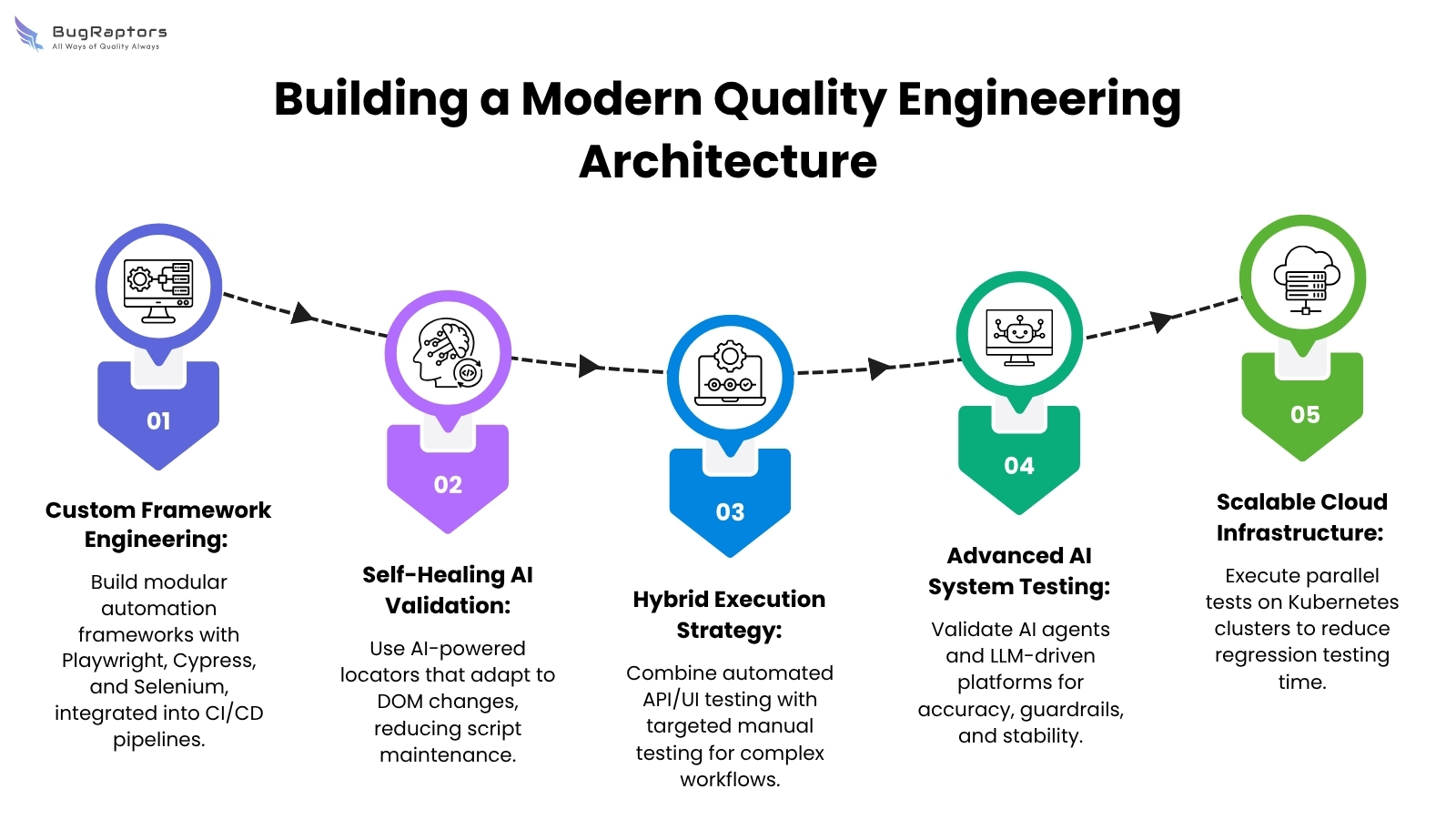
Custom Framework Engineering: Architecting modular, maintainable automation frameworks using Playwright, Cypress, and Selenium. Integrating automated test execution directly into Jenkins, GitHub Actions, and GitLab CI pipelines eliminates manual release delays through seamless automation regression testing.
Self-Healing AI Validation: Deploying machine learning locators that adapt to DOM modifications in real time. Replacing brittle static selectors cuts script maintenance overhead by up to seventy percent across large enterprise applications.
Hybrid Execution Strategy: Blending automated API and UI scripts with targeted manual testing services. Experienced QA engineers conduct deep exploratory testing across complex transactional workflows and edge cases that automated scripts miss.
Advanced AI System Testing: Applying specialized validation protocols for testing autonomous AI agents and LLM-driven platforms. Methodical testing models verify accuracy, guardrails, and system stability across non-deterministic software outputs.
Scalable Cloud Infrastructure: Executing parallel test runs across containerized Kubernetes clusters. Distributing execution loads across hundreds of parallel nodes reduces full regression run times from hours to minutes.
Partnering with BugRaptors gives technical leaders full visibility into software stability, pipeline efficiency, and defect distribution. Utilizing dedicated regression testing services allows enterprise engineering teams to accelerate feature delivery with complete confidence.
Concluding Thoughts
Accelerating software delivery without compromising system stability requires replacing outdated testing methods with modern, multi-tiered validation architectures. Implementing automation regression testing, self-healing AI frameworks, and targeted exploratory checks protects platform performance across rapid release cycles.
Continuous validation pipelines catch severe defects long before they impact the end user experience. Engineering leaders who modernize their quality pipelines reduce script maintenance overhead, eliminate release bottlenecks, and deliver ideal software products.
Rajeev Verma
Security Testing, Web & Mobile Testing
About the Author
Rajeev works as Project Manager at BugRaptors. He is working on several Web Applications, Network Vulnerability assessments, Mobile Applications, Secure Network Architecture reviews. Proven track record of successfully leading and mentoring cross-functional teams in dynamic environments. Work with all of the development teams to improve initial release quality, quality of production releases and agile development practices. He is passionate about leveraging technology to elevate QA practices and contribute to the success of innovative projects.


