

Jun 30, 2026
Safeguarding Multi-Brand E-Commerce: Architectural Quality Engineering for Enterprise Scale

When you operate a digital commerce ecosystem across multiple international borders, processing thousands of concurrent checkout events for over 70 global brands, the standard concept of "QA" completely breaks down.
Most corporate discussions treat software validation as a simple pre-release checklist, a final mechanical hurdle before a deployment goes live. However, they don’t realize that a single decoupled subsystem failure during a peak regional shopping event can cause immediate cart abandonment, inventory misalignment, or multi-tenant data leakage. In such cases, software quality ceases to be an operational afterthought. It becomes a core driver of business revenue.
Being quality engineering strategists, we have spent years in the trenches managing these exact architectural pressures. In our experience, scaling an enterprise retail platform requires moving far beyond basic e-commerce website testing. It demands a shift towards designing proactive, machine-driven validation systems that uncover architectural anomalies before they affect a single live customer transaction.
The Distributed Realities of Enterprise Retail Architecture
To understand why traditional testing methods fail at scale, we must first look at the sheer complexity of modern multi-tenant environments.
Architectural Fragmentation: Moving Beyond the Monolith
Enterprise retail networks rarely look like standard, self-contained web applications. Instead, they operate as deeply fragmented ecosystems where headless frontend presentation layers connect asynchronously to multi-tenant transactional backends, localized CRM platforms, and distributed third-party logistics engines.
The Blast Radius: How Localized Changes Create Systemic Risks
When an engineering team deploys a localized update for a single brand, the blast radius can be massive. A database configuration tweak or an unverified endpoint change can ripple through the entire ecosystem, silently breaking checkout paths for entirely different brands that share that underlying architecture.
Data Pipeline Validation: Testing the Hidden Paths of Commerce
This structural volatility is exactly why comprehensive e-commerce website testing must look at the entire data pipeline. We aren't simply validating that a "Buy Now" button looks correct on a desktop screen. We are verifying asynchronous data states, analyzing edge-case payload transformations across distributed microservices, and confirming that localized tax and currency calculation engines execute flawlessly under fluctuating network conditions.
Managing this level of fragmentation through manual exploratory testing is mathematically impossible; it requires a specialized software testing company that treats code quality as an algorithmic, architectural discipline.
The Real-World Friction Points in Multi-Tenant Environments
When you are responsible for stabilizing a platform that powers global digital commerce, you quickly realize that enterprise-level risks look completely different from standard software bugs. Over years of hands-on delivery, we have found that four distinct architectural friction points consistently threaten platform stability:
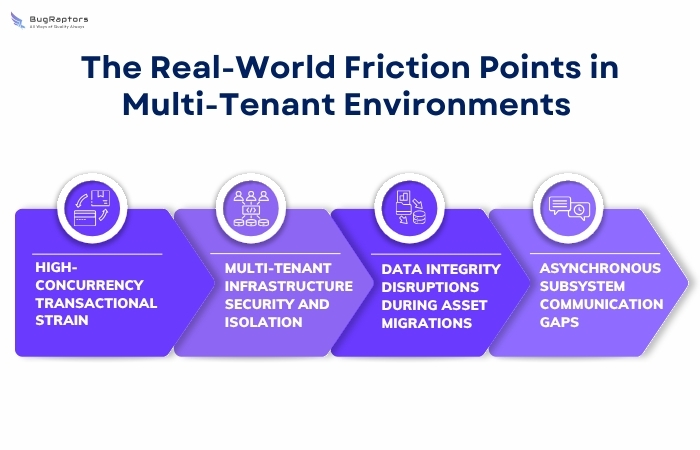
High-Concurrency Transactional Strain
Promotional traffic spikes trigger aggressive concurrent database writes and search queries. Basic functional checks fail to detect connection pool exhaustion or memory leaks under heavy user load. For example, J.Crew suffered a Black Friday outage costing an estimated $10 million due to capacity overloads. Costco faced similar Thanksgiving traffic surges that exposed hidden backend microservice bottlenecks, causing systemic checkout slowdowns.
Multi-Tenant Infrastructure Security and Isolation
Shared infrastructure for multiple brand profiles creates severe data exposure risks. Access control misconfigurations or API routing errors breach isolation boundaries. Continuous, automated verification must protect customer registries and transaction histories. The Salesforce/Heroku vulnerability showed this when leaked GitHub tokens allowed unauthorized access across distinct tenant environments. Adobe Commerce/Magento faced a similar issue via the PolyShell exploit, exposing thousands of subdomains to remote code execution.
Data Integrity Disruptions During Asset Migrations
Moving millions of digital assets between legacy storage and modern platforms risks file corruption, metadata loss, and broken path resolutions. Broken storefront elements immediately drop checkout conversions. Gymshark faced this during its migration to Shopify Plus, experiencing a multi-hour database and asset delivery failure on Black Friday. This disruption left millions of global customers stranded, proving the need for automated asset synchronization pipelines.
Asynchronous Subsystem Communication Gaps
Decoupled frontends rely on background API transactions that are sensitive to schema changes. Unannounced edits to backend fields disrupt order-fulfillment pipelines, breaking tracking and checkout functions. The Fastly CDN outage proved this fragility when a single-line routing change severed asynchronous pathways for Amazon, Target, and eBay, breaking global backend-to-frontend communications instantly.
Designing a Modern, Scalable Validation Strategy
A seamless user journey across an online retail store demands a flawless underlying architecture. As global online transactions continue to climb, a specialized software testing organization must employ multi-layered web testing services to protect the user experience from performance lag and transactional failures.
Building a resilient, high-performance ecosystem relies on five core pillars of ecommerce website testing.
Functional & UI Test Automation
A broken checkout funnel or a non-responsive cart icon translates directly into immediate revenue loss. Modern storefronts must render flawlessly across thousands of browser-device combinations and adapt dynamically to promotional changes. Implementing automation testing services guarantees that repetitive storefront actions are validated consistently after every deployment.
End-to-End User Flows: Verifying search filtering, localized product availability, cross-device cart persistence, and dynamic discount calculations.
Mobile-First Layouts: Validating UI responsiveness across multiple screen breakpoints and ensuring touch-target accuracy on mobile browsers.
Microservices & API Verification
Modern retail networks run on distributed microservices that manage everything from inventory updates to logistics tracking. Validating individual endpoints early in the development lifecycle ensures structural bugs are caught long before the user interface is completely built. Robust API testing services confirm that internal systems and external modules handle payload exchanges correctly.
Third-Party Integrations: Validating contracts for localized tax calculations, inventory management software, and third-party fulfillment services.
Security & Data Consistency: Checking token-based authentication handling and ensuring customer profile data remains safe between session handoffs.
Payment Gateway Optimization
The checkout step requires absolute functional stability. The system must process payment routing flawlessly while maintaining absolute data security.
Alternative Payment Methods: Confirming validation patterns for digital wallets, immediate bank transfers, and flexible financing modules.
Error Handling and Timeouts: Testing transaction recoveries when external merchant networks experience a lag or unexpected drops during authorization.
Performance & Scalability Frameworks
Spike events, such as seasonal clearance events, can easily degrade response times if the platform infrastructure isn't properly configured. High bounce rates occur when page rendering takes longer than standard thresholds, making load verification a critical requirement.
Concurrency Metrics: Testing structural behavior during major traffic spikes, paying special attention to inventory locking speeds and concurrent database query limits.
Latency Testing: Tracking backend time-to-first-byte metrics to avoid order processing lag during peak operational hours.
Security & Compliance
Online store environments handle sensitive personal data and financial data daily, making structural data security a top priority.
Access Vulnerabilities: Finding weak configuration setups, testing authorization controls, and preventing unauthorized access to order records.
Compliance Alignment: Running systematic scans to meet international digital commerce payment handling regulations and data storage requirements.
Case Study: Turning Architectural Complexity into Commercial Reliability
We recently worked on a quality engineering initiative for an international retail titan managing over 70 global brands (including H&M and Starbucks) across Europe and the MENA region. Protecting a digital footprint of this scale during a massive cloud transformation leaves zero room for error.
The Challenge
The client was consolidating its retail portfolio into a unified engine on Microsoft Azure, with a focus on launching an athletic-wear storefront across Kuwait, KSA, and the UAE. The architecture linked a decoupled Drupal frontend to a multi-tenant Magento core.
However, high concurrent traffic triggered extreme API instability and CPU spikes, causing frequent P1/P2 production outages that stalled the H&M Hello Member loyalty program rollout. Additionally, the infrastructure required strict tenant data isolation, and migrating millions of assets from Amazon S3 to AEM DAM posed significant risks of data corruption.
Our Strategy and Implementation
We embedded our quality specialists directly into the agile sprints, assigning a dedicated QA owner to each brand launch to execute a proactive verification framework:
Preventative Integration Testing: We deployed automated API testing services to catch payload structural conflicts between Magento and Drupal before they caused system-wide disruptions.
Root-Cause Remediation: We isolated a major backend environment conflict (24M) that caused the P1/P2 failures and engineered a custom feature-flag strategy to safely validate and relaunch the stalled loyalty program.
Migration and Release Management: Our team took over the release pipeline, using custom automation testing services to verify cryptographic checksums, ensuring millions of media assets migrated to AEM DAM perfectly.
Decoupling Team Dependencies: We delivered a centralized Confluence "QA Toolkit" with configuration guides and scripts, giving internal operational teams complete testing autonomy.
The Clear Operational Outcomes
By treating quality assurance as an architectural discipline, we turned a volatile migration into a stable, high-performance platform rollout:
60% Reduction in Integration Defects: Preventative testing systematically cleaned up communication boundaries between the Magento and Drupal subsystems.
100% Data Migration Integrity: Millions of high-value brand assets were transferred into the AEM DAM ecosystem with zero file corruption.
Total Elimination of Critical Production Outages: Pinpointing the 24M backend conflict permanently cleared the P1/P2 incident backlog.
Flawless Three-Market Launch: We delivered an error-free, end-to-end platform rollout for the premier athletic-wear brand across Kuwait, KSA, and the UAE.
Read the complete case study for an exhaustive, step-by-step breakdown of how we mapped out the testing automation matrices and scaled the multi-tenant architecture.
The Strategic Path Forward for E-commerce
As e-commerce environments evolve, the technical structures supporting them must become more and more sophisticated. The current platform designs are fast evolving from traditional cloud instances to highly decentralized multi-clouds, micro-frontend display layers, and edge-computed business logic.
The decentralized nature makes standard reactive quality assurance approaches inadequate. To preserve a competitive edge, enterprises need to think ahead and discover small system problems before they impair the user experience. The way forward includes solutions such as continuous production observation loops, automated system sandboxing, and machine-driven test creation.
Ultimately, sustained commercial success is dependent on disciplined system validation and strong e-commerce website testing procedures. By turning quality assurance from a last development bottleneck into a continuous architectural practice, multinational companies can grow their systems reliably, safeguard precious consumer transactions, and offer dependable, high-performance shopping experiences throughout every foreign market.

Kanika Vatsyayan
Automation & Manual Testing, QA Delivery & Strategy
About the Author
Kanika Vatsyayan is Vice-President – Delivery and Operations at BugRaptors who oversees all the quality control and assurance strategies for client engagements. She loves to share her knowledge with others through blogging. Being a voracious blogger, she published countless informative blogs to educate audience about automation and manual testing.


