

Oct 7, 2026
Strategic ROI Frameworks for AI-Driven Quality Engineering

Enterprise software organizations allocate most of their total IT budgets to software validation and quality maintenance. According to the Consortium for Information and Software Quality (CISQ), poor software quality drains over $2.41 trillion annually from the US economy in operational failures, technical debt, and unmitigated production incidents.
For engineering executives, computing a rigorous AI testing ROI provides the financial justification required to modernize legacy validation pipelines, refactor brittle Selenium/Appium suites, and eliminate release bottlenecks. Despite these investments, scaling modern validation capabilities across complex enterprise stacks remains difficult.
Capgemini’s World Quality Report shows that 89% of enterprises are actively piloting generative capabilities in quality engineering, but only 15% have effectively scaled those solutions into enterprise deployment. Getting started with the AI testing ROI early in the transformation lifecycle assures automation efforts will offer tangible financial benefits rather than being stuck in a never-ending pilot phase.
Strategic Shift: Moving from Maintenance to Business Velocity
Measuring the true impact of intelligent quality transformation requires expanding beyond simple headcount reduction. Traditional assessment techniques only consider software quality in terms of hours saved for execution. This limited perspective overlooks the larger financial ripple effects throughout complex business software architectures, from disconnected front ends to old mainframe back ends and microservices.
Today’s delivery teams send changes constantly with tools like GitHub Actions, Jenkins, and GitLab CI. When validation depends too much on manual testing services or on brittle, locator-heavy automation, testing becomes the main bottleneck of releases. Flaky tests and manual locator changes lead to legacy frameworks stalling deployments for 5 to 7 days every release cycle.
Modernizing these environments requires combining parallel automated pipelines with targeted manual testing services to handle exploratory validation and complex business logic. Moving toward specialized AI testing services establishes three core operational shifts:
From Reactive Repair to Proactive Risk Mitigation: Shifting quality analysis upstream by synthesizing test cases from Jira user stories, mapping risk profiles across Git commits, and auto-generating masked synthetic data.
From Linear Headcount Scaling to Exponential Coverage: Expanding regression coverage across multi-browser configurations and localized API payloads without increasing QA personnel linearly.
From Isolated QA Metrics to Business Velocity: Directing quality engineering services toward measurable outcomes, such as reduced deployment lead times, protected user retention, and lower production incident costs.
Before upgrading core infrastructure, engineering leaders can consult an enterprise AI testing checklist to audit pipeline readiness, data security guardrails, and environment maturity.
Quantifying Total Return: The Four-Pillar Financial Framework
A comprehensive framework for calculating AI testing ROI evaluates four distinct financial vectors to capture the full economic impact across the software delivery lifecycle:
Pillar 1: Labor Efficiency and Capacity Reallocation
Building comprehensive test suites manually for enterprise feature modules requires roughly 16 to 24 engineering hours. Machine learning-assisted test generation tools analyze OpenAPI specifications, DOM trees, and user stories to produce baseline suites in 1 to 3 hours, delivering a significant time reduction in standard quality engineering services. Parallel execution and self-healing scale these operational savings further:
Execution Throughput: Running a 1,000-scenario regression suite sequentially or via unoptimized legacy grids takes roughly 160 hours. Parallelized execution engines across cloud grids complete the same suite in under 45 minutes.
Self-Healing Maintenance: Self-healing test architectures apply computer vision and structural DOM analysis to update broken dynamic locators automatically. This significantly cuts routine script maintenance efforts.
Addressing False Positives: A common risk in self-healing frameworks is the "false negative" where an engine auto-heals an element locator when an actual UI layout regression occurred. BugRaptors addresses this by enforcing strict visual regression checkpoints alongside structural DOM analysis before applying locator updates.
Pillar 2: Defect Escape Avoidance
The primary financial driver for modern quality engineering centers on defect cost escalation. In enterprise environments, an escaped production defect carries an average cost of $15,000 to $50,000 when accounting for emergency hotfix deployments, developer rework, customer support handling, and potential SLA breach penalties. Demonstrating a reduction in production incidents directly strengthens the projected AI testing ROI presented to executive board members.
Integrating risk-based test prioritization increases Defect Detection Efficiency (DDE) from an industry baseline of 68% to over 92%. Machine learning models analyze commit density, code complexity, and historical defect logs to route execution toward high-risk modules, intercepting critical defects before release.
Pillar 3: Release Velocity and Revenue Acceleration
Shortening validation cycles directly accelerates feature delivery. Compressing multi-day regression runs down to 3 hours gives product teams a clear competitive edge. Gaining 5 to 6 deployment days per release cycle allows enterprise product organizations to ship capabilities faster, capturing early market share and maximizing overall AI testing ROI.
Pillar 4: Autonomous Systems and Complex Workflows
As enterprise applications adopt non-deterministic machine learning features and multi-step agentic workflows, traditional static pass/fail assertions prove insufficient. Validating probabilistic systems requires specialized methodologies for testing autonomous AI agents to verify decision logic, context retention, safety guardrails, and hallucination bounds before deployment.
Implementing custom AI engineering solutions enables enterprises to fine-tune local models on proprietary API schemas and historical defect logs, improving automated validation accuracy across complex, domain-specific architectures.
Pitfalls and False Metrics in Financial Models
Finance teams often evaluate automation proposals with skepticism due to inflated assumptions or misaligned metrics. Achieving an accurate, defensible AI testing ROI projection requires avoiding common calculation traps:
False Savings vs. Reallocated Value
Counting saved engineering hours as direct cash savings is a common error. Time saved on test maintenance only delivers financial returns if those hours are directed toward backlog feature development, security audits, or revenue-generating projects.
Total Cost of Ownership (TCO) Realities
Net AI testing ROI models must account for all operational costs, including hidden implementation friction:
Platform Licensing and Infrastructure: Annual subscription fees for testing tools alongside cloud compute resources for parallel execution runs.
Model Inference & API Token Costs: Ongoing token consumption expenses incurred when calling commercial LLMs for test case synthesis and log analysis.
Training & Model Fine-Tuning Period: The initial 4-to-6-week engineering window required to train models on internal application schemas and refine prompt logic.
Integration & Onboarding: Engineering effort required to connect validation tools into existing GitHub, GitLab, or Jenkins CI/CD toolchains.
Neglecting Quality Baselines
Proving financial gains requires accurate historical baselines. Organizations must track precise pre-implementation metrics for manual test creation hours, weekly script maintenance allocations, false-positive alert rates, and production defect remediation costs.
Pursuing Unrealistic 100% Automation Targets
Attempting to automate 100% of testing workflows yields diminishing returns. Targeted manual testing services remain indispensable for exploratory validation, physical device usability reviews, and nuanced business logic. The most cost-effective operating model blends automated execution for regression suites with targeted manual testing services for high-touch scenarios.
Enterprise Metrics: Legacy QA vs. Modern Standards
Measuring the business value of quality transformation requires tracking operational changes across key software delivery indicators. The following matrix details target performance benchmarks when transitioning to modern quality engineering services:
Operational Metric Category | Traditional QA Baseline | Modern AI-Driven Target | Engineering Prerequisites & Benchmarks |
|---|---|---|---|
Test Case Generation Time | 16–24 hours per feature module | 1–3 hours per feature module | Clean OpenAPI/Swagger specs and structured Jira acceptance criteria |
Test Script Maintenance | 50%–60% of total QA budget | 10%–15% of total QA budget | DOM tagging hygiene, dynamic locator fallbacks, and visual assertions |
Defect Detection Efficiency (DDE) | 65%–70% caught pre-release | 92%–95% caught pre-release | Risk-based execution mapping commit density to historical bug hotspots |
Regression Validation Run | 5–7 calendar days per release | 2–4 hours per release run | Parallelized cloud grid execution across multi-browser nodes |
False-Positive Failure Rate | 25%–30% of total build alerts | Under 3% false-positive alerts | Automated log triage categorizing environment glitches vs. real bugs |
Production Incident Volume | 12–18 critical bugs per major release | 1–3 critical bugs per major release | Shift-left integration with pull request validation checks |
Architectural Integration: Scaling Intelligent QA Across Legacy Toolchains
A major challenge in realizing a positive AI testing ROI is integrating new validation engines into existing enterprise infrastructure. Legacy delivery stacks often feature a fragmented mix of issue trackers, CI/CD pipelines, test repositories, and custom database schemas built over years. Deploying AI testing services without a clear integration architecture risks creating isolated silos of automation that fail to deliver expected speed gains.
Enterprise leaders must focus on three core architectural pillars:
Bi-Directional Pipeline Synchronization
Intelligent test suites need to hook directly into the continuous integration servers and development environments. When a pull request is made, risk-based prioritization algorithms analyze updated code paths and automatically initiate targeted regression runs. Results, error logs, and DOM snapshots translate back to issue-tracking systems in real time, shortening developer reaction cycles from days to minutes.
Enterprise Governance, Data Anonymization, and Private Inference
Data privacy issues can hamper corporate adoption of generative platforms. If your organization handles HIPAA, GDPR, or SOC 2 regulated data, you cannot open up proprietary codebases or production PII to public cloud endpoints. To build unique AI engineering solutions, you need to install private inference endpoints and automated data masking engines that extract sensitive client PII before test generation or model assessment.
Human-in-the-Loop Quality Control
Automation should augment human expertise, not replace it. Clear human-in-the-loop review gates for the auto-generated test logic provide excellent scenario fidelity and avoid mistake propagation. Senior quality engineers move away from ordinary script creation to analyze complicated edge situations and validate the tests provided by models to ensure higher quality standards across all team outputs.
Post-Implementation Measurement & Budget Action Plan
Sustaining long-term return on investment requires continuous monitoring of leading and lagging quality indicators. Technology leaders can use the following four-step plan to prepare for upcoming budget allocation rounds:
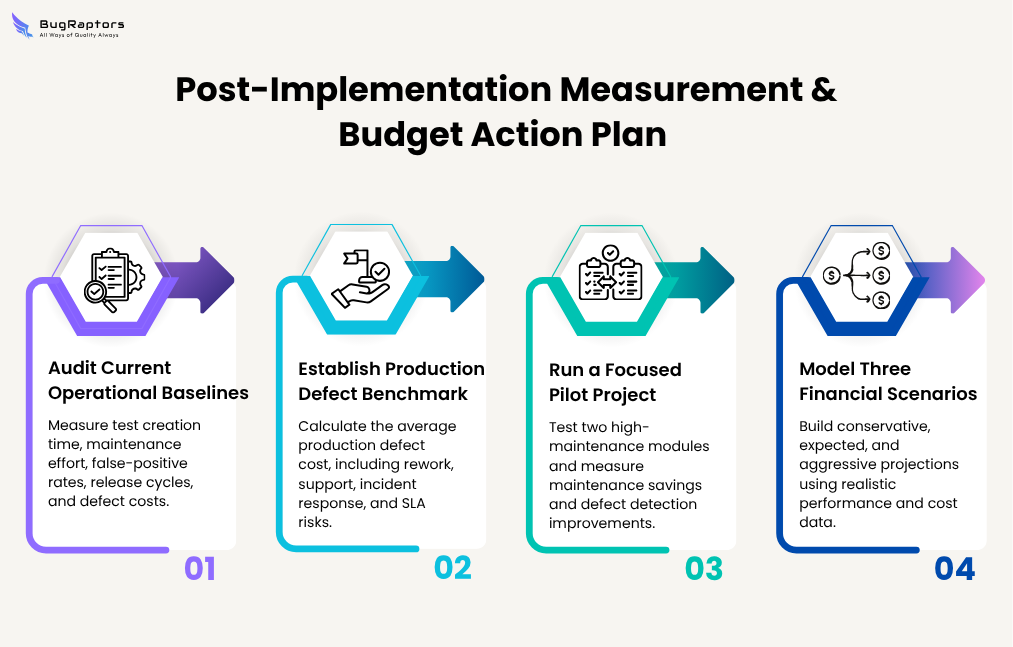
Step 1: Audit Current Operational Baselines
Document exact historical metrics across manual creation time, script repair hours per sprint, false-positive build alerts, release cycle durations, and historical production defect remediation costs.
Step 2: Establish a Single Production Defect Benchmark
Work directly with finance and operations leadership to define an agreed-upon financial benchmark for a production defect. Factoring in developer rework hours, incident response effort, customer support volume, and potential SLA breach penalties grounds the business case in verified organizational data.
Step 3: Run a Focused Pilot Project
Implement automated testing solutions across two high-maintenance application modules. Gathering real-world pilot metrics on maintenance reduction and defect interception provides concrete proof of performance for board presentations.
Step 4: Model Three Financial Scenarios
Structure financial projections across conservative, expected, and aggressive scenarios. Demonstrating fiscal discipline through conservative estimates builds credibility with CFOs and executive leadership teams when proving overall AI testing ROI.
Strategic Summary: The BugRaptors Advantage
Modernizing enterprise quality engineering turns a traditional cost center into an engine for business growth. At BugRaptors, we bridge the gap between legacy QA practices and modern automated frameworks.
By combining custom AI engineering solutions with specialized AI testing and targeted manual testing services, we deliver end-to-end coverage tailored to complex enterprise toolchains. Our hybrid delivery strategy leverages domain expertise with private, security-compliant testing frameworks to keep your data safe while speeding up and improving the dependability of your pipelines.
Performance improvements in labor efficiency, defect prevention, release speed, and platform maintenance are measurable and offer a strong financial rationale for investment in contemporary quality engineering services. The use of modern validation frameworks mitigates software risk, accelerates the deployment of features, and guarantees that software operations scale efficiently in competitive global marketplaces.

Sandeep Vashisht
Mobile, Web Testing
About the Author
Sandeep Vashisht is the Manager – Quality Assurance at BugRaptors. With experience of more than 15 years, Sandeep specializes in delivering mobile, web, content management, and eCommerce solutions. He holds a strategic QA vision and has the ability to inspire and mentor quality assurance. He is an expert with a grip on project plan development, test strategy development, test plan development, test case & test data review.


